Join us on a literary world trip!
Add this book to bookshelf
Grey
Write a new comment Default profile 50px
Grey
Subscribe to read the full book or read the first pages for free!
All characters reduced
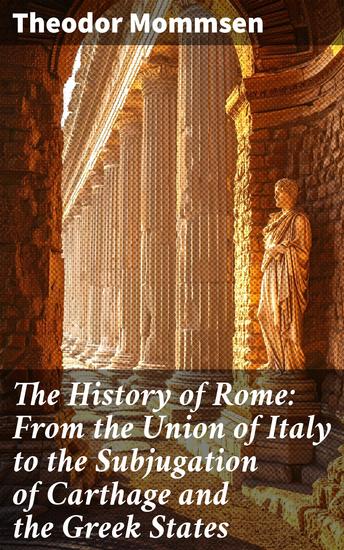
The History of Rome: From the Union of Italy to the Subjugation of Carthage and the Greek States - Unveiling Rome's Ascendance: Conquests Politics and Power - cover

The History of Rome: From the Union of Italy to the Subjugation of Carthage and the Greek States - Unveiling Rome's Ascendance: Conquests Politics and Power

Theodor Mommsen

Translator William P. Dickson

Publisher: Good Press

  • 0
  • 0
  • 0

Summary

In "The History of Rome: From the Union of Italy to the Subjugation of Carthage and the Greek States," Theodor Mommsen presents a meticulously crafted narrative that chronicles the transformative events of the Roman Republic from the late 4th century BC to the Roman conquest of Carthage and the Greek territories. Mommsen's literary style is characterized by its vivid prose and analytical rigor, blending historical detail with engaging storytelling. The work is situated within the broader literary context of 19th-century historiography, where Mommsen's unique perspective illuminates the socio-political dynamics of ancient Rome, presenting a richly textured view of its rise and imperial ambitions. Theodor Mommsen, a German classical scholar and politician, was awarded the Nobel Prize in Literature in 1902 for this very work, which reflects his deep engagement with Roman history and its lasting implications on Western civilization. His extensive studies in philology and archaeology informed his comprehensive approach to history, linking the political and military events of Rome with the cultural evolution of its society. Additionally, his commitment to civic duty and belief in progress may have influenced his interpretation of Rome as a model of governance and civilization. Readers seeking to deepen their understanding of Roman history will find Mommsen's work indispensable. With its scholarly depth and eloquent presentation, this book not only serves as a foundational text for aspiring historians but also appeals to general readers fascinated by the complexities of ancient Rome. Drawing from timeless historical insights, Mommsen's narrative invites reflection on the nature of power and its consequences, making it a compelling read for anyone interested in the legacies that shape our modern world.
Available since: 08/12/2023.
Print length: 527 pages.

Other books that might interest you

  • Lakhmids The: The History of the Ancient Arab Kingdom that Fought in the Roman-Persian Wars - cover

    Lakhmids The: The History of the...

    Editors Charles River

    • 0
    • 0
    • 0
    During the first half of the 1st millennium CE, an empire arose in Persia that extended its power and influence to Mesopotamia in the east, Arabia in the south, the Caucasus Mountains in the north, and as far east as India. This empire, known alternatively as the Sasanian Empire or Sassanid Empire, was the last of three great dynasties in Persia—the Achaemenid and the Parthian being the first two dynasties—before the rise of Islam. In fact, many scholars consider the Sasanian Empire to be the last great empire of the ancient Near East because once it had been obliterated, Islam became the standard religion of the region, ushering in the Middle Ages.  
    	The Sasanian Empire was important for a number of reasons. Besides being the last of three great Persian dynasties, they carried on many Persian cultural traditions relating to religion and kingship. The Sasanians fostered and promoted the native religion of Zoroastrianism to the point of persecuting other religions from time to time. It was during the Sasanian period that the numerous Zoroastrian hymns, prayers, and rituals were collected under one book, known as the Avesta.  
    	However, as the Eastern Roman Empire and Sasanian Empire began to expand in the region through a combination of warfare, trade, and diplomacy, a number of Arab tribes caught in the middle coalesced to form their own powerful dynasties and states, one of which was the Lakhmid Dynasty. The Lakhmid Dynasty formed in the Mesopotamian city of al-Hira in the late 3rd century or 4th century from an Arab tribe that was searching for a home, yet within 100 years, the Lakhmids had carved out a sizable state in southern Arabia that included parts of the modern nation-states of Iraq, Saudi Arabia, Kuwait, Bahrain, and Oman. The Lakhmids were able to build this dynasty through a combination of brute force and skillful diplomacy, walking a political tightrope.
    Show book
  • Rome’s Best Emperors: The History and Legacy of the Roman Empire’s Most Able Leaders - cover

    Rome’s Best Emperors: The...

    Editors Charles River

    • 0
    • 0
    • 0
    The importance of Gaius Julius Caesar Augustus (or as he was known from birth, Gaius Octavius “Octavian” Thurinus) to the course of Western history is hard to overstate. His life, his rise to power, his political, and his social and military achievements all laid the foundations for the creation of an empire which would endure for almost five centuries, and whose traditions, laws, architecture and art continue to influence much of Europe and the world today. Octavian was the first true Roman Emperor, and the first man since the Etruscan Tarquins five centuries earlier to establish a successful hereditary ruling dynasty in what had been a proud Republic for over half a millennium. He was a canny strategist, an excellent orator, a fine writer, a generous patron of the arts and enthusiastic promoter of public works, but above all he was a master politician. Octavian’s great-uncle (and adoptive father) Julius Caesar was a great general, and his rival Mark Antony was a great soldier, but as a politician Octavian outmatched them all. He still stands in bronze on Rome’s Via dei Fori Imperiali to this day, along with the likes of Caesar, Hadrian, Trajan and Marcus Aurelius, and he is forever immortalized in all Western calendars as the patron of the month of August, which was dedicated to him when he was deified, following his death, as Divus Augustus.  
    	“The Five Good Emperors,” a reference to the five emperors who ruled the Roman Empire between 96 and 180 CE (Nerva, Trajan, Hadrian, Antoninus Pius, and Marcus Aurelius), was a term first coined by Machiavelli and later adopted and popularized by historian Edward Gibbon, who said that under these men, the Roman Empire “was governed by absolute power under the guidance of wisdom and virtue.” This period of 84 years is generally regarded as the high point of the Roman Empire, at least after Augustus.
    Show book
  • Authoritarianism and Totalitarianism - Examining the Structure and Influence of Authoritarian Regimes (3 in 1) - cover

    Authoritarianism and...

    Arlo Holders

    • 0
    • 0
    • 0
    This bundle consists of the following books: 
      - Totalitarianism Unmasked: Totalitarianism is a political system in which the state holds total control over every aspect of public and private life, leaving no room for opposition or individual freedoms. Unlike other forms of governance, where political competition and individual rights are somewhat preserved, totalitarianism demands absolute loyalty and conformity. The concept of totalitarianism emerged in the early 20th century, though its roots can be traced back to ancient and medieval periods. In its modern form, it is most closely associated with dictatorial regimes that arose in the aftermath of World War I and throughout the 20th century. 
      - Kleptocracy: Kleptocracy, derived from the Greek words kleptēs (thief) and kratos (rule), refers to a system of governance where leaders exploit their positions of power to enrich themselves at the expense of the public. It is a regime of theft, where corruption is not merely an incidental byproduct of governance but a fundamental aspect of its operation. In kleptocratic systems, the state becomes a tool for personal and collective gain for a small elite, often at the cost of societal well-being and economic development. 
      - Corporatism: Corporatism, as a political and economic system, refers to the integration of corporate and governmental interests, where the lines between the state and private enterprises often blur. It involves the collaboration of various sectors, such as businesses, government, and occasionally labor unions, to form policies and frameworks that benefit the economy and society, but sometimes at the expense of democratic processes. 
    Take advantage of this discounted box set right now!
    Show book
  • SUMMUM - Sealed Except to the Open Mind - cover

    SUMMUM - Sealed Except to the...

    Summum Bonum Amen Ra

    • 0
    • 0
    • 0
    Billions of years ago, the universe came into existence with a "Big Bang." The creation of the universe is the single paramount event from which all other events precipitate, and why it happened is the greatest mystery we have ever known. 
    On the tiniest of scales, the cosmos reveals to us a universe filled with quanta particles; and on the largest, a universe of planets, stars, galaxies, and life. The expanse is endless. Are we then to believe ourselves alone in the vastness of creation, or to solely occupy the crown of it? 
    In 1975, Corky Ra, an administrative manager for a large supply company, began to experience a series of encounters with advanced beings. His first reactions of shock and disbelief led him to a period of seclusion, yet the "visits" continued, leading him to an awakening. Ra realized it was the purpose of these beings to re-introduce, in a pure form, principles of nature that have always existed and address all issues of existence, sexuality, and death. 
    SUMMUM: Sealed Except to the Open Mind is about existence in its broadest context and delves into the forces behind cosmic rhythms and change. Most importantly, it describes a meditation for developing a personal relationship with the essence of nature. 
    This is the second edition of a work first published in 1988. Make this audiobook your companion and venture to get a glimpse of the inner workings of Creation.
    Show book
  • Sex Rules! - Astonishing Sexual Practices and Gender Roles Around the World - cover

    Sex Rules! - Astonishing Sexual...

    Janice Zarro Brodman

    • 0
    • 0
    • 0
    #1 Best Seller in Trivia & Fun Facts, Questions & Answers, Curiosities & Wonders, and Cults & Demonism ─ Think You Know About Sexual Customs Around Our World? Have Fun and Enjoy Some Surprises!This book is a humorous glimpse of a wide range of stereotype-busting sexual, relationship and romantic mores around the world. It is fun, interesting, and eye-opening! For example, places where women control the mating game, set marriage rules, and marry one another for political power. The fact that it's all true also makes it fascinating. Take a romp through a rollicking worldwide tour with LOL views of extraordinary sexual customs. It will astound and regale you. At the same time, it proves sex is like happiness – universally sought but subjectively enjoyed.
    Show book
  • The Mahabharata - Divine Essence Of All Yoga - cover

    The Mahabharata - Divine Essence...

    Veda Vyas

    • 0
    • 0
    • 0
    Krishna Dvaipāyana, also known as and Veda Vyāsa "the one who classified the Vedas"), is a rishi (sage). He is best known as the author of the Mahabharata, one of the two most important epics of Hinduism. He is also credited as the traditional compiler of the Vedas, as well as the writer of other important works including the Puranas. As per the Mahabharata, Vyasa is the son of rishi Parashara and a fisherwoman named Kali (Satyavati), who later marries king Shantanu of Kuru. Throughout the epic, Vyasa appears occasionally helping the Kuru kingdom. His spiritual career includes compiling many texts and spreading the knowledge through his disciples. The festival of Guru Purnima is dedicated to him. It is also known as Vyasa Purnima, the day believed to be both of his birth and when he divided the Vedas. Vyasa is considered one of the seven Chiranjivis (long-lived, or immortals), who are still in existence according to Hindu tradition.
    Show book