Join us on a literary world trip!
Add this book to bookshelf
Grey
Write a new comment Default profile 50px
Grey
Subscribe to read the full book or read the first pages for free!
All characters reduced
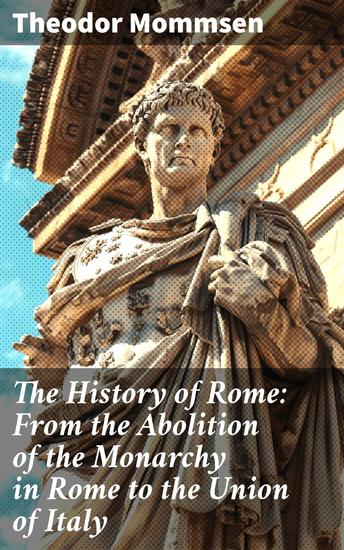
The History of Rome: From the Abolition of the Monarchy in Rome to the Union of Italy - A Comprehensive Journey Through Ancient Roman Transformation - cover

The History of Rome: From the Abolition of the Monarchy in Rome to the Union of Italy - A Comprehensive Journey Through Ancient Roman Transformation

Theodor Mommsen

Translator William P. Dickson

Publisher: Good Press

  • 0
  • 0
  • 0

Summary

In "The History of Rome: From the Abolition of the Monarchy in Rome to the Union of Italy," Theodor Mommsen meticulously chronicles the rise of the Roman Republic and the transformative events that shaped the Italian peninsula. Utilizing a blend of narrative history and scholarly analysis, Mommsen employs a rhythmic prose style that captures the grandeur and complexity of Rome's political and social evolution. The book is set against the backdrop of 19th-century Europe, reflecting themes of nationalism and unity that resonated with contemporary audiences, particularly during the period of Italian unification. Mommsen, a distinguished historian and Nobel laureate, drew from his extensive knowledge of classical studies and his own German academic milieu to craft this comprehensive account. His background in law and history particularly fueled his interest in the political machinations of ancient Rome, leading him to explore themes of governance that were strikingly relevant to the political landscape of his time. This duality of scholarly rigor and passionate engagement underlies much of his work, contributing to his lasting impact on historical scholarship. This book is highly recommended for both history enthusiasts and scholars seeking an in-depth understanding of Rome's transition from monarchy, through republicanism, to its eventual role in the unification of Italy. Mommsen's eloquent narrative, combined with his rigorous analysis, provides readers with a profound appreciation for the complexities of ancient civilization and its enduring legacy.
Available since: 08/12/2023.
Print length: 279 pages.

Other books that might interest you

  • The Great Dictionary English - French - 130000 Entries - cover

    The Great Dictionary English -...

    Benjamin Maximilian Eisenhauer

    • 0
    • 0
    • 0
    This dictionary contains around 130,000 English terms with their French translations, making it one of the most comprehensive books of its kind. It offers a wide vocabulary from all areas as well as numerous idioms.
    The terms are translated from English to French. If you need translations from French to English, then the companion volume "The Great Dictionary French - English" is recommended.
    Show book
  • The Gift of Not Belonging - How Outsiders Thrive in a World of Joiners - cover

    The Gift of Not Belonging - How...

    Rami Kaminski MD

    • 0
    • 0
    • 0
    From a renowned psychiatrist comes the first book to explore the otrovert personality—someone who feels like an outsider in any group, regardless of its members—revealing all the advantages of being an otrovert and ways they contribute to the world.  Were you the kid who never wanted to join after school clubs or go to sleepaway camp? Do you loathe parties but love spending time with close friends one-on-one? Are you allergic to teamwork but thrive creatively and professionally when working alone? Do you struggle to fit in? If so, you are likely an otrovert.  Otroverts are not natural born joiners. Unlike introverts, they are not shy or quiet, and do not quickly tire from one-on-one socializing. Yet in large groups they feel uncomfortable, alienated, and alone. Unlike those who have been excluded or marginalized, otroverts are embraced and often quite popular.  Yet they never feel like they truly belong. ​ In a culture that puts a premium on joining, many otroverts have gone through life feeling misunderstood. But, contrary to what we have been taught, argues psychiatrist Rami Kaminski, belonging is not a requirement for living a rich, rewarding life. Quite the opposite.  When you have no affinity for a particular group, your self-worth is not conditioned on the group’s approval. You can enjoy deep connection in individual relationships without the obligation to follow the rules the group follows, or care about what the group cares about. Best of all, you know of no other way to think or be, other than for yourself.The Gift of Not Belonging urges otroverts to embrace their unique gifts, and equips them with the knowledge and tools to thrive in a communal world.
    Show book
  • Secrets and Scandals: The Dark Ties of Power and Crime - Uncover the Secrets and Scandals: Audio Lessons Revealing the Dark Ties of Power and Crime - cover

    Secrets and Scandals: The Dark...

    Gideon Thorne

    • 0
    • 0
    • 0
    "Secrets and Scandals: The Dark Ties of Power and Crime" 
    ⭐⭐ Simplified Audio Guide & Explanations Included ⭐⭐ 
    Are you intrigued by the dark underbelly of society, where power and crime intertwine? Ready to delve into gripping tales of intrigue and corruption? 
    Look no further! 
    This audiobook serves as your definitive companion for understanding the complex web of secrets and scandals, applying critical thinking, and engaging in thought-provoking narratives. With this, you're set for an exhilarating journey. 
    Updated for the latest revelations and insights into power and crime. 
    Key features of this enriched audiobook: 
    - Profound insights into the labyrinth of power and crime. 
    - Detailed explanations of the mechanisms behind influential scandals. 
    - Effective strategies for uncovering hidden truths and analyzing corruption. 
    Our audiobook distinguishes itself through comprehensive coverage, essential for a thorough understanding of these dark ties. Concepts aren't merely glossed over; they are explored with precision. 
    Please note that this audiobook is not affiliated with any official investigative entity and is purely an independent resource for your benefit. 
    Designed with a clear structure and easy-to-understand language, our guide ensures smooth transitions between topics. Say goodbye to dense jargon and welcome clear, precise, and engaging content. 
    So, why wait? Click the BUY NOW button, secure your audiobook, and begin your journey into the intriguing world of power and crime!
    Show book
  • Death by Talons - Did An Owl 'Murder' Kathleen Peterson? - cover

    Death by Talons - Did An Owl...

    Tiddy Smith

    • 0
    • 0
    • 0
    A re-examination of the infamous 2001 North Carolina “Staircase murder” through the outrageous theory that an owl was the killer—and not Michael Peterson. 
     
    On December 9, 2001, Kathleen Peterson was found dead at the bottom of a staircase in her Durham, North Carolina, home. Her scalp was laced with deep incisions, and her blood was strewn from outside to inside the house. 
     
    The sinister truth of that night turned her murder into North Carolina’s most enigmatic criminal case, capturing media attention across the globe. 
     
    Police zeroed in on Kathleen’s husband, Michael Peterson, and charged him with murder. But was it the truth? 
     
    A neighbor, Larry Pollard, came up with an alternative “killer.” He claimed an owl attacked Kathleen outside her house. He said it sliced her scalp with its fierce talons and caused her to run inside, collapsing at the stairwell, and bleeding to death. 
     
    When the media heard about his theory, Larry was mocked. And Michael was convicted. Now, twenty years later, author Tiddy Smith explores Pollard’s theory and questions whether law enforcement ignored, or even hid, evidence to convict Michael Peterson. And was an owl, in fact, the real killer? In Death by Talons, Tiddy Smith gives insight into the “Staircase” and the conspiracy behind the Michael Peterson trial.
    Show book
  • Aftershock - How Past Events Shake Up Your Life Today - cover

    Aftershock - How Past Events...

    Geri-Lynn Utter

    • 0
    • 0
    • 0
    You may be at a point in your life where you realize that you have been edgy, a bit depressed, feeling unsettled. Yet everything in your life seems to be okay. You look for a cause, but you just can't put your finger on it. Perhaps you should examine your recent past—six months ago, a year ago—and ask yourself, "What did I go through that was stressful at the time, yet I was able to deal with by suppressing my stress until that situation was over?" 


    "Aftershock" is a term coined by clinical psychologist Dr. Geri-Lynn Utter, who came to recognize this largely ignored scenario in many of her patients. As a subclinical level of the more familiar post-traumatic stress disorder, "aftershock" may underlie your present emotional stress, a delayed emotional response that affects many of us after common, yet big deal, life events such as miscarriage, moving to a new city, divorce, or, for some people, the Covid-19 pandemic that has rocked much of the world. 


    The most urgent raison d'etre of Aftershock is to enlighten listeners to the very presence of this psychological trauma—what it is and what causes it, how to recognize the symptoms, and how to heal when life's stressors keep you in the center of the aftershock of a storm.
    Show book
  • Circus Maximus and the Colosseum The: The History of Ancient Rome’s Most Famous Sports Venues - cover

    Circus Maximus and the Colosseum...

    Editors Charles River

    • 0
    • 0
    • 0
    The ambitious and fearless emperors that built the legendary Roman Empire from scratch, the broad-shouldered and bronzed gladiators with their iconic plume helmets and glinting swords, and elaborate parties attended by toga-wearing Romans fueled by alcohol, violence, orgies, and other godless acts all paint a picture of Roman life. 
    At the Circus Maximus, the guttural cheers of the spectators reverberated across the enormous open space, but their cries could hardly be heard over the rumble of the ground. On the ellipse-shaped track, 5 charioteers would skew their bodies and steer their magnificent vehicles around the curves. Gusts of sand and dirt flew up from the whizzing wheels and encircled the pounding hooves of the stunning stallions. Distracted personnel and guards dragging their feet were considered fair game. As one chariot careened to the side, preparing to collide with another chariot, a row of guards might have to try to duck out of the way in the nick of time. Some would be trampled by hooves. Chariot races were dangerous for participants too. A charioteer could become disoriented and fail to position himself as his horses moved instinctively, sending his body catapulting forward out of the chariot. Needless to say, chariot racing in Rome was a nail-biting spectacle. 
    When the Colosseum was built in the late 1st century A.D., the Romans, a people known for their architectural acumen, managed to amaze themselves. Martial believed the Colosseum was so grand a monument that it was even greater than the other Wonders of the Ancient World, which had been written about and visited endlessly by the Romans and Greeks in antiquity. The Colosseum was a spectacular achievement in architecture, something new and innovative, and therefore an amazing “Wonder” in its own way. The Colosseum is a large stadium even by today’s standards, and its great size conveys the power of the empire as it dominates the landscape and towers over nearby buildings.
    Show book