Join us on a literary world trip!
Add this book to bookshelf
Grey
Write a new comment Default profile 50px
Grey
Subscribe to read the full book or read the first pages for free!
All characters reduced
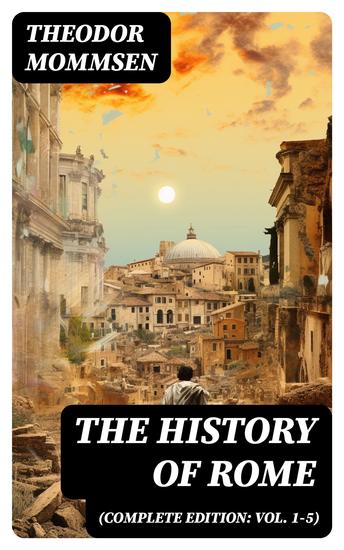
The History of Rome (Complete Edition: Vol 1-5) - Enriched edition From the Foundations of the City to the Rule of Julius Caesar - cover

The History of Rome (Complete Edition: Vol 1-5) - Enriched edition From the Foundations of the City to the Rule of Julius Caesar

Theodor Mommsen

Translator William P. Dickson

Publisher: DigiCat

  • 0
  • 0
  • 0

Summary

The complete edition of Theodor Mommsen's "The History of Rome" spans five volumes and offers a comprehensive exploration of Roman civilization from its foundational myths to the fall of the Western Empire. Mommsen employs a narrative style combining rigorous scholarship with vivid storytelling, allowing readers to engage deeply with both the political machinations and cultural developments of ancient Rome. The work is notable for its systematic approach and critical analysis, representing a milestone in historical writing and reflecting the influence of 19th-century positivism, which emphasized empirical evidence in historical inquiry. Mommsen, a German historian, philologist, and politician, was awarded the Nobel Prize in Literature in 1902 for his exceptional contributions to the field of history. His passion for the Roman world stemmed from a profound interest in classical studies and a desire to connect the past with contemporary issues in governance and society, which is evident in his meticulous examination of Roman political institutions. This monumental work is essential for anyone seeking to understand the complexities of one of history's greatest civilizations. Whether you are a scholar, student, or general reader, Mommsen's "The History of Rome" provides invaluable insights and remains a cornerstone of historical literature.

In this enriched edition, we have carefully created added value for your reading experience:
- A succinct Introduction situates the work's timeless appeal and themes.
- The Synopsis outlines the central plot, highlighting key developments without spoiling critical twists.
- A detailed Historical Context immerses you in the era's events and influences that shaped the writing.
- An Author Biography reveals milestones in the author's life, illuminating the personal insights behind the text.
- A thorough Analysis dissects symbols, motifs, and character arcs to unearth underlying meanings.
- Reflection questions prompt you to engage personally with the work's messages, connecting them to modern life.
- Hand‐picked Memorable Quotes shine a spotlight on moments of literary brilliance.
- Interactive footnotes clarify unusual references, historical allusions, and archaic phrases for an effortless, more informed read.
Available since: 12/15/2023.
Print length: 2023 pages.

Other books that might interest you

  • On Interpretation - cover

    On Interpretation

    Aristotle

    • 0
    • 0
    • 0
    In his work On Interpretation, Aristotle seeks to uncover the underlying principles of language and meaning. He begins by examining the nature of signs and symbols, and how they are used to communicate information. He then goes on to explore the relationship between language and reality, and how our understanding of words is shaped by our experience of the world. Ultimately, Aristotle concludes that language is a tool for understanding reality, and that its meaning is determined by the way we use it. Read in English, unabridged.
    Show book
  • The Enemy Harassed - Washington's New Jersey Campaign of 1777 - cover

    The Enemy Harassed -...

    Jim Stempel

    • 0
    • 0
    • 0
    In late December 1776, the American War of Independence appeared to be on its last legs. General George Washington's continental forces had been reduced to a shadow of their former strength, and the British Army had chased them across the Delaware River into Pennsylvania. Desperate times call for desperate measures, however, and George Washington responded to this crisis with astonishing audacity. On Christmas night 1776, he recrossed the Delaware as a nor'easter churned up the coast, burying his small detachment under howling sheets of snow and ice. Undaunted, they attacked a Hessian brigade at Trenton, New Jersey, taking the German auxiliaries by complete surprise. Then, only three days later, Washington struck again, crossing the Delaware, slipping away from the British at Trenton, and attacking the Redcoats at Princeton. 


    The British, now back on their heels, retreated toward New Brunswick as Washington's reinvigorated force followed them north into Jersey. Over the next eight months, Washington's continentals and the state militias of New Jersey would go head-to-head with the British in a multitude of battles, eventually forcing the British to flee New Jersey by sea. In this captivating narrative of the American War of Independence, Jim Stempel brings to life one of the most violent, courageous, yet virtually forgotten periods of the Revolutionary War.
    Show book
  • Axum Empire - The African Kingdom That Controlled the Red Sea Trade - cover

    Axum Empire - The African...

    Rolf Hedger

    • 0
    • 0
    • 0
    The Axum Empire was one of the most influential civilizations in ancient Africa, flourishing between the 4th and 7th centuries AD. It was located in what is today northern Ethiopia and parts of Eritrea, strategically positioned along the Red Sea trade routes. This placement not only allowed Axum to thrive economically but also made it a key player in global trade between Africa, the Middle East, and Asia. The kingdom of Axum’s rise to prominence marked a pivotal moment in African history, shaping the culture, economy, and politics of the region for centuries. 
    The origins of the Axum Empire are somewhat shrouded in mystery, but its establishment is often linked to the rise of the city of Axum (also spelled Aksum) around the 1st century AD. According to various historical accounts, Axum was originally a small kingdom that grew in power through trade, conquest, and political alliances. It eventually became one of the most advanced civilizations of its time, possessing advanced knowledge of agriculture, architecture, and metallurgy. 
    At its height, the Axum Empire was an extraordinary political and economic entity. The kingdom controlled an extensive territory that stretched from modern-day Ethiopia and Eritrea to parts of Sudan and Arabia. Axum became a major center for trade, exporting goods such as ivory, gold, frankincense, and myrrh, while also importing luxury goods from Roman, Indian, and Arabian merchants. The city of Axum itself was known for its monumental obelisks, palaces, and sophisticated urban planning.
    Show book
  • A Rare Recording of Bertrand Russell's Message To Future Generations - cover

    A Rare Recording of Bertrand...

    Bertrand Russell

    • 0
    • 0
    • 0
    Bertrand Russell (May 18, 1872 - February 2, 1970) was born in Monmouthshire, into one of the most prominent aristocratic families in Britain. Russell was a philosopher, logician, mathematician, historian, prominent anti-war activist, and an outspoken opponent of nuclear weapons. In 1950, Russell was awarded the Nobel Prize in Literature.
    Show book
  • Suspended Education - School Punishment and the Legacy of Racial Injustice - cover

    Suspended Education - School...

    Aaron Kupchik

    • 0
    • 0
    • 0
    Every year, millions of public school students are suspended. This overused punishment removes students from the classroom, but it does not improve their behavior. Instead, suspension disrupts their education, harming the students, their families, and their schools. Black students suffer most within this broken system, experiencing a far greater risk of school punishment and the significant harms that accompany it. Many activists and scholars have considered how school punishment increases racial inequity, but few have thought to ask why. Why do we punish students the way we do, and why have we allowed this harmful practice to impact the lives of our nation's children? 


    In Supended Education, Aaron Kupchik shows that suspensions were not intended as a behavior management tool. Instead, they were designed to remove unwanted students from the classroom. Through statistical analysis and in-depth case studies of schools in Massachusetts and Delaware, Kupchik reveals how suspension rates skyrocketed after the 1954 Brown v. Board of Education decision, serving as an unofficial means of removing Black children from newly desegregated schools. His groundbreaking research traces the legacy of these segregationist movements, demonstrating that school districts with more desegregation-related legal battles from the 1950s onward suspend more Black students today.
    Show book
  • How to Leave a Group Chat - A guide to navigating digital communication - cover

    How to Leave a Group Chat - A...

    Louisa Guise

    • 0
    • 0
    • 0
    Do you lose hours of your life scrolling social media? 
    Have too many group chats on your smartphone? 
    Do you want to leave them, but don’t know how? 
    Then this book is for you. How to Leave a Group Chat is a practical guide that will help you navigate the world of digital communication. 
    Since the late eighties, communication has been developing at a speed that has greatly outpaced us and continues to do so. Social media and instant messengers might just be the tip of the iceberg but, although we enjoy them, they have pushed us into a new digital dimension which has dehumanised us, and we haven’t quite had the chance to understand what this means. 
    How to Leave a Group Chat is a ground-breaking book which makes sense of this new digital age whilst providing a fascinating look at how we communicate and how this has changed over time.
    Show book