¡Acompáñanos a viajar por el mundo de los libros!
Añadir este libro a la estantería
Grey
Escribe un nuevo comentario Default profile 50px
Grey
Suscríbete para leer el libro completo o lee las primeras páginas gratis.
All characters reduced
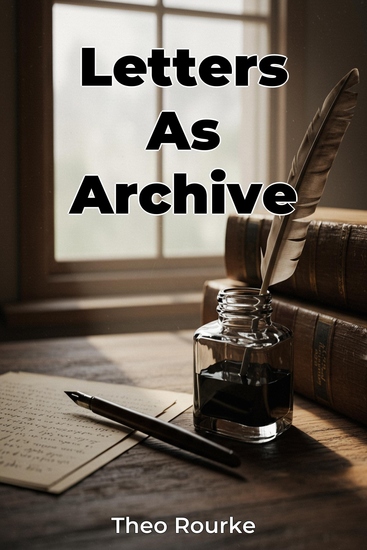
Letters As Archive - cover

Letters As Archive

Theo Rourke

Traductor A AI

Editorial: Publifye

  • 0
  • 0
  • 0

Sinopsis

Letters As Archive explores the untapped potential of personal correspondence as invaluable historical documents. Challenging traditional historical methodologies, the book champions letters as archives that capture individual experiences and reflect broader social and cultural norms. Did you know personal letters can offer insights into migration patterns or reveal attitudes during times of war, providing firsthand accounts often missing from official records? By examining these primary sources, the book advocates for a more inclusive understanding of the past, amplifying voices often excluded from mainstream historical narratives.

 
The book unfolds systematically, first establishing a theoretical framework for analyzing letters as historical archives. Subsequent chapters delve into specific themes and case studies, such as the role of letters in shaping family history or documenting social upheaval. This approach offers practical guidance on archival methods and textual analysis, emphasizing ethical considerations.

 
Ultimately, Letters As Archive encourages a decentralized approach to historical inquiry, urging scholars to consider personal correspondence as a vital source of historical knowledge.
Disponible desde: 05/05/2025.
Longitud de impresión: 57 páginas.

Otros libros que te pueden interesar

  • From a Cowboy to a World-Renowned Inventor - The Extraordinary Life and Legacy of Slim Spurling - cover

    From a Cowboy to a...

    Slim Spurling

    • 0
    • 0
    • 0
    Discover the remarkable journey of Slim Spurling, a man whose roots as a cowboy led him to become a pioneering inventor with a global impact. In this inspiring audiobook, Slim’s tells his story from humble beginnings to groundbreaking discoveries in energy harmonizing technology. 
    Dive into the world of dowsing, geopathic stress, and the Hartmann grid, as Slim reveals his methods for restoring balance to the planet. More than just an inventor, Slim was a visionary whose work continues to support the well-being of individuals and the Earth itself. Today, his legacy lives on through his wife, Katharina Spurling-Kaffl and her dedicated team as they continue to manufacture the Light-Life Tools in alignment with his original principles, ensuring a brighter, more harmonious future for generations to come. 
    This audiobook is perfect for those seeking alternative health solutions, energy healing, or simply enjoy listening to the story of a true innovator who dared to change the world.
    Ver libro
  • Aloysha the Pot - From their pens to your ears genius in every story - cover

    Aloysha the Pot - From their...

    Leo Tolstoy

    • 0
    • 0
    • 0
    Leo Tolstoy was born in 1828 in the Russian province of Tula to a wealthy noble family. As a child, he had private tutors but he showed little interest in any formal education. When he went to the University of Kazan in 1843 to study oriental languages and law, he left without completing his courses.  Life now was relaxed and idle but with some writing also taking place.  Gambling debts forced an abrupt change of path and he joined the army to fight in the Crimean War.  He was commended for his bravery and promoted but was appalled at the brutality and loss of life.  He recorded these and other earlier experiences in his diaries which formed the basis of several of his works. 
    In 1852 ‘Childhood’ was published to immediate success and was followed by ‘Boyhood’ and ‘Youth’. 
    His experience in the army and the horrors he witnessed resulted in ‘The Cossacks’ in 1862 and the trilogy ‘Sevastopol Tales’. After the war he travelled around Europe, visiting London and Paris and meeting such luminaries as Victor Hugo and Charles Darwin.  
    It was now that Tolstoy began his masterpiece, ‘War and Peace’. Published in 1869 it was an epic work that changed literature. He quickly followed this with ‘Anna Karenina’.  
    These successes made Tolstoy rich and helped him accomplish many of his dreams but also brought problems as he grappled with his faith and the lot of the oppressed poor. These revolutionary views became so popular that the authorities now kept him under surveillance.  
    He led a life of asceticism and vegetarianism and put his socialist ideals into practice by establishing numerous schools for the poor and food programmes. He also believed in giving away his wealth, which caused much discord with his wife.  
    His writing continued to bring forth classics such as ‘The Death of Ivan Ilyich’ and many brilliant and incisive short stories such as ‘How Much Land Does A Man Need’.  
    In 1901 Tolstoy was excommunicated from the Church and controversially deselected for the Nobel Prize for Literature. 
    Whilst undertaking a pilgrimage by train in October 1910 with his daughter Aleksandra he caught pneumonia in the nearby town of Astapovo.  Leo Tolstoy died on November 9th, 1910, he was 82.
    Ver libro
  • The Top 10 Short Stories – The 20th Century – The British & Irish Men - The top ten Short Stories of the 20th Century written by British and Irish male authors - cover

    The Top 10 Short Stories – The...

    James Joyce, D H Lawrence,...

    • 0
    • 0
    • 0
    Short stories have always been a sort of instant access into an author’s brain, their soul and heart.  A few pages can lift our lives into locations, people and experiences with a sweep of landscape, narration, feelings and emotions that is difficult to achieve elsewhere. 
     
    In this series we try to offer up tried and trusted ‘Top Tens’ across many different themes and authors. But any anthology will immediately throw up the questions – Why that story? Why that author?  
     
    The theme itself will form the boundaries for our stories which range from well-known classics, newly told, to stories that modern times have overlooked but perfectly exemplify the theme.  Throughout the volume our authors whether of instant recognition or new to you are all leviathans of literature. 
     
    Some you may disagree with but they will get you thinking; about our choices and about those you would have made.  If this volume takes you on a path to discover more of these miniature masterpieces then we have all gained something. 
     
    In this tumultuous century world wars will shatter all of Europe and Britain will finally be forcible divorced from Catholic Ireland.  Revolution and economic disaster are followed by a society that appears more equal, growing in confidence and its authors use every morsel of debate to create excellent literary works.  
     
    1 - The Top 10 - The British & Irish Men - The 20th Century - An Introduction 
    2 - The Dead - Part 1 by James Joyce 
    3 - The Dead - Part 2 by James Joyce 
    4 - The Rocking Horse Winner by D H Lawrence 
    5 - The Interlopers by Saki the pseudonym for H H Munro 
    6 - The Informer by Joseph Conrad 
    7 - Oh Whistle and I'll Come to You My Lad by M R James 
    8 - The Salvation of a Forsythe - Part 1 by John Galsworthy 
    9 - The Salvation of a Forsythe - Part 2 by John Galsworthy 
    10 - August Heat by W F Harvey 
    11 - The Matador of the Five Towns by Arnold Bennett 
    12 - The Kit Bag by Algernon Blackwood 
    13 - The Burial of the Rats by Bram Stoker
    Ver libro
  • Betty Brown the St Giles Orange Girl - From their pens to your ears genius in every story - cover

    Betty Brown the St Giles Orange...

    Hannah More

    • 0
    • 0
    • 0
    Hannah More was born on February 2nd, 1745 at Fishponds in the parish of Stapleton, near Bristol. She was the fourth of five daughters. 
    The City of Bristol, at that time, was a centre for slave-trading and Hannah would, over time, become one of its staunchest critics.  
    She was keen to learn, possessed a sharp intellect and was assiduous in studying.  Hannah first wrote in 1762 with The Search after Happiness (by the mid-1780s some 10,000 copies had been sold). 
    In 1767 Hannah became engaged to William Turner.  After six years, with no wedding in sight, the engagement was broken off.  Turner then bestowed upon her an annual annuity of £200.  This was enough to meet her needs and set her free to pursue a literary career.   
    Her first play, The Inflexible Captive, was staged at Bath in 1775. The famous David Garrick himself produced her next play, Percy, in 1777 as well as writing both the Prologue and Epilogue for it.  It was a great success when performed at Covent Garden in December of that year.  
    Hannah turned to religious writing with Sacred Dramas in 1782; it rapidly ran through nineteen editions. These and the poems Bas-Bleu and Florio (1786) mark her gradual transition to a more serious and considered view of life. 
    Hannah contributed much to the newly-founded Abolition Society including, in February 1788, her publication of Slavery, a Poem recognised as one of the most important of the abolition period.   
    Her work now became more evangelical.  In the 1790s she wrote several Cheap Repository Tracts which covered moral, religious and political topics and were both for sale or distributed to literate poor people.  The most famous is, perhaps, The Shepherd of Salisbury Plain, describing a family of incredible frugality and contentment. Two million copies of these were circulated, in one year. 
    In 1789, she purchased a small house at Cowslip Green in Somerset. She was instrumental in setting up twelve schools in the area by 1800. 
    She continued to oppose slavery throughout her life, but at the time of the Abolition Bill of 1807, her health did not permit her to take as active a role in the movement as she had done in the late 1780s, although she maintained a correspondence with Wilberforce and others.  
    In July 1833, the Bill to abolish slavery throughout the British Empire passed in the House of Commons, followed by the House of Lords on August 1st. 
    Hannah More died on September 7th, 1833.
    Ver libro
  • Whack Job - A History of Axe Murder - cover

    Whack Job - A History of Axe Murder

    Rachel McCarthy James

    • 0
    • 0
    • 0
    A brilliant and bloody examination of the axe's foundational role in human history, from prehistoric violence, to war and executions, to newspaper headlines and popular culture.For as long as the axe has been in our hands, we have used it to kill.Much like the wheel, the boat, and the telephone, the axe is a transformative piece of technology—one that has been with us since prehistory. And just as early humans used the axe to chop down trees, hunt for food, and whittle tools, they also used it to murder. Over time, this particular use has endured: as the axe evolved over centuries to fit the needs of new agricultural, architectural, and social development, so have our lethal uses for it.Whack Job is the story of the axe, first as a convenient danger and then an anachronism, as told through the murders it has been employed in throughout history: from the first axe murder nearly half a million years ago, to the brutal harnessing of the axe in warfare, to its use in King Henry VIII's favorite method of execution, to Lizzie Borden and the birth of modern pop culture. Whack Job sheds brilliant light on this familiar implement, this most human of weapons. This is a critical examination of violence, an exploration of how technology shapes human conflict, the cruel and sacred rituals of execution and battle, and the ways humanity fits even the most savage impulses into narratives of the past and present.A Macmillan Audio production from St. Martin’s Press.
    Ver libro
  • My Search for Jazzbo Jones - cover

    My Search for Jazzbo Jones

    Ethan Hirsh

    • 0
    • 0
    • 0
    Written as a tribute to the unusual, older student he befriended in college, this “real-life memoir adventure” retraces the author’s life as he searches for clues about the horrific crash that blinded his friend many years before they met.  
    The story weaves keen observation, nostalgia, and humor in its portrayal of Jim Beeson, a colorfully complex character from small-town Kansas who overcame adversity and loss to become an outspoken advocate for the blind in Houston. Even though Beeson and Hirsh differed in age, background, and education, Beeson’s outgoing personality and unlikely mentorship had a lifelong positive impact beyond simply teaching the author about mechanics when they overhauled a 1954 Ford.  
    Touching on issues of blindness and resilience in the face of tragedy, My Search for Jazzbo Jones includes vivid recollections of personal history and the JFK assassination, civil rights, the Vietnam draft, and even an encounter with Cuba’s Che Guevara. After more than a decade of online detective work, Hirsh ultimately delivers far more raw facts than he ever expected about that fiery wreck on a Wichita racetrack.
    Ver libro