Join us on a literary world trip!
Add this book to bookshelf
Grey
Write a new comment Default profile 50px
Grey
Subscribe to read the full book or read the first pages for free!
All characters reduced
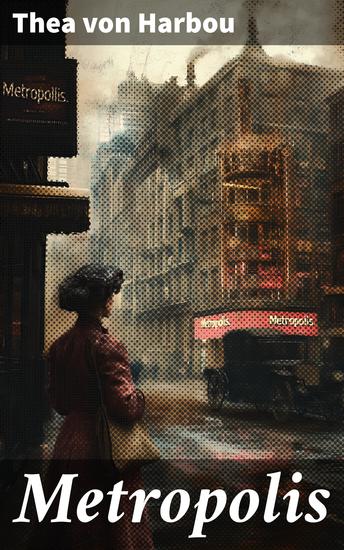
Metropolis - cover

Metropolis

Thea von Harbou

Publisher: Good Press

  • 0
  • 0
  • 0

Summary

In "Metropolis," Thea von Harbou presents a compelling narrative set in a dystopian future where stark class divisions manifest through a towering, industrialized city. The novel is characterized by its expressionistic style, employing vivid imagery and allegorical motifs that critique early 20th-century society, particularly reflecting the tensions of the Weimar Republic. Through its complex characters and intricate plot, the text explores themes of technology, control, and the human condition, probe the existential dilemmas faced by individuals trapped within the mechanized world. Thea von Harbou, a screenwriter and novelist, was intricately linked to the German film industry, particularly through her collaborations with her partner Fritz Lang. Her experiences with the burgeoning technological advances and societal upheaval of her time significantly informed her vision in writing "Metropolis." Influenced by her fascination with the interplay of art and industry, as well as her understanding of the socio-political landscape, von Harbou created a visionary work that anticipates contemporary discussions on automation and societal inequities. "Metropolis" is highly recommended for readers intrigued by speculative fiction that delves into the psychological and ethical implications of a mechanized existence. Its rich narrative and profound themes continue to resonate today, offering insights into the challenges of modern civilization and prompting reflection on humanity's relationship with technology.
Available since: 03/02/2025.
Print length: 90 pages.

Other books that might interest you

  • Reverie - cover

    Reverie

    Arthur C. Clarke

    • 0
    • 0
    • 0
    "Reverie" is a 1992 short story by Arthur C. Clarke, not a novel. It's a part of the collection "The Stories of Arthur C. Clarke" and is not as well-known as his other works like "Childhood's End" or "Rendezvous with Rama". The story involves the encounter with a giant, apparently abandoned, alien ship, and the subsequent exploration of its mysteries by a group of human astronauts.
    Show book
  • The Death of Ivan Ilyich - cover

    The Death of Ivan Ilyich

    Leo Tolstoy

    • 0
    • 0
    • 0
    Leo Tolstoy’s The Death of Ivan Ilyich is a profound exploration of mortality, morality, and the human condition. The novella follows Ivan Ilyich, a high-court judge living a life of superficial success and conformity, until he is diagnosed with a terminal illness. As Ivan grapples with his impending death, he reflects on his life, realizing its emptiness—marked by career ambition, social posturing, and emotional detachment from his family. His physical suffering mirrors his spiritual anguish, forcing him to confront existential questions about authenticity and meaning. Isolated by societal indifference and his own past choices, Ivan’s journey becomes one of self-awareness and redemption. Tolstoy masterfully portrays the universal fear of death while offering a poignant critique of bourgeois values. Through Ivan’s final awakening, the story underscores the importance of living truthfully and compassionately, leaving readers to ponder their own lives’ significance.
    Show book
  • Fantomina: Love in a Maze - cover

    Fantomina: Love in a Maze

    Eliza Haywood

    • 0
    • 0
    • 0
    'Her design was once more to engage him, to hear him sigh, to see him languish, to feel the strenuous pressures of his eager arms, to be compelled, to be sweetly forc'd to what she wished with equal ardour.'
    
    Originally published in 1725, and daringly exploring themes such as identity, class and female desire, Fantomina: Love in a Maze is comprehended as one of the finest – yet underappreciated – novellas of the eighteenth-century.
    
    A beautiful young woman becomes intrigued with a charming, but severely shallow, young man at the theatre: Beauplaisir. Witnessing his treatment of some of the ladies there, she disguises herself as 'Fantomina', to determine whether his behaviour would change towards her. After a short fling, Beauplaisir tires of her and leaves, much to her outrage. Fantomina then takes on a series of alternative personas in a bid to re-capture his attention. A scathing commentary on men's treatment of women in society, Fantomina: Love in a Maze is a remarkable work which would have scandalised its readers at the time of publication. This audiobook is brought to life by the brilliant Helen Keeley.
    Eliza Haywood (1693 – 1756) was an English writer, actress and publisher. In her lifetime, she penned over seventy works, including novels, poetry, plays and periodicals. A proto-feminist, she was famed for her romance writing, which mirrored contemporary scandals in eighteenth century society.
    Show book
  • The Diary Of A Dead Officer - The Classic Tale - cover

    The Diary Of A Dead Officer -...

    Arthur Graeme West

    • 0
    • 0
    • 0
    Published posthumously in 1919, this collection of diary entries presents a scathing picture of army life and is said to be one of the most vivid accounts of daily life in the trenches. It chronicles West's increasing disillusion with war and his move toward pacifist and atheist beliefs. The final part consists of his powerful war poems, including God, How I Hate You, You Young Cheerful Men, and Night Patrol. West was killed by a sniper in 1917. In view of some of his poems, one wonders if death was not unwelcome. Arthur Graeme West was a British writer and war poet. West was born in Eaton, Norfolk, educated at Highgate School, then Blundell's School and Balliol College, Oxford, and killed by a sniper in 1917.
    Show book
  • Les Misérables: Volume 2: Cosette - Book 2: The Ship Orion (Unabridged) - cover

    Les Misérables: Volume 2:...

    Victor Hugo

    • 0
    • 0
    • 0
    Victor-Marie Hugo (26 February 1802 - 22 May 1885) was a French poet, novelist, essayist, playwright, and dramatist of the Romantic movement. During a literary career that spanned more than sixty years, he wrote abundantly in an exceptional variety of genres: lyrics, satires, epics, philosophical poems, epigrams, novels, history, critical essays, political speeches, funeral orations, diaries, and letters public and private, as well as dramas in verse and prose.
    BOOK 2: THE SHIP ORION: Jean Valjean had been recaptured. The reader will be grateful to us if we pass rapidly over the sad details. We will confine ourselves to transcribing two paragraphs published by the journals of that day, a few months after the surprising events which had taken place at M. sur M.
    Show book
  • Beryl the Croucher and the Rest of England - From their pens to your ears genius in every story - cover

    Beryl the Croucher and the Rest...

    Thomas Burke

    • 0
    • 0
    • 0
    Thomas Burke was born Sydney Thomas Burke on November 29th, 1886 in Eltham, London (at the time it was part of Kent). 
    An author in the early years of the 20th Century Burke brought his skills of pen and eye to parts of London, specifically the Limehouse district of the East End, to write with drive and vigour about the characters he met and the places that he knew.  Whether he turned that material into fiction or non-fiction the words seep quality.  His publications ranged from these wonderful vignettes of down-at-heel London to writings on homosexuality and the English Countryside. 
    Thomas Burke died in the Homeopathic Hospital in Queens Square, Bloomsbury on 22 September 1945.
    Show book