Join us on a literary world trip!
Add this book to bookshelf
Grey
Write a new comment Default profile 50px
Grey
Subscribe to read the full book or read the first pages for free!
All characters reduced
The Chimes - cover

The Chimes

Charles Dickens

Publisher: CLXBX

  • 0
  • 0
  • 0

Summary

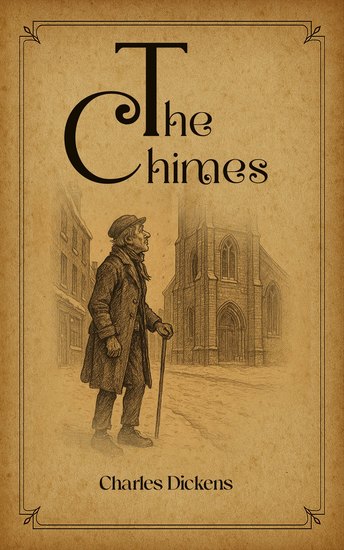
The Chimes is a powerful and emotionally charged novella by Charles Dickens that delivers a passionate critique of social injustice, poverty, and moral hypocrisy. Written as part of Dickens's Christmas books, the story blends realism with supernatural elements to challenge harsh attitudes toward the poor in Victorian society.

The story follows Toby "Trotty" Veck, a humble ticket-porter whose life has been shaped by hardship and self-doubt. Influenced by the cold philosophies of the wealthy and powerful, Trotty comes to believe that poverty is a personal failure and that people like himself are a burden on society. On New Year's Eve, as the church bells—known as the Chimes—ring out, Trotty experiences a series of haunting visions that force him to confront the devastating consequences of despair, injustice, and social cruelty.

Through these visions, Dickens exposes the damaging effects of neglect, exploitation, and moral indifference, particularly toward working-class families. At the same time, the story offers a message of hope, emphasizing compassion, social responsibility, and the possibility of renewal.

The Chimes is a moving blend of social protest and spiritual awakening. With its vivid imagery, emotional intensity, and enduring moral message, the novella stands as a heartfelt call for empathy and reform, reminding readers that kindness, understanding, and human dignity must lie at the heart of any just society.
Available since: 02/05/2026.
Print length: 129 pages.


Other books that might interest you

  • The Human Comedy - cover

    The Human Comedy

    Honoré de Balzac

    • 0
    • 0
    • 0
    Own the Entire Spectacle of the Human Condition.
    
    Honoré de Balzac did not just write fiction; he built a civilization. "The Human Comedy" is arguably the most ambitious project in literary history—a vast, interconnected universe designed to capture every facet of 19th-century life. This collection serves as a grand social map, spanning from the opulence of Parisian high society to the rugged reality of the French provinces.
    
    Inside this monumental body of work, you will discover:
    
    A Living Social History: A staggering web of characters who reappear across different stories, creating a sense of a persistent, evolving world that influenced authors from Flaubert to Kerouac.
    
    The Architecture of Ambition: Unflinching observations of the power of wealth, the weight of social status, and the relentless drive for success in a rapidly changing world.
    
    Masterful Realism: Balzac's signature style of meticulous detail, bringing to life the fashion, architecture, and secret motivations of an entire era.
    
    The Philosophical Core: Deep inquiries into the forces that govern human behavior—obsessions, passions, and the inevitable clash between the individual and society.
    
    Reading this collection is an immersive experience. To enter Balzac's world is to witness the birth of modern society through the eyes of its most astute observer. This volume is an essential cornerstone for any library of world literature and a must-read for anyone seeking to understand the true complexity of human nature.
    
    Step into the grand design of a literary titan. Buy "The Human Comedy" today and explore the depths of Balzac's genius.
    Show book
  • Devereux's Last Smoke - From their pens to your ears genius in every story - cover

    Devereux's Last Smoke - From...

    Izola Forrester

    • 0
    • 0
    • 0
    The bookshelves of American literature are incredible collections that have gathered together centuries of very talented authors.  From this continent their fame spread and whilst among their number many are now forgotten or neglected their talents endure.  Among them is Izola Forrester.
    Show book
  • The Seven Who Were Hanged - cover

    The Seven Who Were Hanged

    Anonymous

    • 0
    • 0
    • 0
    The story of seven people tried for murder and sentenced to death by hanging. As they await their execution in prison and contemplate what it means to die, they struggle with fear and horror, each in their own way.  
    Praise for The Seven Who Were Hanged:  
    ⭐️⭐️⭐️⭐️⭐️	Trial, verdict, awaiting an execution: Leonid Andreyev paints vivid and livid psychological portraits of those sentenced to death – both idealists and dreamers; and also mean and calloused criminals. The story is profound, precise and frightful. 
    ⭐️⭐️⭐️⭐️⭐️ 	Perfect craft in this story on the cruelty of execution. I don't know a better story in the world. 
    ⭐️⭐️⭐️⭐️⭐️	Every time I read this I come away feeling even more positively about this as a completely transcendent and astonishing piece of literature. By now I'm pretty convinced it's the best book I've ever read and maybe ever will read.  
    ⭐️⭐️⭐️⭐️⭐️ 	The book questions the humanity of the death penalty as a response to violent crime, and does so in a way that is subtle rather than heavy handed or moralistic. But what is most impressive is how Andreyev manages to convey the state of mind of people who are confronted with imminent death.
    Show book
  • Christmas at Red Butte - From their pens to your ears genius in every story - cover

    Christmas at Red Butte - From...

    Lucy Ward Montgomery

    • 0
    • 0
    • 0
    The bookshelves of American literature are incredible collections that have gathered together centuries of very talented authors.  From this continent their fame spread and whilst among their number many are now forgotten or neglected their talents endure.  Among them is Lucy Ward Montgomery.
    Show book
  • Maelzel's Chess-Player - cover

    Maelzel's Chess-Player

    Edgar Allan Poe

    • 0
    • 0
    • 0
    "Maelzel's Chess Player" (1836) is an essay by Edgar Allan Poe exposing a fraudulent automaton chess player called The Turk, which had become famous in Europe and the United States and toured widely. The fake automaton was invented by Wolfgang von Kempelen in 1769 and was brought to the U.S. in 1825 by Johann Nepomuk Mälzel after von Kempelen's death.
    In his essay, Poe asserts that a mechanical chess player would play perfectly, but Maelzel's "machine" occasionally errs, and is therefore suspect. Although it is the most famous essay on the Turk, many of Poe's hypotheses were incorrect. He also may or may not have been aware of earlier articles written in the Baltimore Gazette where two youths were reported to have seen chess player William Schlumberger climbing out of the machine. He did, however, borrow heavily from David Brewster's Letters on Natural Magic. Other essays and articles had been written and published prior to Poe's in Baltimore, Philadelphia, and Boston—cities in which Poe had lived or visited before writing his essay.
    Show book
  • Horror at Sea - 15 Nautical Nightmares - cover

    Horror at Sea - 15 Nautical...

    William Hope Hodgson, H. P....

    • 0
    • 0
    • 0
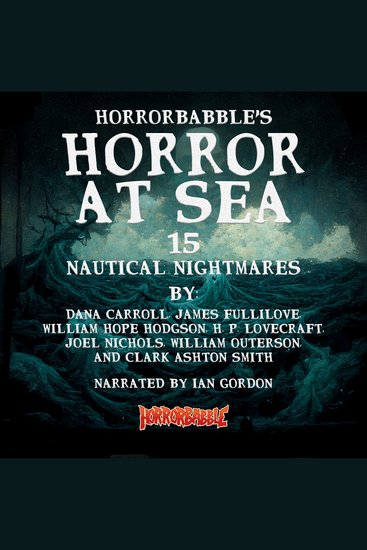
    HorrorBabble's complete "Horror at Sea" collection. 15 nautical nightmares: from the discovery and subsequent investigation of a mysterious vessel in The Derelict; to the terrifying ordeal of a lighthouse keeper stationed at the remote, Three Skeleton Key. 
    "There’ll be restless nights for thee, upon these seven seas…" 
    Contents: 
    The Derelict by W. H. Hodgson (Red Magazine, Dec 1912) 
    The Ocean Ogre by D. Carroll (Weird Tales, July 1937) -- A stranded ship. 
    Ghouls of the Sea by J. B. S. Fullilove (WT, March 1934) -- Death aboard the "Kay Marie". 
    The Voice in the Night by W. H. Hodgson (Blue Book Magazine, Nov 1907) -- A schooner, approached in the night. 
    The Black, Dead Thing by F. B. Long (WT, Oct 1933) -- A dreadful thing came aboard the ship. 
    The Temple by H. P. Lovecraft (WT, Sep 1925) -- A submarine on a strange descent. 
    The Lure of Atlantis by J. M. Nichols, Jr. (WT, April 1925) -- An expedition into a lost city. 
    The Uncharted Isle by C. A. Smith (WT, Nov 1930) -- A sailor lost at sea. 
    The Night Ocean by H. P. Lovecraft (Californian, Winter 1936) -- An artist, unsettled by the ocean. 
    Fire in the Galley Stove by W. Outerson (Atlantic, May 1937) -- An attack on the "Unicorn". 
    The Black Kiss by R. Bloch (WT, June 1937) -- The thing that swam in black waters. 
    Lost by A. M. Schnirring (WT, July 1943) -- A tale of the marshes. 
    The Thing in the Weeds by W. H. Hodgson (Story-teller, Jan 1913) -- A Sargasso Sea story. 
    The Brain-Eaters by F. B. Long (WT, June 1932) -- A horror from four-dimensional space. 
    Three Skeleton Key by G. G. Toudouze (Esquire, Jan 1937)
    Show book