Join us on a literary world trip!
Add this book to bookshelf
Grey
Write a new comment Default profile 50px
Grey
Subscribe to read the full book or read the first pages for free!
All characters reduced
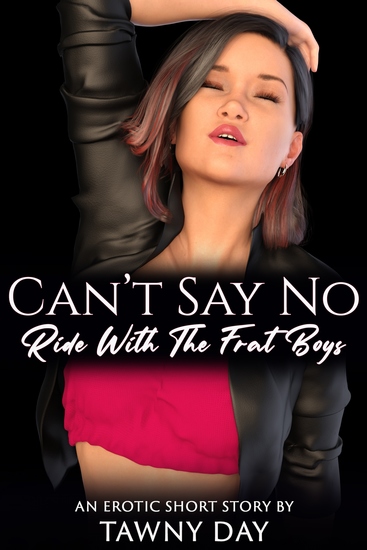
Can't Say No - Ride With The Frat Boys - cover

Can't Say No - Ride With The Frat Boys

Tawny Day

Publisher: Spicy Cocktail Press

  • 0
  • 0
  • 0

Summary

A commuter train filled with horny frat boys!
 
Kelly signs up for college classes, but the campus is too far to drive. It’s her first time on the commuter train and she has no idea why nobody gets on besides her. Once she climbs aboard, she finds herself surrounded by a ton of frat boys! It’s their private car, but they don’t mind letting her stay. Especially when they realize that Kelly never says no. Soon they’re all getting in on the action - and giving her the ride of her life!
 
*Explicit* *Erotic* *Hot*
 
Can't Say No: Ride With The Frat Boys is a stand-alone erotic short story in the Can’t Say No series about Kelly. Read them in order to enjoy the full experience!
Available since: 12/13/2022.
Print length: 29 pages.

Other books that might interest you

  • The Half-White Album - cover

    The Half-White Album

    Cynthia J. Sylvester

    • 0
    • 0
    • 0
    This powerful debut collection explores lives lived between worlds. Sylvester masterfully weaves together fiction, poetry, and nonfiction to give listeners a poignant though fractured view of her characters' lives, their loves, and their struggles. Told from the perspective of an urban Native, the work details a journey led by the nomadic band, the Covers. It is an experience meant to heal generational trauma and bring back into the light people who may otherwise be forgotten. At its heart, The Half-White Album is a healing ceremony of the author's own creation, a process grounded in music that celebrates what it is to be human and imperfect and to love imperfectly.
    Show book
  • Monkey Nuts - cover

    Monkey Nuts

    D H Lawrence

    • 0
    • 0
    • 0
    ‘Monkey Nuts’ was written by D H Lawrence in 1922. 'Monkey Nuts' turns the traditional love story on its head. It is the woman (the new liberated woman Lawrence had little time for) who does the chasing and the boy who is reluctant. Lawrence seems to be saying it is the unspoken love between the two men in the story which is more satisfying than the possible love between the man and the woman which the boy rejects. Although the older man goes through the motions of chasing the girl, even he seems to realise the sterility of one-sided love.
    Show book
  • A Man with Two Lives - From their pens to your ears genius in every story - cover

    A Man with Two Lives - From...

    Ambrose Bierce

    • 0
    • 0
    • 0
    Ambrose Gwinnett Bierce was born on 24th June 1842 at Horse Cave Creek in Meigs County, Ohio. His parents were poor but they introduced him to literature at an early age, instilling in him a deep appreciation of books, the written word and the elegance of language.  
    Growing up in Koscuisko County, Indiana poverty and religion were defining features of his childhood, and he would later describe his parents as “unwashed savages” and fanatically religious, showing him little affection but always quick to punish. He came to resent religion, and his introduction to literature appears to be their only positive effect. 
    At age 15 Bierce left home to become a printer’s devil, mixing ink and fetching type at The Northern Indian, a small Ohio paper. Falsely accused of theft he returned to his farm and spent time sending out work in the hopes of being published. 
    His Uncle Lucius advised he be sent to the Kentucky Military Institute. A year later he was commissioned as an Officer.  As the Civil War started Bierce enlisted in the 9th Indiana Infantry Regiment.  
    In April 1862 Bierce fought at the Battle of Shiloh, an experience which, though terrifying, became the source of several short stories. Two years later he sustained a serious head wound and was off duty for several months. He was discharged in early 1865.  
    A later expedition to inspect military outposts across the Great Plains took him all the way to San Francisco. He remained there to become involved with publishing and editing and to marry, Mary Ellen on Christmas Day 1871.  They had a child, Day, the following year.  
    In 1872 the family moved to England for 3 years where he wrote for Fun magazine. His son, Leigh, was born, and first book, ‘The Fiend’s Delight’, was published.  
    They returned to San Francisco and to work for a number of papers where he gained admiration for his crime reporting. In 1887 he began a column at the William Randolph Hearst’s San Francisco Examiner.  
    Bierce’s marriage fell apart when he discovered compromising letters to his wife from a secret admirer. The following year, 1889 his son Day committed suicide, depressed by romantic rejection. 
    In 1891 Bierce wrote and published the collection of 26 short stories which included ‘An Occurrence at Owl Creek Bridge’.  Success and further works including poetry followed.  
    Bierce with Hearst’s resources helped uncover a financial plot by a railroad to turn 130 million dollars of loans into a handout. Confronted by the railroad and asked to name his price Bierce answered “my price is $130 million dollars. If, when you are ready to pay, I happen to be out of town, you may hand it over to my friend, the Treasurer of the United States”.  
    He now began his first foray as a fabulist, publishing ‘Fantastic Fables’ in 1899.  But tragedy again struck two years later when his second son Leigh died of pneumonia relating to his alcoholism.  
    He continued to write short stories and poetry and also published ‘The Devil’s Dictionary’.  
    At the age of 71, in 1913 Bierce departed from Washington, D.C., for a tour of the battlefields where he had fought during the civil war. At the city of Chihuahua he wrote his last known communication, a letter to a friend. It’s closing words were “as to me, I leave here tomorrow for an unknown destination,” Ambrose Bierce then vanished without trace.
    Show book
  • Moonshine springs - cover

    Moonshine springs

    Mikhail Bulgakov

    • 0
    • 0
    • 0
    Moonshine springs - is a satirical story by Mikhail Afanasyevich Bulgakov (1891 - 1940), an outstanding writer, playwright and theatre worker.
    Bulgakov was a Soviet playwright, novelist, and short story writer best known for his humor and penetrating satire. Because of their realism and humor, Bulgakov's works enjoyed great popularity, but their trenchant criticism of Soviet mores was increasingly unacceptable to the authorities.
    Show book
  • Of Withered Apples - cover

    Of Withered Apples

    Philip K. Dick

    • 0
    • 0
    • 0
    Of Withered Apples by Philip K. Dick is a hauntingly symbolic short story that blends dreamlike imagery with unsettling undercurrents of fate and desire. In this surreal tale, Dick draws readers into a world where ordinary objects—such as withered apples hanging on a tree—take on an ominous significance, suggesting temptation, decay, and the fragility of human will. Known for his explorations of altered reality and psychological tension, Dick uses this story to probe the boundaries between the real and the illusory, leaving readers questioning what lies beneath the surface of everyday life. Perfect for fans of speculative fiction, existential allegories, and classic mid-20th century science fiction.
    Show book
  • The Way Things Were - cover

    The Way Things Were

    Marko Vovchok

    • 0
    • 0
    • 0
    The Way Things Were is a collection of stories and novellas by Ukrainian writer Marko Vovchok (Maria Alexandrona Vilinskaya-Markevich) focused around the lives of Russian and Ukrainian serfs during the last decade of slavery in the Russian Empire. These works were instrumental to the abolitionist movement, whose members - writers, poets, artists, and political activists - eventually succeeded in bringing about the Emancipation reform of 1861 and ending six centuries of serfdom. 
    Marko Vovchok's stories are not epic, historically significant episodes, but rather small, everyday vignettes from the lives of serfs and their masters, made all the more powerful by their serene, conversational style bringing the reality of the era into stark relief. 
    This collection includes the following works:The Merchant's DaughterSashaMischief MakerThe SchoolgirlKaterinaNine Brothers and Their Sister GalyaThe Tulle BabaLazy BonesLittle ToyThe King of HeartsLemerivnaMasha
    Show book