Join us on a literary world trip!
Add this book to bookshelf
Grey
Write a new comment Default profile 50px
Grey
Subscribe to read the full book or read the first pages for free!
All characters reduced
The Origin and Situation of the Germans - cover

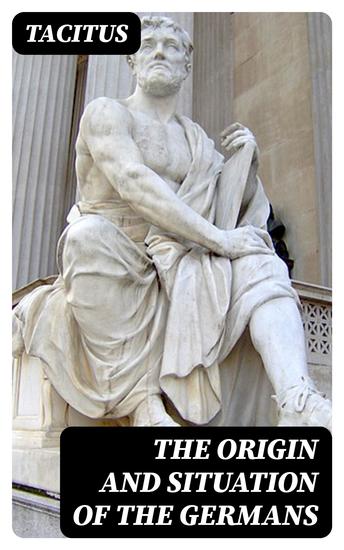
The Origin and Situation of the Germans

Tacitus Tacitus

Translator Alfred John Church, William Jackson Brodribb

Publisher: DigiCat

  • 0
  • 0
  • 0

Summary

In "The Origin and Situation of the Germans," Tacitus presents a meticulously detailed ethnographic study of the Germanic tribes, juxtaposing their customs, governance, and societal structures against the backdrop of Roman imperialism. The text is characterized by its succinct prose and keen observational style, seamlessly weaving historical analysis with vivid descriptions. Tacitus, through an impartial lens, critiques Roman civilization while illuminating the complexities of Germanic life, effectively capturing the ideological clash between the two cultures during the first century AD. His work serves not only as a valuable historical document but also as a reflection of Roman perceptions of the 'barbarian' other. Tacitus, a prominent Roman historian, was born around 56 AD and lived through a tumultuous period marked by political upheaval and moral decay within the Empire. His personal experiences, coupled with his interests in governance and ethical philosophy, likely influenced his exploration of Germanic societies. The disenchantment with contemporary Rome and a fascination with the perceived simplicity and virtue of the Germans manifest throughout Tacitus's writings, offering keen insights into his worldview. Readers intrigued by the intersection of history, culture, and identity will find Tacitus's work to be both enlightening and provocative. "The Origin and Situation of the Germans" not only serves as a foundational text for understanding Germanic heritage but also offers timeless reflections on the nature of civilization itself, making it essential reading for anyone interested in historical anthropology and classical studies.
Available since: 08/10/2022.
Print length: 25 pages.


Other books that might interest you

  • Start of World War II The: The History of the Events that Culminated with Nazi Germany’s Invasion of Poland - cover

    Start of World War II The: The...

    Editors Charles River

    • 0
    • 0
    • 0
    "My good friends," the mustached, bony man with thick eyebrows and large, strong teeth somewhat reminiscent of those of a horse, shouted to the crowds from the second-floor window of his house at 10 Downing Street, "this is the second time in our history, that there has come back to Downing Street from Germany peace with honor. I believe it is peace for our time." The man addressing the crowd, British Prime Minister Neville Chamberlain, had just returned from the heart of Nazi Germany following negotiations with Adolf Hitler, and the crowd gathered outside the English leader's house on September 30, 1938 greeted these ringing words with grateful cheers. The piece of paper Chamberlain flourished exultantly seemed to offer permanent amity and goodwill between democratic Britain and totalitarian Germany. In it, Britain agreed to allow Hitler's Third Reich to absorb the Sudeten regions of Czechoslovakia without interference from either England or France, and since high percentages of ethnic Germans – often more than 50% locally – inhabited these regions, Hitler's demand for this territory seemed somewhat reasonable to Chamberlain and his supporters. With Germany resurgent and rearmed after the disasters inflicted on it by the Treaty of Versailles following World War I, the pact – known as the Munich Agreement – held out hope of a quick end to German ambitions and the return of stable, normal international relations across Europe. 
    Of course, the Munich agreement is now notorious because its promise proved barren within a very short period of time. Chamberlain's actions either failed to avert or actually hastened the very cataclysm he wished to avoid at all costs. The "Munich Agreement" of 1938 effectively signed away Czechoslovakia's independence to Hitler's hungry new Third Reich, and within two years, most of the world found itself plunged into a conflict which made a charnel house of Europe and left somewhere between 60-80 million people dead globally.
    Show book
  • The human machine - cover

    The human machine

    Arnold Bennett

    • 0
    • 0
    • 0
    "The Human Machine" by Arnold Bennett is a classic self-help book published in 1908. In this work, Bennett explores the intricacies of human psychology and behavior, offering insights into how individuals can better understand and control their thoughts, emotions, and actions to lead more fulfilling lives. Through practical advice and philosophical reflections, Bennett delves into the inner workings of the human mind, examining topics such as habit formation, willpower, concentration, and personal development.
    Show book
  • Dark Red Rooms: Volume One - A Collection of Queer Erotic Flashbacks - cover

    Dark Red Rooms: Volume One - A...

    sweets

    • 0
    • 0
    • 0
    We all have memories of our favorite encounters. They exist like dark little red rooms lining the corners of the hallways of our minds. Some are revisited often, others we happen upon when it is least expected, interrupting your thoughts like little pangs in the middle of a conversation. It's easy to want to revisit those rooms again and again, and at the same time, there's this desire to keep them untouched and sacred. 
    These are brief, re-tellings of my favorite pang-inducing erotic memories. Some of them haven't happened yet, others are so etched into my psyche that they'll always be a part of this house. 
    Enjoy. 
    -sweets
    Show book
  • The Acharnians - cover

    The Acharnians

    Aristophanes

    • 0
    • 0
    • 0
    The Acharnians, one of Aristophanes’ earliest surviving comedies, is a sharp and entertaining critique of war and politics in ancient Athens. Written during the Peloponnesian War, the play follows Dicaeopolis, a weary farmer who takes matters into his own hands by negotiating a private peace with Sparta, defying the city’s warmongering leaders. As he enjoys the benefits of peace—wine, trade, and personal freedom—he faces opposition from the chorus of Acharnian charcoal-burners, staunch supporters of the war. Through absurdity, satire, and bold humor, Aristophanes challenges Athenian militarism and exposes the folly of political opportunism. Blending fantasy with pointed social commentary, The Acharnians champions individual reason and peace over nationalistic zeal, offering a timeless reflection on the costs of war and the courage to seek alternatives.
    Show book
  • Bare Bones - I'm Not Lonely If You're Reading This Book - cover

    Bare Bones - I'm Not Lonely If...

    Anonymous

    • 0
    • 0
    • 0
    A touching, funny, heart-wrenching, and triumphant memoir from one of the biggest names in radio, the host of The Bobby Bones Show, one of the most listened-to drive time morning radio shows in the nation. 
    Growing up poor in Mountain Pine, Arkansas, with a young, addicted mom, Bobby Estell fell in love with country music. Abandoned by his father at the age of five, Bobby saw the radio as his way out—a dream that came true in college when he went on air at the Henderson State University campus station broadcasting as Bobby Bones, while simultaneously starting The Bobby Bones Show at 105.9 KLAZ. Bobby’s passions were pop, country music, and comedy, and he blended the three to become a tastemaker in the country music industry, heard by millions daily. Bobby broke the format of standard country radio, mixing country and pop with entertainment news and information, and has interviewed some of the biggest names in the business, including Luke Bryan, Taylor Swift, Blake Shelton, Tim McGraw, Lady Antebellum, and Jason Aldean. 
    Yet despite the glamour, fame, and money, Bobby has never forgotten his roots, the mom and grandmother who raised him, the work ethic he embraced which saved him and encouraged him to explore the world, and the good values that shaped him. In this funny, poignant memoir told in Bobby’s distinctive patter, he takes fans on a tour of his road to radio. Bobby doesn’t shy away from the curves he continues to navigate—including his obsessive-compulsive disorder—on his journey to find the happiness of a healthy family. 
    Funny and tender, raw and honest, Bare Bones is pure Bobby Bones—surprising, entertaining, inspiring, and authentic.
    Show book
  • The action of Intelligence - Brockwood Park 1972 - Public Discussion 2 - cover

    The action of Intelligence -...

    Jiddu Krishnamurti

    • 0
    • 0
    • 0
    The action of intelligence - 14 September 1972 
    • Q: Why don’t we see the division between the observer and the observed? 
    • How does the division come about which causes conflict and misery? 
    • Are we aware that we are fragmented? Why does contradiction exist? 
    • Can we have a mind that is not fragmented and contradictory? 
    • Can the mind live without comparison? 
    • The brain sees that nationalities and religious divisions are disastrous for 
    human relationship. What is the capacity that makes the brain see this? Is this 
    awareness? Is this intelligence? 
    • What is the relationship of intelligence to all that is taking place? 
    • Intelligence operating has its own action. When there is that intelligence, there 
    is sanity. 
    • Is intelligence operating in you?
    Show book