Join us on a literary world trip!
Add this book to bookshelf
Grey
Write a new comment Default profile 50px
Grey
Subscribe to read the full book or read the first pages for free!
All characters reduced
The Histories - Enriched edition Power Struggles and Political Intrigues in Ancient Rome - cover

The Histories - Enriched edition Power Struggles and Political Intrigues in Ancient Rome

Tacitus Tacitus

Translator Alfred John Church, William Jackson Brodribb

Publisher: Good Press

  • 0
  • 0
  • 0

Summary

In "The Histories," Tacitus provides a compelling chronicle of the Year of the Four Emperors (AD 69), a tumultuous period that followed the death of Nero. Written in a terse and incisive style that reflects Tacitus' penchant for brevity and psychological depth, this work employs a mixed narrative approach, blending historical account with poignant political analysis. The text not only documents the power struggles intrinsic to imperial Rome but also offers profound insights into the decay of civic virtue and the nature of tyranny, elucidating the dynamics of autocracy versus democracy. Tacitus' incorporation of speeches imbues the narrative with dramatic tension, rendering the past vividly alive for contemporary audiences, while his critical stance on corruption and moral decline invites reflection on the cyclical nature of history. Tacitus, born around AD 56 into a prominent Roman family, navigated the complexities of political life during the Julio-Claudian and Flavian dynasties, experiences which fueled his disillusionment with the imperial regime. His career as a senator and a governor of provinces provided him with a firsthand perspective on the moral ambivalence of power and the fragility of governance, themes poignantly explored in "The Histories." Tacitus' writings are often regarded as a reflection of his struggle with loyalty to the Empire and his commitment to historical truth, making his perspectives invaluable for scholars of Roman history. Readers seeking to understand the intricacies of imperial Rome and its leaders will find "The Histories" essential. This work not only enriches our understanding of a critical historical juncture but also resonates with contemporary concerns about power, corruption, and human nature. Tacitus' masterful exploration of these themes makes this text a vital read for anyone interested in the legacy of Rome and the lessons it imparts for modern governance.

In this enriched edition, we have carefully created added value for your reading experience:
- A succinct Introduction situates the work's timeless appeal and themes.
- The Synopsis outlines the central plot, highlighting key developments without spoiling critical twists.
- A detailed Historical Context immerses you in the era's events and influences that shaped the writing.
- An Author Biography reveals milestones in the author's life, illuminating the personal insights behind the text.
- A thorough Analysis dissects symbols, motifs, and character arcs to unearth underlying meanings.
- Reflection questions prompt you to engage personally with the work's messages, connecting them to modern life.
- Hand‐picked Memorable Quotes shine a spotlight on moments of literary brilliance.
- Interactive footnotes clarify unusual references, historical allusions, and archaic phrases for an effortless, more informed read.
Available since: 11/18/2023.
Print length: 217 pages.

Other books that might interest you

  • The Dialectical Behavior Therapy Skills Workbook for CPTSD - Heal from Complex Post-Traumatic Stress Disorder Find Emotional Balance and Take Back Your Life - cover

    The Dialectical Behavior Therapy...

    MSW Sheri Van Dijk

    • 0
    • 0
    • 0
    Powerful and evidence-based dialectical behavior therapy (DBT) skills to help you heal from traumas, balance emotions, and feel safe in the present moment. 


    If you've experienced chronic, multiple, or ongoing instances of trauma, you may be experiencing complex post-traumatic stress disorder, or C-PTSD—and one-size-fits-all treatment methods just aren't enough. In this evidence-based workbook, dialectical behavior therapy (DBT) expert Sheri Van Dijk combines cutting-edge research and evidence-based skills to help you feel safer and more stable, and recognize and reconcile traumas, so you can take charge of your life. 


    Based in DBT, polyvagal theory, and other proven-effective modalities, this powerful and accessible workbook will help you process and manage intense emotions, free yourself from self-destructive behaviors, and feel more stable—and safe—in the present. 


    What happened to you in your past wasn't your fault, and it doesn't have to define your future. Drawing on the best practices of DBT and polyvagal theory, this vital workbook will help you begin healing and reclaim wholeness.
    Show book
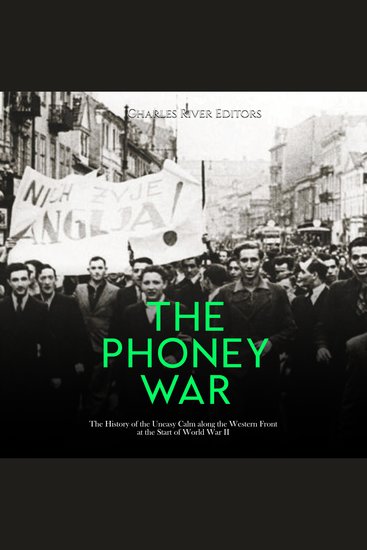
  • Phoney War The: The History of the Uneasy Calm along the Western Front at the Start of World War II - cover

    Phoney War The: The History of...

    Editors Charles River

    • 0
    • 0
    • 0
    Though the French would be decisively defeated soon after the Nazi invasion of Belgium and France in early 1940, they had not sat on their hands. As the power of Nazi Germany grew alarmingly during the 1930s, the French sought means to defend their territory against the rising menace of the Thousand Year Reich. As architects of the most punitive measures in the Treaty of Versailles following World War I, France was the most natural target for German retribution, so the Maginot Line, a series of interconnected strongpoints and fortifications running along much of France's eastern border, helped allay French fears of invasion.  
    	The popular legend of the Maginot Line portrays the frontier defenses as a useless “white elephant” project that was prompted by a gross misapprehension of warfare's new realities in the mid-20th century and quickly overwhelmed by the forceful advance of the German blitzkrieg. English idiom today invokes this vision of the Maginot Line as a metaphor for any defensive measure strongly believed in but actually useless. Indeed, usages such as “Maginot Line mentality,” describing an overly defensive, reactive mindset, perpetuate the legend. As a French author and military liaison with the British, Andre Maurois, wrote about his disillusionment with the defensive line he originally enthusiastically supported: “We know now that the Maginot line-complex was a dangerous disease of the mind; but I publish this as it was written in January, 1940.”  
    This was what brought about the stasis along the Western Front near the end of 1939, a short period of time now referred to as the Phoney War, during which the Western Allies awaited some sort of action by the Nazis. Ultimately, the Allies had not expected the Germans would be able to move armored units through the Ardennes Forests, a heavily wooded region spanning parts of Belgium, France and the Netherlands. 
    Show book
  • Uncertain Climes - Debating Climate Change in Gilded Age America - cover

    Uncertain Climes - Debating...

    Joseph Giacomelli

    • 0
    • 0
    • 0
    Uncertain Climes looks to the late nineteenth century to reveal how climate anxiety was a crucial element in the emergence of American modernity. 
     
    Even people who still refuse to accept the reality of human-induced climate change would have to agree that the topic has become inescapable in the United States in recent decades. But as Joseph Giacomelli shows in Uncertain Climes, this is actually nothing new: as far back as Gilded Age America, climate uncertainty has infused major debates on economic growth and national development. 
      
    In this ambitious examination of late-nineteenth-century understandings of climate, Giacomelli draws on the work of scientists, foresters, surveyors, and settlers to demonstrate how central the subject was to the emergence of American modernity. Amid constant concerns about volatile weather patterns and the use of natural resources, nineteenth-century Americans developed a multilayered discourse on climate and what it might mean for the nation’s future. Although climate science was still in its nascent stages during the Gilded Age, fears and hopes about climate change animated the overarching political struggles of the time, including expansion into the American West. Giacomelli makes clear that uncertainty was the common theme linking concerns about human-induced climate change with cultural worries about the sustainability of capitalist expansionism in an era remarkably similar to the United States’ unsettled present.
    Show book
  • The Leaving Season - A Memoir in Essays - cover

    The Leaving Season - A Memoir in...

    Kelly McMasters

    • 0
    • 0
    • 0
    Kelly McMasters found herself in her mid-thirties living her fantasy: she'd moved with her husband, a painter, from New York City to rural Pennsylvania, where their children roamed idyllic acres in rainboots and diapers. The pastoral landscape and the bookshop they opened were restorative at first, for her and her marriage. But soon, she was quietly plotting her escape. 


    In The Leaving Season, McMasters chronicles the heady rush of falling in love and carving out a life in the city, the slow dissolution of her relationship in an isolated farmhouse, and the complexities of making a new home for herself and her children as a single parent. She delves into the tricky and often devastating balance between seeing and being seen; loss and longing; desire and doubt; and the paradox of leaving what you love in order to survive. 


    Whether considering masculinity in the countryside through the life of a freemartin calf, the vulnerability of new motherhood in the wake of a car crash, or the power of community pulsing through an independent bookshop, The Leaving Season finds in every ending a new beginning.
    Show book
  • Dark Folklore - cover

    Dark Folklore

    Mark Norman, Tracey Norman

    • 0
    • 0
    • 0
    How did our ancestors use the concept of demons to explain sleep paralysis? Is that carving in the porch of your local church really what you think it is? And what’s that tapping noise on the roof of your car..? 
    The fields of folklore have never been more popular – a recent resurgence of interest in traditional beliefs and customs, coupled with morbid curiosities in folk horror, historic witchcraft cases and our superstitious past, have led to an intersection of ideas that is driving people to seek out more information. Tracey Norman (author of the acclaimed play WITCH) and Mark Norman (creator of The Folklore Podcast) lead you on an exploration of those more salubrious facets of our past, highlighting those aspects of our cultural beliefs and social history that are less ‘wicker basket’ and more ‘Wicker Man’.
    Show book
  • Willingness to Learn - The Open Mindset - cover

    Willingness to Learn - The Open...

    Esther Jameson

    • 0
    • 0
    • 0
    The journey begins with the simple act of curiosity, a spark that drives us to explore the vast realm of knowledge and self-improvement. In every life, there exists a turning point where the desire to learn outweighs the comfort of the familiar. This chapter explores the early stages of that transformative journey, when individuals decide to step beyond their comfort zones and embrace the challenges of growth. It is a time filled with both excitement and uncertainty, where every question asked becomes a stepping stone toward a deeper understanding of oneself and the world. 
    At the heart of this journey is the recognition that learning is not a finite process. Instead, it is an ongoing adventure that demands patience, persistence, and an open mind. The decision to learn often comes after moments of reflection, when past experiences—both successes and failures—combine to illuminate the need for change. This process involves shedding limiting beliefs and accepting that each setback is a valuable lesson in disguise. The willingness to embrace the unknown, even when the outcome is uncertain, becomes the foundation upon which a richer, more informed life is built. 
    In this early stage, individuals frequently encounter obstacles that test their resolve. It is in overcoming these barriers that the true value of the learning journey is revealed. The initial steps may be filled with self-doubt, yet every challenge conquered reinforces the commitment to personal growth. This chapter emphasizes that every small victory contributes to a greater sense of purpose and capability. The gradual accumulation of knowledge and experience leads to a newfound confidence that empowers learners to tackle more complex questions and explore diverse fields of inquiry.
    Show book