Join us on a literary world trip!
Add this book to bookshelf
Grey
Write a new comment Default profile 50px
Grey
Subscribe to read the full book or read the first pages for free!
All characters reduced
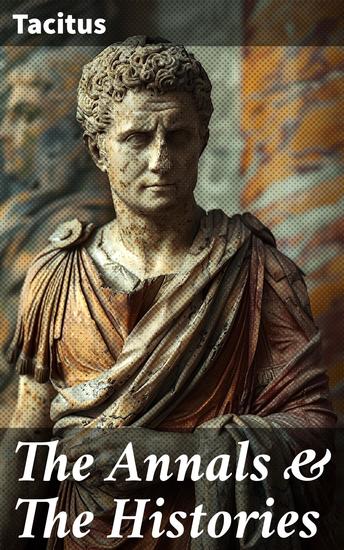
The Annals & The Histories - A Timeless Analysis of Power and Corruption in the Roman Empire - cover

The Annals & The Histories - A Timeless Analysis of Power and Corruption in the Roman Empire

Tacitus Tacitus

Translator Alfred John Church, William Jackson Brodribb

Publisher: Good Press

  • 0
  • 0
  • 0

Summary

Tacitus' "The Annals & The Histories" stands as a monumental chronicle of the Roman Empire's imperial governance and civil strife from the death of Augustus in AD 14 to the year 70. Written in an elegant and concise style, Tacitus employs a meticulous narrative technique, blending historical rigor with a profound psychological insight into the motivations of political actors. The text is distinguished by its moral seriousness and the keen observation of power dynamics, presenting a vivid depiction of the tumultuous period characterized by political intrigue, corruption, and the fluctuations of power, all enriched by Tacitus' distinctive prose that interweaves dramatic narrative with astute analysis, reflecting the complexities of human ambition and ethical dilemmas in governance. Tacitus, a senator and historian of the first century, was profoundly affected by the political landscape of his time, marked by the transition from the Republic to an Empire. His life immersed in political and social spheres of Rome provided him with the insights and perspectives instrumental in crafting a narrative both reflective of his society's moral decay and a cautionary tale regarding absolute power. He grappled with themes of tyranny, the loss of republican values, and the integrity of history itself, making his works both personal and profoundly political. This essential text is recommended for readers interested in the intricate workings of power and governance, historians seeking rich narratives of the past, and anyone desiring to understand the complexities of moral integrity amidst the backdrop of political ambition. Tacitus' reflections and interpretations invite readers to ponder the cyclical nature of history, establishing the significance of his work in any comprehensive study of Roman history.
Available since: 11/18/2023.
Print length: 583 pages.

Other books that might interest you

  • Early Indian Empires - Foundations of Indian Power (3 in 1) - cover

    Early Indian Empires -...

    Rolf Hedger

    • 0
    • 0
    • 0
    The history of early Indian empires is a fascinating story of conquest, governance, and cultural transformation. Over centuries, three powerful dynasties—the Maurya, Satavahana, and Gupta Empires—laid the foundations of Indian civilization, shaping its political, economic, and social structures.  
    The Maurya Empire, established by Chandragupta Maurya, was the first large-scale empire to unify much of the Indian subcontinent, creating a highly organized administrative system.  
    Under Ashoka, the empire saw a shift from military expansion to the promotion of Buddhism and moral governance. Following the Mauryas, the Satavahana Empire emerged as a vital force in the Deccan, maintaining stability through a blend of military strength and trade dominance. They controlled key routes linking northern and southern India, facilitating cultural and commercial exchanges.  
    Later, the Gupta Empire brought about a golden age of Indian history, marked by advancements in science, mathematics, literature, and the arts. Their reign saw the revival of Hindu traditions alongside continued Buddhist and Jain influences. Together, these three empires set the stage for India’s rich historical and cultural legacy, influencing the region for centuries to come.
    Show book
  • Violence and the Sacred - cover

    Violence and the Sacred

    René Girard

    • 0
    • 0
    • 0
    Violence and the Sacred is René Girard's landmark study of human evil. Here Girard explores violence as it is represented and occurs throughout history, literature, and myth. Girard's forceful and thought-provoking analyses of Biblical narrative, Greek tragedy, and the lynchings and pogroms propagated by contemporary states illustrate his central argument that violence belongs to everyone and is at the heart of the sacred.
    Show book
  • Essays: First Series The Over-Soul - cover

    Essays: First Series The Over-Soul

    Ralph Waldo Emerson

    • 0
    • 0
    • 0
    Ralph Waldo Emerson's The Over-Soul isn't just an essay—it's a revelation. It speaks of a vast, unshakable presence within us all, a silent force that knows, guides, and connects. Beyond intellect, beyond ego, Emerson leads us to the infinite.
    The Over-Soul is the quiet voice of truth, the source of wisdom that needs no teacher. It is intuition over logic, unity over isolation. When we listen, the noise of the world fades, and something deeper takes its place—clarity, purpose, transcendence.
    Emerson doesn't explain; he awakens. His words remind us that insight isn't learned but remembered, waiting beneath the surface of daily life. This isn't philosophy to study—it's truth to experience.
    Part of his seminal Essays: First Series, The Over-Soul remains a timeless meditation on the divine spark within. Open these pages, and you may just recognize something infinite in yourself.
    Show book
  • Quiet Time with The President - A Doctor's Story About Learning to Listen - cover

    Quiet Time with The President -...

    Peter Friedland Friedland, Jill...

    • 0
    • 0
    • 0
    One Sunday in 2001 ear, nose and throat specialist Dr Peter Friedland received an unexpected call from Nelson Mandela's personal physician. The former president was struggling to hear. Could Peter visit him at home?
    Friedland discovered that Mandela was using antiquated hearing aids and was struggling to maintain them. Soon he became a regular visitor to Mandela's home in Houghton where he experienced the elderly statesman, in the frailty of old age, away from the crowds. He was full of stories and always bearing a lesson.
    But outside Mandela's quiet house, Friedland's life was ricocheting from treating one victim of violent crime to another. On many days he worked as a head and neck trauma surgeon and found himself drawn into the victims' families. When his own family and friends were exposed to violent crime, he was driven to make a life-changing decision.
    In Quiet Time with the President, Friedland also examines the powerful forces that push people away from South Africa and those that pull them back. Telling his famous patient that he was planning to leave the country was insurmountably difficult for Friedland, but Mandela surprised him.
    He'd accept his leaving, but on one condition . . .
    Show book
  • The Song Dynasty - Economic and Technological Innovations - cover

    The Song Dynasty - Economic and...

    Jun Liu

    • 0
    • 0
    • 0
    The Song Dynasty (960–1279) emerged from the remnants of the fragmented Five Dynasties and Ten Kingdoms period, establishing a centralized government that would shape China for centuries. Unlike previous dynasties that relied heavily on military conquest, the Song prioritized administration, economic growth, and cultural development, laying the foundation for one of the most prosperous eras in Chinese history. 
    The dynasty is traditionally divided into two periods: the Northern Song (960–1127) and the Southern Song (1127–1279). The Northern Song was founded by Emperor Taizu, who implemented policies to weaken the power of military governors and strengthen civilian rule. This shift reduced the influence of warlords, allowing for a stable bureaucratic system. However, external threats, particularly from the Khitan Liao and later the Jurchen Jin, forced the court to focus on diplomacy and financial strategies rather than military expansion. Eventually, the Jin conquest of the north in 1127 led to the retreat of the Song court to the south, marking the beginning of the Southern Song period. Despite losing control over key northern territories, the Southern Song maintained a flourishing economy, driven by trade, technological advancements, and agricultural productivity. 
    The Song Dynasty’s political structure was characterized by a well-organized bureaucracy based on merit rather than aristocratic privilege. The expansion of the civil service examination system ensured that government officials were selected through rigorous academic testing rather than birthright. This system, rooted in Confucian ideals, emphasized knowledge of classical texts and governance principles, creating a scholar-official class that played a crucial role in state affairs. While this meritocratic system promoted stability, it also created a conservative bureaucracy resistant to radical reforms.
    Show book
  • We Were Once a Family - A Story of Love Death and Child Removal in America - cover

    We Were Once a Family - A Story...

    Roxanna Asgarian

    • 0
    • 0
    • 0
    One of Literary Hub's most anticipated books of 2023"Narrator Suehyla El-Attar gives an impassioned performance that enhances the touching, terrifying tale of social injustice and systemic failure. Her delivery is compelling and clear, evoking a captivating listening experience from this true-crime tragedy."- Library JournalThe shocking, deeply reported story of a murder-suicide that claimed the lives of six children—and a searing indictment of the American foster care system.On March 26, 2018, rescue workers discovered a crumpled SUV and the bodies of two women and several children at the bottom of a cliff beside the Pacific Coast Highway. Investigators soon concluded that the crash was a murder-suicide, but there was more to the story: Jennifer and Sarah Hart, it turned out, were a white married couple who had adopted the six Black children from two different Texas families in 2006 and 2008. Behind the family's loving facade, however, was a pattern of abuse and neglect that went ignored as the couple withdrew the children from school and moved across the country. It soon became apparent that the State of Texas knew very little about the two individuals to whom it had given custody of six children—with fateful consequences.In the manner of Adrian Nicole LeBlanc's Random Family and other classic works of investigative journalism, Roxanna Asgarian’s We Were Once a Family is a revelation of vulnerable lives; it is also a shattering exposé of the foster care and adoption systems that produced this tragedy. As a journalist in Houston, Asgarian became the first reporter to put the children’s birth families at the center of the story. We follow the author as she runs up against the intransigence of a state agency that removes tens of thousands of kids from homes each year in the name of child welfare, while often failing to consider alternatives. Her reporting uncovers persistent racial biases and corruption as children of color are separated from birth parents without proper cause. The result is a riveting narrative and a deeply reported indictment of a system that continues to fail America’s most vulnerable children while upending the lives of their families.A Macmillan Audio production from Farrar, Straus and Giroux.
    Show book