Join us on a literary world trip!
Add this book to bookshelf
Grey
Write a new comment Default profile 50px
Grey
Subscribe to read the full book or read the first pages for free!
All characters reduced
The Annals & The Histories - 2 Classics of Roman History - cover

The Annals & The Histories - 2 Classics of Roman History

Tacitus Tacitus

Translator Alfred John Church, William Jackson Brodribb

Publisher: DigiCat

  • 0
  • 0
  • 0

Summary

Tacitus' "The Annals & The Histories" stands as a seminal work in Roman historiography, chronicling the tumultuous periods of the Roman Empire and the civil wars that followed the death of Nero. With a keen eye for political nuance, Tacitus employs a prose style characterized by its eloquence and sharp moral depth, weaving together events that highlight the corrupting influence of power and the complexities of human nature. His meticulous attention to detail and psychological insight into figures such as Tiberius and Vespasian allows readers to grasp the intricacies of governance and the fragility of liberty in times of upheaval. As a senator and a praetor, Tacitus was not merely an observer but a participant in the very political climate he describes, which undeniably shaped his narratives. Living during a time when the Roman Empire was marked by both grandeur and decay, Tacitus sought to understand the lessons of history to warn future generations. His elite background and personal experiences with tyranny and moral decay lend authenticity and urgency to his historical writings, compelling readers to reflect on their contemporary contexts. This book is a must-read for anyone interested in the intricacies of power, the dynamics of history, and the human condition. Tacitus' insights resonate profoundly with modern audiences, and his unwavering examination of human motivations serves as a timeless reminder of history's cyclical nature. Engage with his powerful prose to uncover the lessons embedded within the annals of a civilization that continues to influence our world today.
Available since: 05/17/2022.
Print length: 583 pages.


Other books that might interest you

  • The Hidden Language - Decoding Body Language to Connect Communicate and Relate - cover

    The Hidden Language - Decoding...

    Laura Navarro, Joe Jackson

    • 0
    • 0
    • 0
    The Hidden Language: Decoding Body Language to Connect, Communicate, and Relate 
    This insightful book unlocks the secrets of nonverbal communication, revealing the powerful messages transmitted through gestures, postures, and expressions that often bypass words yet say so much more. 
    Introducing "The Hidden Language: Decoding Body Language to Connect, Communicate, and Relate." Master the silent symphony of body language to enhance your personal and professional relationships, by learning to interpret the subtleties that speak volumes. 
    Decode the silent signals with: 
    🚶‍♂️ Postural Prose: Learn to read the stories told by stance and posture, the unspoken narratives of confidence, nervousness, or openness that shape our perceptions. 
    👀 Gaze Guidance: Understand the language of the eyes, from the flicker of a glance to the steady gaze, and how they command attention or convey sincerity. 
    👐 Gestural Grammar: Unravel the meaning behind gestures and touch, the punctuation of our physical expressions that can emphasize, contradict, or reinforce our words. 
    🤝 Relational Rhythms: Discover how body language varies across cultures and contexts, influencing relationships and communication in an increasingly interconnected world. 
    "The Hidden Language" is an essential guide for anyone looking to improve their communication skills, from business professionals and educators to individuals looking to foster deeper personal connections. 
    Embark on the journey of understanding with 'The Hidden Language,' and transform the way you communicate in the silent spaces between words. 📚🔍🤝
    Show book
  • The Time Beneath the Concrete - Palestine Between Camp and Colony - cover

    The Time Beneath the Concrete -...

    Nasser Abourahme

    • 0
    • 0
    • 0
    In The Time beneath the Concrete, Nasser Abourahme argues that settler colonialism is always as much an attempt to conquer time as it is to conquer land. Taking as his primary object  Palestinian refugee camps, created in the fallout of the eliminatory violence of Israel's founding, Abourahme shows how these camps become the primary place where settler colonial attempts to dominate space and time encounter Indigenous refusal. Seen from the camps, Israel becomes a settler colonial project defined by its inability to move past the past—a project stuck at its foundational moment of conquest. At the same time, the Palestinian insistence on return is a refusal to abide by the closure of the past into settler futurity. Palestinian struggle does not just happen in the open time of dispossession; it happens over this time. That struggle, Abourahme demonstrates, is a form of anticolonial refusal that draws its power not from any decisive finality, but precisely from irresolution and keeping time open. 


    Duke University Press Scholars of Color First Book Award
    Show book
  • The Art Of War - cover

    The Art Of War

    Sun Tzu

    • 0
    • 0
    • 0
    "The Art of War" is a timeless and influential treatise on strategy and warfare attributed to Sun Tzu, a renowned Chinese military strategist, philosopher, and tactician of ancient China. Written over 2,500 years ago, this classic work has transcended its original purpose as a military manual to become a foundational text on strategic thinking applicable to various aspects of life, including business, leadership, and conflict resolution. 
    Divided into thirteen chapters, "The Art of War" delves into the intricate complexities of warfare and the principles that govern success on the battlefield. Sun Tzu emphasizes the importance of flexibility, adaptability, and understanding the terrain in order to gain an advantage over one's adversaries. The book discusses various strategies, including the direct and indirect approaches, the utilization of deception, the management of resources, and the significance of timing in achieving victory. 
    One of the central concepts in the book is the idea that the ultimate triumph lies in winning without engaging in actual combat. Sun Tzu stresses the value of outsmarting opponents through strategic maneuvering and psychological warfare, reducing the need for bloody confrontation. He underlines the importance of understanding both one's own strengths and weaknesses, as well as those of the opposition, in order to make informed decisions that lead to success. 
    "The Art of War" also touches upon leadership qualities and the need for effective communication and discipline within an organization. Sun Tzu's insights have been applied not only to military strategies but also to various fields, such as business management, negotiation, and personal development. His teachings highlight the significance of preparation, planning, and adaptability in achieving one's goals.
    Show book
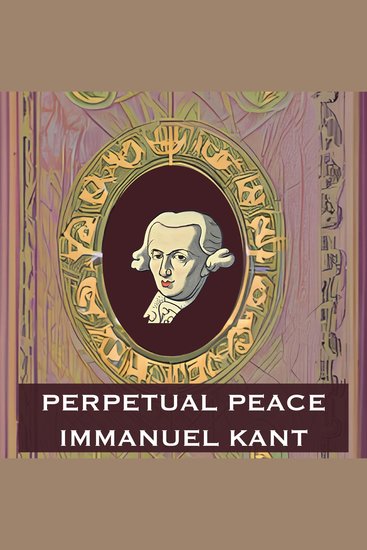
  • Perpetual Peace - Immanuel Kant - cover

    Perpetual Peace - Immanuel Kant

    Immanuel Kant

    • 0
    • 0
    • 0
    "Perpetual Peace" is a philosophical work written by the German philosopher Immanuel Kant in 1795. In this work, Kant argues that peace can only be achieved through a world order based on international law, democratic governance, and the promotion of free trade. 
    Kant believed that war was a result of a flawed system of international relations, where states pursued their own self-interests without regard for the interests of other nations. He argued that in order to establish a lasting peace, a system of international law must be established that would regulate the behavior of nations and prevent them from going to war. 
    Kant also believed that a world federation of nations would be necessary to ensure peace. This federation would be based on democratic governance, where each nation would have an equal say in decisions that affected the world as a whole. Kant believed that this would help to ensure that the interests of all nations were taken into account, and that no one nation could dominate the others. 
    Finally, Kant argued that free trade was essential for peace. He believed that by promoting economic interdependence between nations, free trade would create incentives for nations to work together and avoid war. 
    Overall, Kant's "Perpetual Peace" is a seminal work in the history of political philosophy, and continues to be influential today in debates about international relations and the pursuit of peace.
    Show book
  • The Age of Jackson - The Rise of Democracy in America - cover

    The Age of Jackson - The Rise of...

    Harry Montgomery

    • 0
    • 0
    • 0
    Andrew Jackson's rise to prominence began in the backwoods of the Carolinas, where he was born in 1767 to Irish immigrant parents. Orphaned at a young age and shaped by the violence of the Revolutionary War, Jackson's early years were filled with hardship and struggle. These formative experiences instilled in him a fierce independence and an unwavering sense of personal honor, traits that would define his character for the rest of his life. Largely self-taught and known for his fiery temper, Jackson developed a reputation for toughness, earning the nickname “Old Hickory” from soldiers who served under him. Despite limited formal education, he pursued a career in law and eventually moved westward to Tennessee, where he would find opportunity and recognition. 
    Jackson's military career was the first major platform that launched him into the national spotlight. During the War of 1812, he was appointed a general in the U.S. Army and quickly demonstrated his capabilities as a leader. His most celebrated moment came at the Battle of New Orleans in January 1815. Although the battle technically took place after the war had officially ended with the signing of the Treaty of Ghent, news had not yet reached American forces. Jackson’s troops, composed of militia, freedmen, Native Americans, and even pirates, faced a professional British army. Against the odds, they achieved a decisive victory, inflicting heavy casualties while suffering minimal losses. This triumph turned Jackson into a national hero and a symbol of American resilience and patriotism. The victory solidified his image as a man of action who could defend the country against foreign threats.
    Show book
  • The Atomic Alchemist - J Robert Oppenheimer And The Birth of The Nuclear Age - cover

    The Atomic Alchemist - J Robert...

    Davis Truman

    • 0
    • 0
    • 0
    In "The Atomic Alchemist: J. Robert Oppenheimer and the Birth of the Nuclear Age," we embark on a captivating journey through the life and legacy of one of the most influential figures of the 20th century. This meticulously researched and thought-provoking book delves into the fascinating story of Oppenheimer's role in the development of the atomic bomb, the unprecedented power it unleashed, and the profound ethical questions it raised. 
    From Oppenheimer's early years as a brilliant physicist to his pivotal leadership in the Manhattan Project, this book chronicles his journey through creating the underground Los Alamos laboratory, where exceptional minds collaborated under intense pressure to build a weapon of unimaginable destruction. Gain a front-row seat as scientific breakthroughs lead to the splitting of the atom, and the world stands on the precipice of a new era. 
    "The Atomic Alchemist" goes beyond scientific advancements and dives deep into the moral dilemmas faced by Oppenheimer. Explore the inner conflicts he grappled with as he confronted the immense power of the atomic bomb and the catastrophic consequences it could bring. Witness the haunting moments of the Trinity test, the first atomic explosion, and the aftermath of the bombings of Hiroshima and Nagasaki, forever changing the course of history. 
    "The Atomic Alchemist" is an engaging and enlightening exploration of the birth of the nuclear age. It examines Oppenheimer's complex legacy, from his entanglement with political suspicion during the Red Scare to his enduring advocacy for arms control and international cooperation. It serves as a poignant reminder of the enduring questions surrounding the responsible use of science and the quest for a peaceful world.
    Show book