Join us on a literary world trip!
Add this book to bookshelf
Grey
Write a new comment Default profile 50px
Grey
Subscribe to read the full book or read the first pages for free!
All characters reduced
Ezra Pound: His Metric and Poetry - cover

Ezra Pound: His Metric and Poetry

T. S. Eliot

Publisher: DigiCat

  • 0
  • 0
  • 0

Summary

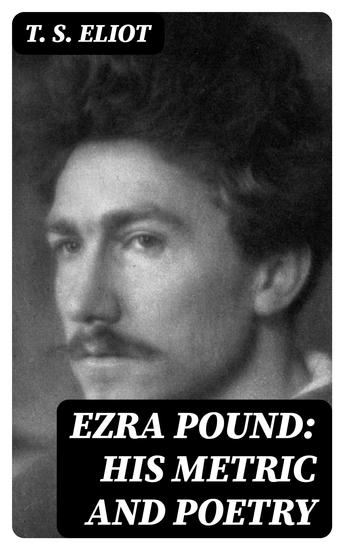
In "Ezra Pound: His Metric and Poetry," T. S. Eliot offers a profound exploration of Pound's innovative use of metrics and the intricacies of his poetic form. This critical work encapsulates the essence of modernist poetry, situating Pound within the broader literary landscape of the early 20th century. Eliot employs a meticulous analytical style, examining the rhythmic nuances and structural elements that underpin Pound's oeuvre, while simultaneously reflecting on the interplay between tradition and innovation in his work. The book serves as both a scholarly critique and an appreciation of Pound's attempts to redefine poetic language and its metrics, making it a cornerstone text in understanding modernist poetics. T. S. Eliot, a pivotal figure in modernist literature, draws on his extensive knowledge of poetic tradition and form to articulate the significance of Pound's contributions. The interplay between Eliot's own poetic style and Pound's experimental techniques provides a unique lens through which readers can appreciate the transformative nature of 20th-century poetry. Eliot's admiration for Pound is evident, as he seeks to illuminate the complex relationship between form, content, and cultural critique in poetry. This book is highly recommended for scholars and enthusiasts of modernist literature, as it not only enriches the understanding of Ezra Pound's artistic vision but also showcases Eliot's critical acumen. It invites readers to delve deeply into the metrics of poetry and encourages a broader contemplation of artistic innovation in a tumultuous historical context.
Available since: 08/15/2022.
Print length: 19 pages.
Other books that might interest you

  • The Way We Are - cover

    The Way We Are

    Hugh Mackay

    • 0
    • 0
    • 0
    Australia's leading social psychologist examines our society today and asks timely and urgent questions about its future 
     
    Life is messy. Relationships are complex. Outcomes are uncertain. Yet none of our differences-whether based on ethnicity, politics, religion, cultural tastes and preferences, or gender-are nearly as significant as the humanity we share. 
     
    Amidst our epidemics of loneliness, anxiety and depression, and the impacts of entrenched poverty and ubiquitous technology, The Way We Are examines the major trends that are shaking the foundations of the Australian way of life. 
     
     
    Drawing on thousands of interviews over a lifetime of research, Hugh Mackay, much loved and highly respected social psychologist, presents a compelling portrait of Australia today. He celebrates the march towards gender equality and explains the stubborn persistence of misogyny, the anti-social consequences of social media, the complex legacy of the Baby Boomers, and the 'fake wisdom' that guides too much of our thinking. Exploring the steady decline in religious faith and practice, Hugh identifies the many gods we continue to worship, and points to the positive role that dreaming can play in our lives. Though some of his observations may not be easy reading, Hugh's analysis is suffused with affection for our country. 
     
     
    Inspiring, provocative and powerfully argued, The Way We Are is the most important-and uplifting-book you'll read all year. It will encourage you to reflect deeply on the question: What kind of society do we want to become? 
     
     
    'Hugh Mackay is one of this country's most perceptive social commentators.' - Sydney Morning Herald 
     
     
    'Mackay is something of a national treasure.' - Canberra Times
    Show book
  • Confucianism - The Philosophy of Ethics Relationships and Governance in East Asia - cover

    Confucianism - The Philosophy of...

    Amman Hirsch

    • 0
    • 0
    • 0
    Confucianism, one of the world’s oldest and most influential philosophies, has deeply shaped Chinese culture, governance, and social structures for over two millennia. Rooted in the teachings of Confucius, a revered teacher and philosopher who lived in ancient China, Confucianism is less a religion than a guiding framework for leading an ethical life, cultivating personal virtues, and fostering harmonious relationships. Its principles emphasize respect for family, reverence for tradition, and a commitment to education and self-betterment—values that resonate universally, even as they are uniquely expressed in East Asian societies. 
    Confucius himself envisioned a society where individuals behaved with compassion and integrity, rulers governed with wisdom and justice, and families formed the foundation of moral learning. Central concepts such as *ren* (humaneness), *li* (ritual propriety), and *xiao* (filial piety) highlight the importance of empathy, respectful conduct, and devotion to family, which lie at the heart of Confucian teachings. Over centuries, these ideals have expanded to influence countless aspects of life, from governance and social etiquette to education and family dynamics. 
    As Confucianism has evolved, it has also encountered both support and criticism, adaptations and reinterpretations. In modern times, the philosophy faces new questions: How does Confucianism reconcile with individual rights and equality? What role does it play in an increasingly globalized world? This book aims to explore Confucianism in its depth and breadth, unraveling its rich history, core teachings, and its dynamic role in contemporary society.  
    For anyone seeking to understand the values and perspectives that have helped shape one of the most enduring societies on earth, Confucianism offers both timeless wisdom and a meaningful framework for personal and social growth.
    Show book
  • Followed - cover

    Followed

    Anne Reed

    • 0
    • 0
    • 0
    FOLLOWED: By Anne Reed has achieved a remarkable feat by being as Top #100 best seller in two of Amazon's categories. 
    #43 Best Seller ★ in Mystery Literary Criticism (Jan 29, 2025) 
    #92 Best Seller ★ in Teen & Young Adult Ghost Stories eBooks (Jan 29, 2025) 
    “Followed” chronicles the eerie experiences of Anne Reed and her family, spanning multiple generations and locations. From the mysterious happenings at the Linwood House, where Aaron’s socks inexplicably vanish into the wall, to the chilling encounters at the Torquay House and the Barksdale House, each chapter delves into the history and haunting phenomena that plague these homes. 
    As Anne grows older, she moves away to her first apartment, only to encounter the unsettling and face the challenges of adulthood. Yet, even in her new life on West 33rd Avenue, strange occurrences persist, including a disturbing incident at the Othello Tunnels and the complete disappearance of her arm. 
    The narrative builds up at Spruce Street, where Anne confronts a ghostly figure on her bed and her daughter Caitlin and Anne’s sister discover a goblin-like entity haunting Caitlin’s bedroom. Anne seeks to share the truth of her family’s paranormal encounters through these spine-tingling accounts, weaving together a tapestry of fear, wonder and the unexplained.
    Show book
  • The Drive for Dollars - How Fiscal Politics Shaped Urban Freeways and Transformed American Cities - cover

    The Drive for Dollars - How...

    Brian D. Taylor, Eric A. Morris,...

    • 0
    • 0
    • 0
    The story of the interplay between finance, freeways, and urban form in the twentieth century and their enduring impact on American cities and neighborhoods in the twenty-first. 


    American cities are distinct from almost all others in the degree to which freeways and freeway travel dominate urban landscapes. In The Drive for Dollars, Brian D. Taylor, Eric A. Morris, and Jeffrey R. Brown tell the largely misunderstood story of how freeways became the centerpiece of US urban transportation systems, and the crucial, though usually overlooked, role of fiscal politics in bringing freeways about. The authors chronicle how the ways that we both raise and spend transportation revenue have shaped our transportation system and the lives of those who use it, from the era before the automobile to the present day. They focus on how the development of one revolutionary type of road—the freeway—was inextricably intertwined with money. With the nation's transportation finance system at a crossroads today, this book sheds light on how we can best fund and plan transportation in the future. The authors draw on these lessons to offer ways forward to pay for transportation more equitably, provide travelers with better mobility, and increase environmental sustainability and urban livability.
    Show book
  • A Thousand Ways to Pay Attention - A Memoir of Coming Home to My Neurodivergent Mind - cover

    A Thousand Ways to Pay Attention...

    Rebecca Schiller

    • 0
    • 0
    • 0
    It should have been Rebecca Schiller's dream come true: moving her young family to the English countryside to raise goats and coax their own fruit and vegetables from the land. But, as she writes: The summer of striding out toward a life of open fields and sacks of corn, I brought a confused black hole of something pernicious but not yet acknowledged along for the ride. 


    Rebecca's health begins to crumble, with bewildering symptoms: frequent falls, uncontrollable rages, and mysterious lapses in memory. As she fights to be seen by specialists, her fledgling homestead—and her family—hang by increasingly tenuous threads. And when her diagnosis finally comes, it is utterly unexpected: severe ADHD. 


    In her scramble for answers, Rebecca's consciousness alternately sears with pinpoint focus and spirals with connections. Childhood memories resurface with new meaning, and her daily life entwines with the history of women who tended this land before her. Her family weathers their growing pains where generations of acorns have fallen to rise again as trees, where ancient wolves and lynx once stalked the shadows. Written in unsparing, luminous prose, this is an all-absorbing memoir of one woman's newfound neurodivergence—and a clarion call to overturn the narrative that says minds are either normal and good or different and broken.
    Show book
  • Summary of Eric Bolling's Wake Up America - cover

    Summary of Eric Bolling's Wake...

    Falcon Press

    • 0
    • 0
    • 0
    Buy now to get the main key ideas from Eric Bolling's Wake Up America 
      
    In Wake Up America (2016), Eric Bolling warns that the Left is out to destroy all the core values that made America the greatest nation on earth. 
    Bolling argues that fear, guilt, and class conflict have been utilized by the socialist Left to divide us in their quest to dramatically transform American society. They understand that doing so would result in the annihilation of the numerous characteristics that have distinguished America since its establishment, which is what they want. The attributes that characterize America include grit, profit, manliness, thrift, individuality, dominion, merit, pride, and providence. These attributes were critical to success, and regaining their dominance is critical to reclaiming the American dream. Now is the moment for America to wake up. 
     
    Show book