Join us on a literary world trip!
Add this book to bookshelf
Grey
Write a new comment Default profile 50px
Grey
Subscribe to read the full book or read the first pages for free!
All characters reduced
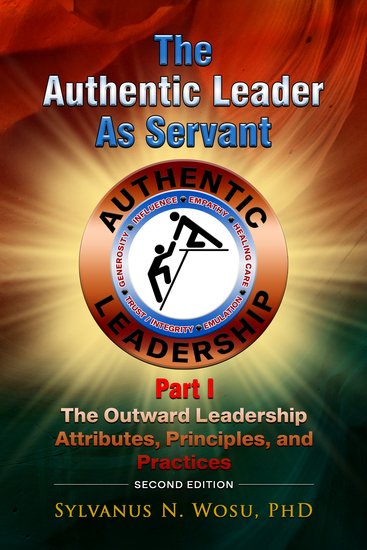
The Authentic Leader as Servant Part I - The Outward Leadership Attributes Principles and Practices - cover

The Authentic Leader as Servant Part I - The Outward Leadership Attributes Principles and Practices

Sylvanus N. Wosu Ph.D.

Publisher: Proisle Publishing Services

  • 0
  • 0
  • 0

Summary

The Authentic Leader as Servant Part I: The Outward Leadership Attributes, Principles, and Practices looks at leadership from a perspective proposed thousands of years ago: A leader who is also a servant is, for the most part, qualified to lead when the individual is ready to carry out their assignment as a servant while pursuing the growth others… The book describes the leaders’ outward attributes using comprehensive, irrevocable facts and principles. The author describes the exemplary leader-as-servant outward attributes, including servant-hood as trust, influence, generosity, and persuasion, among many others, especially how to apply these qualities when serving others. The book focuses on the Biblical model of leadership that engages studies from the secular, sociological, and business perspectives, and explores how a leader as a servant’s relationship to followers can be productive and nurturing. The author argues that nothing is as pure, other people-centered, and service-oriented as a leadership modeled after the ultimate authentic leader and servant, Jesus Christ
Available since: 05/12/2023.
Print length: 294 pages.


Other books that might interest you

  • When Emperors Wept: The First Shogun's War - cover

    When Emperors Wept: The First...

    Gaurav Garg

    • 0
    • 0
    • 0
    This audiobook is narrated by an AI Voice.   
    The late twelfth century. Japan stands on a precipice. The once-glorious Heian era fades, its refined courtly culture overshadowed by the burgeoning power of the warrior class. At the zenith of this new order stands the Taira clan, their crimson banners a symbol of absolute authority under the formidable, yet increasingly tyrannical, Taira no Kiyomori. His ambition knows no bounds, culminating in the manipulation of the Imperial succession – an act of sacrilege that plunges a nation into the abyss of civil war. 
    From the embers of past defeats, the Minamoto clan, the Genji, stirs. Minamoto no Yoritomo, an exile for two decades, his spirit tempered by hardship and a burning desire for retribution, receives a desperate call to arms from a wronged Imperial Prince. Cautious, calculating, and possessed of an unshakeable will, Yoritomo begins to weave a web of alliances in the Kanto, his stronghold of Kamakura destined to become the heart of a new warrior government. 
    "When Emperors Wept: The First Shogun's War" sweeps readers into the heart of the Genpei War, a five-year epic of ambition, honor, loyalty, and devastating betrayal. It is a story of towering personalities – the ruthless Kiyomori, the calculating Yoritomo, the tragic hero Yoshitsune, the indomitable warrior-monk Benkei, and the astute Hōjō Masako. Witness the fall of one age and the violent birth of another, as the
    Show book
  • The Shocking Truth about Media Bias - cover

    The Shocking Truth about Media Bias

    Zoey Fraisers

    • 0
    • 0
    • 0
    The media plays an essential role in shaping public perception, influencing opinions, and determining which issues receive attention. Every day, millions of people rely on news outlets to stay informed, trusting that journalists will present facts objectively. However, the reality is far more complex. Media bias is an undeniable force that affects how stories are reported, which facts are emphasized, and how narratives are framed. This bias can be subtle or overt, intentional or unintentional, but its consequences are profound.  
      
    Throughout history, media bias has been used as a tool for persuasion, propaganda, and agenda-setting. Governments, corporations, and interest groups have long recognized the power of controlling information. Whether through selective reporting, misleading headlines, or emotional language, media outlets can manipulate public sentiment. The question is not whether bias exists, but how it manifests and how it influences society.  
      
    One of the biggest challenges in recognizing bias is its ability to blend seamlessly into seemingly objective reporting. The way a journalist chooses to present a story—what details they include, the sources they cite, and even the language they use—can subtly push readers or viewers toward a particular perspective. Some media organizations openly align with political ideologies, while others claim impartiality but still reflect the interests of their ownership or advertisers. In a time when trust in journalism is declining, it is crucial to understand how bias operates and how to separate fact from opinion. 
    Show book
  • Life Liberty and the Pursuit of Happiness: Book Summary & Analysis - cover

    Life Liberty and the Pursuit of...

    Alexander Pike

    • 0
    • 0
    • 0
    This content is an independent and unofficial summary created for informational and educational purposes only. It is not affiliated with, authorized, approved, licensed, or endorsed by the original author or publisher. All rights to the original work belong to its respective copyright holders. This summary is not intended to substitute the original book, but to offer a concise overview and interpretation of its main ideas. 
     
    What does it truly mean to pursue happiness? And who gets to claim liberty in a land built on ideals both noble and flawed? 
    Life, Liberty, and the Pursuit of Happiness is a sweeping, emotionally rich journey through the heart of the American experiment. Blending historical insight with profound moral reflection, this powerful narrative unpacks one of the most iconic phrases in human history—and challenges you to live it with purpose. 
    From the revolutionary spirit that shaped a nation to the cultural battles of the modern era, this audiobook explores how the promise of freedom has been defined, tested, and reimagined across generations. Through triumphs and contradictions, through crisis and reinvention, this is a story not just of a country—but of the individuals who dare to chase meaning, justice, and fulfillment.
    Show book
  • The Rise of Rage - Harnessing the Most Misunderstood Emotion - cover

    The Rise of Rage - Harnessing...

    Julie A. Christiansen

    • 0
    • 0
    • 0
    Rage through the centuries has shown that anger can be a catalyst for change; it can also be a tool employed in fear by those resisting reform or trying to quell protests or advancements by other people. Perhaps you too have experienced the rise of rage within yourself. You might be fed up with feeling angry and not having any way to express it. But counselor and psychotherapist Julie Christiansen says that if we take time to examine the belief systems that fuel our anger, we can free ourselves from the bondage that anger puts us in, learning how to make it work for us. 


    When we map out our anger, we can learn to manage it. With a ten-step program full of practical exercises such as defining your anger style, understanding your belief systems, releasing residual anger, and more, The Rise of Rage will help you: identify the ten anger styles; develop tools for resolving anger at work; give effective feedback and criticism; listen more effectively with a view to deepening connection; enhance communication in all manner of relationships; harness the power of forgiveness and acceptance; communicate effectively with angry people. 


    Embrace this journey of self-discovery with The Rise of Rage to learn what real anger is, what real forgiveness looks like, and which safe, effective, and successful anger resolution tools work best for you.
    Show book
  • A Hacker's Mind - How the Powerful Bend Society's Rules and How to Bend them Back - cover

    A Hacker's Mind - How the...

    Bruce Schneier

    • 0
    • 0
    • 0
    It’s not just computers—hacking is everywhere. 
     
    A hack is any means of subverting a system’s rules in unintended ways. The tax code isn’t computer code, but a series of complex formulas. It has vulnerabilities; we call them “loopholes.” We call exploits “tax avoidance strategies.” And there is an entire industry of “black hat” hackers  
    intent on finding exploitable loopholes in the tax code. We call them accountants and tax attorneys. 
     
    In A Hacker’s Mind, Bruce Schneier takes hacking out of the world of computing and uses it to analyze the systems that underpin our society: from tax laws to financial markets to politics. He reveals an array of powerful actors whose hacks bend our economic, political, and legal  
    systems to their advantage, at the expense of everyone else. 
     
    Once you learn how to notice hacks, you’ll start seeing them everywhere—and you’ll never look at the world the same way again. Almost all systems have loopholes, and this is by design. Because if you can take advantage of them, the rules no longer apply to you. 
     
    Unchecked, these hacks threaten to upend our financial markets, weaken our democracy, and even affect the way we think. And when artificial intelligence starts thinking like a hacker—at inhuman speed and scale—the results could be catastrophic. 
     
    But for those who would don the “white hat,” we can understand the hackingmindset and rebuild our economic, political, and legal systems to counter those who would exploit our society. And we can harness artificial intelligence to improve existing systems, predict and defend  
    against hacks, and realize a more equitable world.
    Show book
  • Early Greek Philosophy & Other Essays - cover

    Early Greek Philosophy & Other...

    Friedrich Nietzsche

    • 0
    • 0
    • 0
    "The essays contained in this volume treat of various subjects. With the exception of perhaps one we must consider all these papers as fragments. Written during the early Seventies, and intended mostly as prefaces, they are extremely interesting, since traces of Nietzsche's later tenets—like Slave and Master morality, the Superman—can be found everywhere. But they are also very valuable on account of the young philosopher's daring and able handling of difficult and abstruse subjects. "Truth and Falsity," and "The Greek Woman" are probably the two essays which will prove most attractive to the average reader."
    Show book