Join us on a literary world trip!
Add this book to bookshelf
Grey
Write a new comment Default profile 50px
Grey
Subscribe to read the full book or read the first pages for free!
All characters reduced
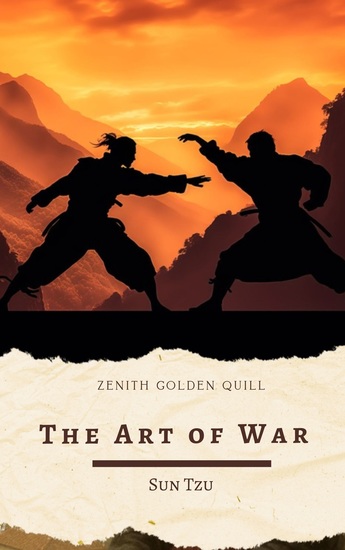
The Art of War - The Most Influential Military and Leadership Text in History - cover

The Art of War - The Most Influential Military and Leadership Text in History

Sun Tzu, Zenith Golden Quill

Publisher: Zenith Golden Quill

  • 0
  • 0
  • 0

Summary

⚔️ Master the battlefield of war—and life—with ancient wisdom that never ages.

Written over 2,500 years ago, The Art of War by Sun Tzu remains the definitive guide on strategy, competition, and leadership. Whether in war, business, sports, or self-development, Sun Tzu's principles on discipline, timing, deception, and strength offer clear tactics for success 🧠📈.

This legendary manual has influenced generals, CEOs, athletes, and thinkers across every field. Its focus on preparation, adaptability, and knowing your opponent speaks to anyone navigating conflict or seeking clarity in chaos.

This fully annotated and beautifully designed edition includes modern commentary, strategic insights, and classic illustrations—ideal for entrepreneurs, leaders, students of philosophy, and ambitious minds.

"Every leader should read this book at least once." — Harvard Business Review
"The most effective strategies are the simplest—this book proves it." — The Wall Street Journal

🏆 Click Buy Now to conquer fear, sharpen your mind, and win without fighting.
Available since: 05/19/2025.
Print length: 31 pages.
Other books that might interest you

  • Summary: Adult Children of Emotionally Immature Parents - How to Heal from Distant Rejecting or Self-Involved Parents - cover

    Summary: Adult Children of...

    Alice Moore, Liam Daniels

    • 0
    • 0
    • 0
    Every person experiences emotions; it's one of life's most natural aspects. Unfortunately, not everyone is capable of dealing with these intense feelings effectively. And, when you’ve been raised by emotionally immature parents who don’t allow you to be an individual who can express their feelings, you will be set up for failed (and sometimes even abusive) relationships in the future. 
    As children, our number one role models are our parents; we give them unconditional trust to guide us through the world. But when the trust is broken, and their behavior and temperament toward us are less than ideal, we can develop coping mechanisms in a bid to shield ourselves from the hurt. If your parent starved you emotionally, then you have a pretty clear picture of what this means – but it doesn't have to remain this way. 
    In her original, Dr. Lindsay Gibson discusses this phenomenon, the effect that the poor emotional development of parents can have on their children’s lives, and practical steps you can take to break free from this cycle. 
    With this summary, you will:Understand in depth the effect that emotionally immature parents have on the adult lives of their children.Gain insight into how your parents' emotional immaturity has shaped your emotional landscape, and identify the subsequent effects.Explore the personality traits associated with emotional immaturity to be able to identify it in others and avoid falling trap to their actions.Learn the steps you can take to wake up from the effects of emotional immaturity to experience the liberation you long for.Learn how to build solid, lasting relationships filled with the emotional intimacy that you desire.And more! 
    But there's only one rule – don't be afraid to dig deep and feel. Facing the resurfacing emotions of your past may be uncomfortable, to say the least, but it is an essential part of the process.
    Show book
  • Dragonslayers - Six Presidents and Their War with the Swamp - cover

    Dragonslayers - Six Presidents...

    Larry Schweikart

    • 0
    • 0
    • 0
    The Swamp has been around for over 150 years, and six major presidents have tried to drain it with varying degrees of success. 
     
    Donald Trump promised to “Drain the Swamp,” by which he originally meant lobbyists. When he got in, he found an entirely different Swamp—a Deep State that had grown, layer upon layer, within the government. But he wasn’t the first to encounter entrenched Swamp opposition. Abraham Lincoln had to battle the  
    “Slave Power Conspiracy”; Grover Cleveland was the most successful of three presidents to fight the spoils Swamp. Theodore Roosevelt found a new iteration of the Swamp awaiting him: Trusts. After World War II, John F. Kennedy discovered that he had little control over the Central Intelligence Agency, and even found he  
    needed the CIA for his own purposes. Despite promising to shrink the bureaucracy Swamp, Ronald Reagan found himself helpless to even make a dent in it. And Trump soon learned that the Deep State could ensure no one ever brought any of its own to justice. Dragonslayers explains why these Swamps exist, and why they were—and remain—so hard to defeat.
    Show book
  • Taming Silicon Valley - How We Can Ensure That AI Works for Us - cover

    Taming Silicon Valley - How We...

    Gary Marcus

    • 0
    • 0
    • 0
    On balance, will AI help humanity or harm it? AI could revolutionize science, medicine, and technology, and deliver us a world of abundance and better health. Or it could be a disaster, leading to the downfall of democracy, or even our extinction. In Taming Silicon Valley, Gary Marcus, one of the most trusted voices in AI, explains that we still have a choice. And that the decisions we make now about AI will shape our next century. In this powerful manifesto, Marcus explains how Big Tech is taking advantage of us, how AI could make things much worse, and, most importantly, what we can do to safeguard our democracy, our society, and our future. 


    Marcus explains the potential—and potential risks—of AI in the clearest possible terms and how Big Tech has effectively captured policymakers. He begins by laying out what is lacking in current AI, what the greatest risks of AI are, and how Big Tech has been playing both the public and the government, before digging into why the US government has thus far been ineffective at reining in Big Tech. He then offers real tools, including eight suggestions for what a coherent AI policy should look like—from data rights to layered AI oversight to meaningful tax reform—and closes with how ordinary citizens can push for what is so desperately needed. Taming Silicon Valley is a must-listen for every concerned citizen.
    Show book
  • Joan of Arc - The Maid of Orleans - cover

    Joan of Arc - The Maid of Orleans

    Harris Ropes

    • 0
    • 0
    • 0
    Joan of Arc was born around January 6, 1412, in the small village of Domrémy, located in northeastern France. She came from a modest family of farmers, with her father, Jacques d’Arc, being a well-respected member of the community. Her mother, Isabelle Romée, was known for her devout religious beliefs, which would greatly influence Joan's early life. Joan was one of five children, and although she lived in relative poverty, her family provided her with a stable and loving environment. 
    Growing up in Domrémy, Joan was surrounded by the rural landscape of Lorraine, a region that was politically unstable at the time. The Hundred Years’ War, which pitted France against England, had caused widespread hardship for many French families. Domrémy, being on the border of French and Burgundian territories, was caught in the middle of this conflict. Joan witnessed firsthand the suffering of the French people, including raids and the destruction of villages, which left a lasting impact on her. 
    Joan was a deeply religious child, often spending time in the local church. It is said that she learned about the lives of saints and felt a special connection to them. Her strong faith became a central part of her identity. By the age of 13, Joan began to experience mystical visions. These visions, which she later described as coming from saints such as Saint Michael, Saint Catherine, and Saint Margaret, were significant in shaping her future. The voices instructed her to help the French crown, specifically to assist Charles VII, the Dauphin, in reclaiming his throne and driving out the English forces from France. Joan took these visions seriously, believing they were divine instructions, and they set her on a path that would change the course of history.
    Show book
  • The Gods of the Nile - Exploring Ancient Egyptian Deities and Their Stories - cover

    The Gods of the Nile - Exploring...

    Julia Blacksmith

    • 0
    • 0
    • 0
    Ancient Egypt was a civilization deeply rooted in religion, where gods and goddesses played an essential role in shaping daily life, governance, and the afterlife. The Egyptian pantheon was vast, with deities representing natural forces, human emotions, and cosmic order. These gods were not distant or abstract figures but were actively involved in the lives of the people, influencing everything from the flooding of the Nile to the fate of the soul after death. The Egyptians believed that by honoring their gods through rituals, prayers, and temple offerings, they could maintain harmony in the universe.  
    One of the defining aspects of Egyptian religion was its polytheistic nature. Unlike monotheistic faiths, which center around a single divine being, the Egyptians worshipped hundreds of gods, each with unique attributes, symbols, and responsibilities. Some, like Ra, the sun god, were powerful and widely revered, while others, such as Taweret, the hippo goddess of childbirth, had more specialized roles. Many deities evolved over time, merging with others or taking on new characteristics as different cities and dynasties rose to prominence. This fluidity allowed Egyptian religion to remain relevant for over three thousand years.  
    The gods were not only worshipped in grand temples but were also deeply integrated into the personal lives of the people. Pharaohs were believed to be divine or semi-divine figures, ruling as representatives of the gods on Earth. Priests conducted elaborate ceremonies in temple complexes dedicated to major deities, ensuring their favor and protection over the land. Ordinary Egyptians also kept small shrines in their homes, prayed to household gods for blessings, and wore protective amulets bearing sacred symbols. Magic and mythology were intertwined with religious practice, with spells and sacred texts often invoking the names of gods for healing, guidance, and protection. 
    Show book
  • Narcissism And Leadership - cover

    Narcissism And Leadership

    Brittany Forrester

    • 0
    • 0
    • 0
    The destiny of humankind as a species fell on the shoulders of great men.The current book aims to unravel the changes in narcissistic leadership that develop over time and examine the potential mechanisms responsible for any such changes.The term “Narcissism” is derived from Ovid’s tale of Narcissus falling in love with his own reflection to the detriment of his genuine/authentic self, which caused him to perish. Although Ovid’s tale of Narcissus being obsessed with his image is void of any psychological examination, it is significant not merely for where the term “narcissism” is derived from. More importantly, constructive themes like unrequited self-love resonated with later interpretations of narcissism as a personality trait.Such individuals’ maintenance of their self-esteem depends on the continued use of certain mental functions. They continually judge others, usually pointing up the moral flaws in other people’s personalities and behavior, and, without shame or hesitation, they set themselves up as the guides and leaders and gods of those who need guidance, of leadership, and as a target for their reverence.These psychoanalytical perspectives suggest that narcissists regulate their self-image through portrayals of boasting, which are often boundless, leading to their rise into leadership positions.
    Show book