Join us on a literary world trip!
Add this book to bookshelf
Grey
Write a new comment Default profile 50px
Grey
Subscribe to read the full book or read the first pages for free!
All characters reduced
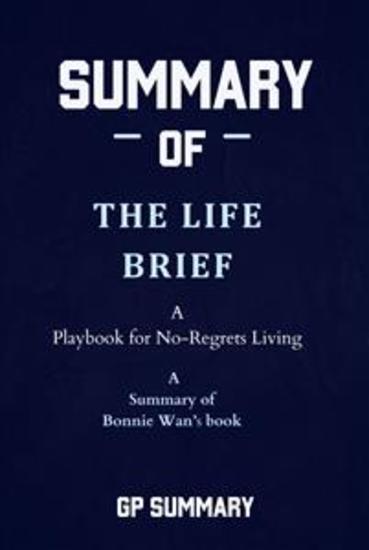
Summary of The Life Brief by Bonnie Wan: A Playbook for No-Regrets Living - cover

Summary of The Life Brief by Bonnie Wan: A Playbook for No-Regrets Living

summary gp

Publisher: BookRix

  • 0
  • 0
  • 0

Summary

DISCLAIMER
This book does not in any capacity mean to replace the original book but to serve as a vast summary of the original book.

Summary of The Life Brief by Bonnie Wan: A Playbook for No-Regrets Living

IN THIS SUMMARIZED BOOK, YOU WILL GET:

	Chapter provides an astute outline of the main contents.
	Fast & simple understanding of the content analysis.
	Exceptionally summarized content that you may skip in the original book


The Life Brief is a playbook designed by Bonnie Wan to help individuals navigate life's decisions, crossroads, and curve-balls. It is a simple yet effective tool for living with intention and imagination. The book is divided into three parts: Get Messy, Get Clear, and Get Active. The first phase uses open-ended writing prompts to break through limiting beliefs, while the second phase offers prompts to find clarity around one's true desires. The Life Brief has transformed thousands of lives, from refining career paths to repairing relationships and rediscovering passion.
Available since: 02/15/2024.
Other books that might interest you

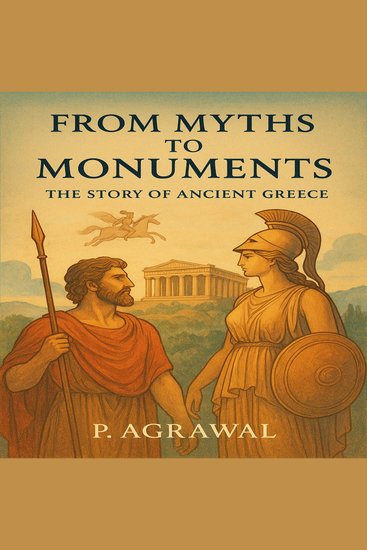
  • From Myths to Monuments - The Story of Ancient Greece - cover

    From Myths to Monuments - The...

    P Agrawal

    • 0
    • 0
    • 0
    This audiobook is narrated by an AI Voice.   
    From Myths to Monuments: The Story of Ancient Greece offers a captivating journey through the heart of one of the most influential civilizations in history. This book explores the profound legacy of Ancient Greece, tracing its origins from the mythic tales of gods and heroes to the lasting monuments of philosophy, art, and democracy that continue to shape our modern world. 
    In this richly illustrated and thoughtfully researched narrative, readers will discover the ancient myths that formed the bedrock of Greek culture, the rise of the city-state, and the flourishing of democracy in Athens. The book delves into the lives of everyday Greeks, the architectural wonders they created, and the philosophical inquiries that revolutionized Western thought. From the spectacular temples of Delphi and Olympia to the intellectual legacy of Socrates, Plato, and Aristotle, From Myths to Monuments illuminates how the Greeks' exploration of human nature, morality, and governance laid the groundwork for much of Western civilization. 
    This work also takes readers through the tumultuous wars and the sweeping conquests of Alexander the Great, culminating in the Hellenistic Age—a time of cross-cultural exchange that forever altered the course of history. Through vivid storytelling and in-depth analysis, this book reveals how Ancient Greece’s artistic, political, and intellectual achievements continue to influence contemporary thought, culture, and society. 
    From Myths to Monuments is an essential read for anyone interested in the enduring legacy of Ancient Greece and its indelible mark on the modern world.
    Show book
  • A Realistic Blacktopia - Why We Must Unite To Fight - cover

    A Realistic Blacktopia - Why We...

    Derrick Darby

    • 0
    • 0
    • 0
    The United States is dogged by racism and racial disparities in income, wealth, health, education, and criminal justice. Philosophers disagree on what kind of politics is needed to address this problem. Do we pursue race-specific remedies to undo racism or do we assume the permanence of racism and opt for non-race-specific remedies in pursuit of a more egalitarian society? Paradoxically, the way to make racial progress in racist America is to downplay race. 


    In A Realistic Blacktopia, political philosopher Derrick Darby challenges the "small tent" approach by examining U.S. Supreme Court cases on education and voting rights arguing that they hold general lessons about the limits of racial politics. Securing racial justice in racist America calls for "big tent" remedies, and Darby argues that pursuing non-race-specific remedies with maximal democratic inclusion is a necessary strategy for mitigating racial inequality and achieving racial justice. 


    A Realistic Blacktopia offers clarity on how racism persists, contrary to claims that America is a post-racial society. Explaining why the myth of post-racialism cannot be ignored in crafting remedies for racial inequality, Darby supplies a principled pragmatic proposal for achieving racial justice. Darby also explains why achieving racial justice requires inclusive democracy.
    Show book
  • Moral Compass The: Navigating Right and Wrong in Modern Times - cover

    Moral Compass The: Navigating...

    Henry J. Howes

    • 0
    • 0
    • 0
    Description: The Moral Compass: Navigating Right and Wrong in Modern Times 
    In today's fast-paced and complex world, the line between right and wrong often blurs, presenting individuals with ethical dilemmas that challenge their values. The Moral Compass: Navigating Right and Wrong in Modern Times explores the intricate dynamics of morality, offering a guide to understanding and addressing these challenges with integrity and purpose. 
    This book delves into the philosophical foundations of morality, the impact of societal and cultural shifts on ethical behavior, and practical strategies for making sound decisions. With a focus on real-world examples and contemporary issues, it provides readers with the tools to navigate moral complexities in both personal and professional settings. 
    Key themes include:The evolution of morality in the modern era.The influence of technology, globalization, and cultural diversity on ethical standards.Practical frameworks for resolving ethical conflicts.The role of empathy, self-reflection, and personal responsibility in moral decision-making. 
    The Moral Compass inspires readers to reflect on their values, embrace critical thinking, and foster a deeper understanding of right and wrong in a world that often tests the limits of morality.
    Show book
  • Letters to Gwen John - cover

    Letters to Gwen John

    Celia Paul

    • 0
    • 0
    • 0
    Celia Paul's Letters to Gwen John centers on a series of letters addressed to the Welsh painter Gwen John (1876–1939), who has long been a tutelary spirit for Paul. John spent much of her life in France, making art on her own terms and, like Paul, painting mostly women. John's reputation was overshadowed during her lifetime by her brother, Augustus John, and her lover Auguste Rodin. Through the epistolary form, Paul draws fruitful comparisons between John's life and her own: their shared resolve to protect the sources of their creativity, their fierce commitment to painting, and the ways in which their associations with older male artists affected the public's reception of their work. 


    Letters to Gwen John is at once an intimate correspondence, an illuminating portrait of two painters, and a writer/artist's daybook, describing Paul's first exhibitions in America, her search for new forms, her husband's diagnosis of cancer, and the onset of the global pandemic. Paul, who first revealed her talents as a writer with her memoir, Self-Portrait, enters with courage and resolve into new unguarded territory—the artist at present—and the work required to make art out of the turbulence of life. 


    Contains mature themes.
    Show book
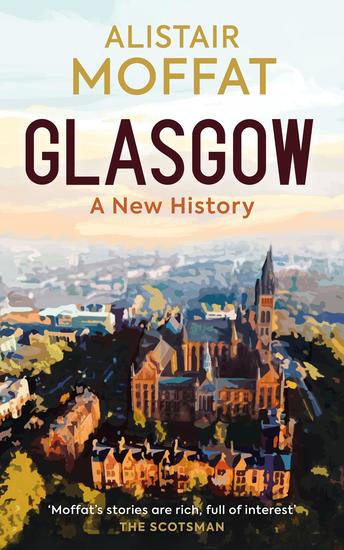
  • Glasgow: A New History - cover

    Glasgow: A New History

    Alistair Moffat

    • 0
    • 0
    • 0
    Scotland's largest city has always been one of the most vibrant, varied and fascinating places in the country.
    This new history of Glasgow begins with the river, for the Clyde made the city flourish. From prehistory to the Romans, to Mungo and the kingdom of Strathclyde, it's a rich, quirky and moving story that remembers the foundation of the burgh by the bishops and moves rapidly to the Union of 1707, when Edinburgh lost a parliament and Glasgow gained access to an empire and business boomed.
    Immigrants began to arrive: Highlanders, Irish families fleeing the famine, Jews fleeing persecution and lately Asians who transformed tastes. Britain's favourite dish, chicken tikka masala, was invented in the city. Football, architecture, heavy industry, politics and a distinctive sense of humour are all celebrated. Glasgow has never hesitated to reinvent itself – because its greatest resource has always been its people.
    They belong to Glasgow and Glasgow belongs to them. This is their story.
    Show book
  • Economic Recovery Program - cover

    Economic Recovery Program

    Ronald Reagan

    • 0
    • 0
    • 0
    On February 18, 1981, Reagan laid out his economic recovery program before a Joint Session of Congress. Reagan had previously outlined his recovery program in an Oval Office address on February 5, 1981, in which he displayed a dollar bill and 36 cents to show how inflation had reduced the value of a dollar since 1960.  
    Reagan made a further plea for enactment of his recovery program on April 28, 1981, following the assassination attempt on his life. Many economists credit this recovery program for reducing the inflation rate and igniting one of the longest and most robust economic expansions in U.S. history. 
    Reagan paints a grim picture of inflation, the national debt, and lagging productivity plaguing the economy. $41.4 billion of reduced spending is proposed with no reduction for “the poverty stricken, the disabled, the elderly, [and] all those with true need”. Subsidies of the synthetic fuel program, the Export-Import Bank, and the Economic Development Administration are targeted.  
    Block grants to states are proposed, along with changes to Medicaid, the space program, the Postal Service, and the Department of Energy. To counter the Soviet Union’s military build-up, defense is the one department with an increased budget. 
    A 10-percent tax cut for individual taxpayers is proposed for each of the next 3 years, along with increased depreciation allowances to allow business the capital needed to modernize.  
    We “must come to grips with inefficient and burdensome regulations, eliminate those we can and reform the others.”  
    To reduce inflation and interest rates, we need to slow the growth of our money supply. 
    This is our proposal for America’s new beginning. “I'm here tonight to ask you to join me in making it our plan.” Government “must not be used to regulate the economy or bring about social change.” 
    Audio recording courtesy of the Ronald Reagan Presidential Library. 
    AspenLeafMedia.com
    Show book