Join us on a literary world trip!
Add this book to bookshelf
Grey
Write a new comment Default profile 50px
Grey
Subscribe to read the full book or read the first pages for free!
All characters reduced
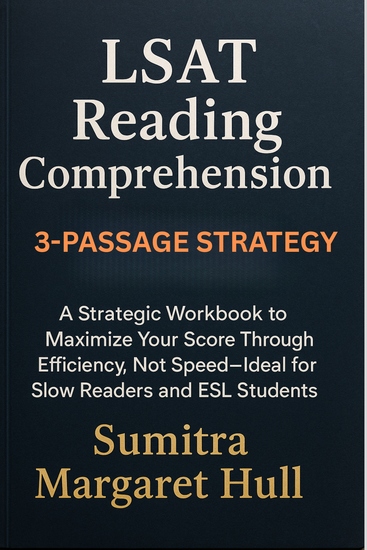
LSAT Reading Comprehension 3-Passage Strategy - A Strategic Workbook to Maximize Your Score Through Efficiency Not Speed—Ideal for Slow Readers and ESL Students - cover

LSAT Reading Comprehension 3-Passage Strategy - A Strategic Workbook to Maximize Your Score Through Efficiency Not Speed—Ideal for Slow Readers and ESL Students

Sumitra Margaret Hull

Publisher: Jstone Publishing

  • 0
  • 0
  • 0

Summary

LSAT Reading Comprehension: 3-Passage Strategy
 
A Strategic Workbook to Maximize Your Score Through Efficiency, Not Speed—Ideal for Slow Readers and ESL Students
 
Transform your approach to LSAT Reading Comprehension with a revolutionary strategy designed specifically for test-takers who need more time to process complex academic texts. This comprehensive workbook challenges the myth that you must read faster to succeed and instead focuses on maximizing accuracy through strategic efficiency.
 
Stop trying to finish everything. Start maximizing your score.
 
This systematic methodology introduces the game-changing 3-Passage Strategy, allowing you to achieve competitive scores by focusing on three passages instead of rushing through four. Learn to redefine success on the RC section through strategic triage, structural reading techniques, and targeted question attack methods.
 
What You'll Master:
 
Strategic passage evaluation and time management techniques
 
"Low-Resolution" reading methods that capture essential structure while ignoring distracting details
 
Systematic question categorization and attack strategies
 
Process of elimination mastery for trap answer identification
 
Academic vocabulary and complex syntax decoding
 
Anxiety management and optimal pacing development
 
Perfect for:
 
Students who identify as slow readers
 
ESL students navigating complex academic English
 
Test-takers seeking strategic alternatives to speed reading
 
Anyone struggling with RC time management
 
Progressive Training System: From untimed accuracy building to full-section implementation, this workbook provides a complete step-by-step training program. The innovative "Step-Down Method" gradually introduces time pressure while maintaining accuracy, helping you find your optimal pace without sacrificing comprehension.
 
Evidence-Based Techniques: Every strategy is grounded in cognitive science research on reading comprehension, working memory, and test anxiety. This isn't about shortcuts—it's about working smarter within your natural reading capabilities.
 
Includes:
 
Detailed methodology explanations with real examples
 
Progressive drill sets for skill building
 
Full section implementation strategies
 
Emergency techniques for difficult passages
 
Comprehensive review checklists
 
Stop fighting your reading speed. Start leveraging your analytical strengths. This workbook proves that accuracy and strategy trump speed every time.
Available since: 09/12/2025.
Print length: 158 pages.

Other books that might interest you

  • The Unindexed Mind Footnotes from the Storm - cover

    The Unindexed Mind Footnotes...

    Tory Handcock

    • 0
    • 0
    • 0
    The Unindexed Mind: Footnotes from the Storm is the follow-up to the original chaos—part journal, part philosophy, part stand-up set written in the eye of a hurricane. This isn't self-help. It's self-interrogation. These are rants, reflections, and stories collected from the trenches of working-class America and the cluttered corners of a mind that refuses to be simplified. From conspiracy logic to retail breakdowns, from profound loneliness to sudden laughter in the face of it—this is not a polished manifesto. It's a footnote collection from a storm you didn't know you were in. If you're tired of curated wisdom and sanitized thinking, step inside. This book won't save you. But it might help you feel a little less insane.
    Show book
  • Both Not Half - 'Few people write about identity with such fluency and sincerity' SATHNAM SANGHERA - cover

    Both Not Half - 'Few people...

    Jassa Ahluwali

    • 0
    • 0
    • 0
    GOLD WINNER OF 'BEST NARRATOR' AT THE AUDIO PRODUCTION AWARDS. 'This guy has better Punjabi than both of us and he's only half Punjabi.' Only. Half. I stared at those words. The intent behind the comment was in no way malicious, but it hurt. I felt diminished. I felt like I was being robbed of something essential to me. And as I stared at my screen, realisation dawned. '#bothnothalf' I replied. For over twenty-five years, actor Jassa Ahluwalia described himself as 'half Indian, half English'. His fluent Punjabi always prompted bewilderment, medical staff questioned the legitimacy of his name, and the world of casting taught him he wasn't 'the right kind of mixed-race'. Feeling caught between two worlds, it wasn't long before Jassa embarked on a call to action: we need to change how we think and talk about mixed identity. By delving into the media we grew up consuming and the legacies of empire we have been taught, Ahluwalia asks: is there anything to be learnt from Rudyard Kipling? Why were movie stars urged to hide their mixed identities? To what extent did colonialism encourage or hinder mixed marriages? Is nationalism outdated? How can the politics of class and queer liberation inform our understanding of mixed identity? Both Not Half is a rallying cry for a new and inclusive future. It's a journey of self-discovery that unearths the historical roots of modern mixed identity as we know it, braving to deconstruct the binaries we have inherited and the narratives we passively accept. Part-memoir, part-manifesto: this is a campaign for belonging in a divided world.This immersive audiobook includes exclusive audio clips from Jassa 's Ted Talk, original audio from self-tapes, a bonus conversation with his sister Ramanique Ahluwalia, and much more.
    Show book
  • The New Middle East - What Everyone Needs to Know® - cover

    The New Middle East - What...

    James L. Gelvin

    • 0
    • 0
    • 0
    In the second edition of The New Middle East, renowned scholar James L. Gelvin explains how in the aftermath of the collapse of the USSR, the American invasion of Iraq, and the Arab uprisings of 2010-11, a new Middle East has emerged. Syria, Libya, and Yemen have become "crisis states," where warlords vie against governments and each other. The economies of Iran, Turkey, and Lebanon, weakened by corruption, sanctions, and neoliberal economic policies, have imploded. Some states have doubled-down on repression, while others intervene in the internal affairs of their neighbors with impunity. 


    This edition explores these hallmarks of the New Middle East, along with the end of American hegemony in the region, the expansion of "conflict zones," the continued centrality of the Saudi-Iranian competition, and the ramifications of the breakdown of the Israel-Palestine peace process. It also highlights the crisis of human security brought on by the COVID-19 pandemic, bad governance, stagnant economies, poor healthcare and educational delivery systems, climate change, food and water insecurity, population growth and imbalance, and the unprecedented displacement of populations. Gelvin outlines the social, political, and economic contours of the New Middle East, illuminating the current crisis in the region and exploring how it is likely to evolve in the decades to come.
    Show book
  • Disappearance of the Surcouf The: The Mysterious Sinking of the Allies’ Largest Submarine during World War II - cover

    Disappearance of the Surcouf...

    Editors Charles River

    • 0
    • 0
    • 0
    When the Surcouf launched in 1929, it was a technological marvel. This wasn’t a conventional submarine at all, but a 3,300-ton, 300-foot-long submersible light cruiser. Armed not just with torpedoes but also a pair of eight-inch guns, the Surcouf had a range of over 10,000 miles and was equipped with a seaplane in a hanger and a prison capable of holding up to 40 prisoners. When it was launched, the submarine looked like something out of the novels of Jules Verne, and many people believed it would make all existing submarines (and many surface warships) obsolete. However, by the time France found itself at war with Nazi Germany in 1939, the Surcouf was outdated and basically irrelevant, though it was still in active service with the French Navy. 
    When France was defeated by Nazi Germany in June 1940, the majority of French troops and warships ceased fighting. However, some relocated to Britain, the only nation still fighting Germany, to join Free French forces under the command of the charismatic General Charles De Gaulle. The crew of the Surcouf joined the Free French Navy and served from late 1940 to February 1942, when she called in at the British port of Bermuda before sailing for the island of Tahiti, French Polynesia, in the South Pacific. On February 12, the Surcouf left Bermuda en route for Tahiti via the Panama Canal and was never seen again. 
    There have been many theories about what might have happened to the Surcouf and her 130-man crew, ranging from an accidental collision to sabotage and even accidental (or deliberate) attacks by her allies. As a result, the fate of the Surcouf has become one of the most enduring and baffling maritime mysteries, and it still generates a great deal of debate.
    Show book
  • A Treatise of Human Nature Book 2 - cover

    A Treatise of Human Nature Book 2

    David Hume

    • 0
    • 0
    • 0
    David Hume's "A Treatise of Human Nature" is a monumental work that reshapes the landscape of philosophy by examining the foundations of human understanding. Through astute analysis, Hume investigates the nature of cognition, emotion, and morality, introducing the revolutionary concept of empiricism—that all knowledge stems from sensory experience. This treatise challenges traditional thought, questioning the limits of reason and the essence of human experience, influencing generations to come.
    Show book
  • A Haunted Walk Through Tudor London - An Immersive Historical Audio Experience - cover

    A Haunted Walk Through Tudor...

    Heather Teysko

    • 0
    • 0
    • 0
    Step into the fog-shrouded streets of 16th-century London. 
    A Haunted Walk Through Tudor London is a 30-minute immersive audio experience that guides listeners through the city as it existed during the Tudor era, from the Tower of London to Smithfield Market, from the witches’ quarter at Bishopsgate to the execution ground at Tyburn, and along the shadowed banks of the River Thames. 
    This is not a ghost story in the modern sense. Instead, it is a historically grounded, atmospheric walk through the places where Tudor Londoners lived, feared, believed, and died, told by candlelight, with subtle sound design and careful attention to historical detail. 
    Along the way, you’ll encounter:The restless spirits of queens and traitors at the Tower of LondonThe vanished bells and bookstalls of old St Paul’sThe fires of faith at Smithfield MarketTudor beliefs about witchcraft, cunning women, and familiar spiritsThe theatres and sins of BanksideThe grim spectacle of Tyburn TreeAnd the river that carried London’s memory, the Thames 
    The walk is narrated by Heather Teysko, host of the long-running Renaissance English History Podcast, the original Tudor history podcast, with millions of downloads worldwide. Heather has been sharing Tudor history since 2009 and is known for bringing the period to life through vivid storytelling, deep research, and an accessible, conversational style. 
    Whether listened to at Halloween or on a quiet winter evening, this audio experience invites you to slow down, imagine the city as the Tudors knew it, and walk through history in a way that feels intimate, reflective, and unforgettable.
    Show book