Join us on a literary world trip!
Add this book to bookshelf
Grey
Write a new comment Default profile 50px
Grey
Subscribe to read the full book or read the first pages for free!
All characters reduced
Delphi Complete Works of Sulpicius Severus Illustrated - cover

Delphi Complete Works of Sulpicius Severus Illustrated

Sulpicius Severus

Publisher: Delphi Publishing Ltd

  • 0
  • 0
  • 0

Summary

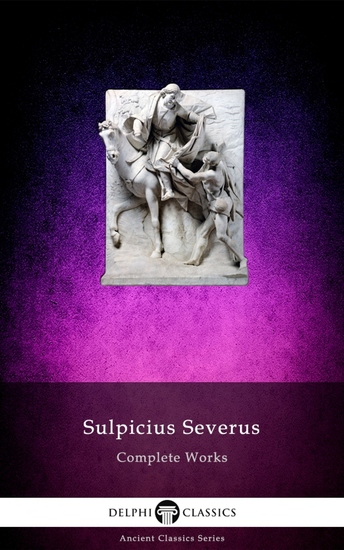
A fourth century Christian ascetic, Sulpicius Severus is an important authority for Gallo-Roman history and the most graceful writer of his time. His most famous work is a biography of Saint Martin of Tours, of whom he was a disciple and his most famous hagiographer. He also wrote an influential ‘Sacred History’, narrating events from the Creation to his own time, while omitting the Gospels. Sulpicius’ ‘Dialogues’ are a literary masterpiece in which the relative merits of Martin’s monastery are debated by one of its inmates with a traveller, who has recently returned to Aquitania from the ascetics of the North African desert. Delphi’s Ancient Classics series provides eReaders with the wisdom of the Classical world, offering both English translations and the original Latin texts.  This eBook presents Sulpicius’ complete works, with illustrations, informative introductions and the usual Delphi bonus material. (Version 1)

 
* Beautifully illustrated with images relating to Sulpicius’ life and works* Features the complete extant works of Sulpicius, in both English translation and the original Latin* Concise introductions to the author* Includes Alexander Roberts’ translation for ‘Nicene and Post-Nicene Fathers: Series II’, Volume XI, 1885 * Excellent formatting of the texts* Easily locate the sections you want to read with individual contents tables* Includes rare spurious works* Provides a special dual English and Latin text, allowing readers to compare the sections paragraph by paragraph — ideal for classical students* Features two bonus biographies, including Gennadius’ first biography of the ascetic — discover Sulpicius’ ancient world

 
CONTENTS:

 
The TranslationsBrief Introduction: Sulpitius Severus (1885) by Alexander RobertsSacred HistoryOn the Life of Saint MartinLettersDialoguesDoubtful Letters

 
The Latin TextsList of Latin Texts

 
The Dual TextsDual Latin and English Texts

 
The BiographiesSeverus the Presbyter (c. 470) by Gennadius of ConstantinopleSulpicius Severus (1911)
Available since: 12/17/2024.
Print length: 1216 pages.

Other books that might interest you

  • The Shakespeare Conundrum - Examining the True Identity of the Literary Genius - cover

    The Shakespeare Conundrum -...

    John Harpoon

    • 0
    • 0
    • 0
    The question of who wrote the works attributed to William Shakespeare has intrigued scholars, historians, and literary enthusiasts for centuries. Despite being one of the most celebrated figures in the world of literature, Shakespeare’s true identity remains a subject of mystery. The sheer volume of his works, their profound depth, and the complexity of their themes have led many to wonder whether the man from Stratford-upon-Avon was truly the author of the plays and sonnets that bear his name. This uncertainty has given rise to one of the most enduring and controversial debates in literary history: the Shakespeare authorship question. 
      
    The core of this mystery lies in the limited biographical information available about Shakespeare’s life. Born in 1564 in Stratford-upon-Avon, Shakespeare’s early years remain largely undocumented, with no personal manuscripts or letters bearing his signature. The surviving records of his life mainly consist of legal documents, such as his marriage license, business transactions, and his will. While these historical artifacts confirm his existence and some of his professional endeavors, they provide little insight into his intellectual and literary development. For a figure of his stature, this absence of personal evidence is startling, leading some to question whether the “Stratford man” could have truly written the works attributed to him. 
      
    In the absence of definitive evidence, a number of alternative theories have emerged, suggesting that another writer, or group of writers, may have been responsible for Shakespeare’s remarkable body of work. These theories have ranged from the claim that the works were penned by an aristocrat such as Francis Bacon, to the suggestion that the true author was the playwright Christopher Marlowe, whose death in 1593 has been disputed by some.
    Show book
  • Please Sit Over There - How to Manage Power Overcome Exclusion and Succeed as a Black Woman at Work - cover

    Please Sit Over There - How to...

    Francine Parham

    • 0
    • 0
    • 0
    The key to your career advancement is understanding how power works--who has it, where it hides, and how it's used. Please Sit Over There teaches Black women the career skills they need to navigate an uneven playing field and achieve long-lasting professional success. 
     
    Black women continuously navigate systems that were never intended for them while using a set of rules that was never designed for them. There are so many unwritten rules of power still at play in professional organizations that repeatedly hinder Black women in their career development and overall workplace experiences. 
     
    In this book, Francine Parham shares her knowledge as a former Black female global executive of two major corporations on how to move up in the workplace while maintaining a sense of sanity. The first section lays the foundation for understanding power dynamics, while the second section shows how to "shift the power" as a professional Black woman. Finally, the third section helps readers to pinpoint and navigate the particulars of an organization's flawed systems and processes so they can advance to the next professional level. 
     
    Please Sit Over There honors the painstaking work being undertaken to deconstruct broken institutions and demonstrates how Black women can achieve their goals while those institutions still exist-effectively opening doors for all women of color to come.
    Show book
  • Deep Reading - Practices to Subvert the Vices of Our Distracted Hostile and Consumeristic Age - cover

    Deep Reading - Practices to...

    Rachel M. De Smith Roberts,...

    • 0
    • 0
    • 0
    This book helps readers develop practices that will result in deep, formative, and faithful reading so they can contribute to the flourishing of their communities and cultivate their own spiritual and intellectual depth. 


    The authors present reading as a remedy for three prevalent cultural vices—distraction, hostility, and consumerism—that impact the possibility of formative reading. Informed by James K. A. Smith's work on "the spiritual power of habit," Deep Reading provides resources for engaging in formative and culturally subversive reading practices that teach readers how to resist vices, love virtue, and desire the good. 


    Rather than emphasizing the spiritual benefits of reading specific texts such as Dante's Divine Comedy or Adventures of Huckleberry Finn, the authors focus on the practice of reading itself. They examine practices many teachers, students, and avid readers employ—such as reading lists, reading logs, and discussion—and demonstrate how such practices can be more effectively and intentionally harnessed to result in deepreading. The practices apply to any work that is meant to be read deeply.
    Show book
  • Sartor Resartus - cover

    Sartor Resartus

    Thomas Carlyle

    • 0
    • 0
    • 0
    Sartor Resartus is one of the most unusual, even quirky, British novels to emerge from the first half of the 19th century. Published in 1836, its varied heritage reflects the earlier eccentricities of Sterne and Swift, curiously mixed with influences from Goethe. 
     
    Its subject matter is strange: it concerns a book called Clothes: Their Origin and Influence by one Diogenes Teufelsdröckh, a German philosopher. And though Thomas Carlyle (1795-1881) became a household name in his lifetime, especially for his essays, and his work as an historian and philosopher, his comic novel Sartor Resartus would prove to have a lasting effect on contemporary writers. American figures in particular - Emerson, Dickinson, Melville and Twain among them - acknowledged its influence. 
     
    In addition, Jorge Luis Borges was among the 20th-century writers to salute the work, which he encountered aged 17. Borges reflects: 'I read Sartor Resartus, and I can recall many of its pages; I know them by heart.' Sartor Resartus (which means 'The Tailor Re-tailored') chronicles the struggles of an unnamed editor attempting to produce an English-language edition of a publication, which, according to the man who has sent it to him, is 'a work of philosophy which has taken all Europe by storm'. 
     
    This is the book on clothes by Teufelsdröckh, with whom the editor was briefly acquainted on his travels. However, the more vigorously the editor sets himself to his task, the more thankless and perhaps impossible it proves. In frustration, he shares fragments of the translated work with his readers, in the search for some collective insight. When a biography of the author arrives, promising to bring some context to the work, the editor finds himself even further at a loss. His trust in Teufelsdröckh begins to unravel, and he becomes suspicious that nothing about this book, not even its author, is as it appears to be. Is it a work of genius? A palimpsest with a secret hidden in its depths? Or is the editor in receipt of something completely different and wholly unexpected? Sartor Resartus may now largely exist in the shadows of On Heroes, Hero-Worship, and the Heroic in History, and his account of the French Revolution, but this early novel represents an interesting phase in Carlyle’s literary output.
    Show book
  • Notorious Memphis Gangster Diggs Nolen - cover

    Notorious Memphis Gangster Diggs...

    Mr. Patrick O'Daniel

    • 0
    • 0
    • 0
    The Memphis Underworld King   Diggs Nolen's name was the byword for crime in 1920s Memphis. As a child, he dreamed of becoming a swashbuckling outlaw. He turned his back on a promising career, his family and consorted with the worst elements of society. Under the tutelage of train robber Frank Holloway, Nolen became a notorious con artist. Later, he and his gun-slinging wife built an empire out of selling narcotics and trafficking stolen goods. Law enforcement caught Nolen, but they could not hold him. Nolen escaped from Leavenworth Prison, led the largest jailbreak in Memphis history and confounded prosecutors with legal wranglings. Author Patrick O'Daniel details Nolen's quixotic quest for criminal fame that earned him the title King of the Memphis Underworld.
    Show book
  • Penalty Strike - The Memoirs of a Red Army Penal Company Commander 1943–45 - cover

    Penalty Strike - The Memoirs of...

    Alexander V Pyl'cyn

    • 0
    • 0
    • 0
    A WWII Soviet officer recalls leading a battalion of convict-soldiers in this rare firsthand account of a Red Army penal unit. Alexander Pyl’cyn was eighteen years old when he was drafted into the Red Army in 1941. He went on to serve with great distinction, earing the Order of the Red Banner, the Order of the Great Patriotic War, and the Order of the Red Star for his actions during the war. As the commander of a penal battalion on the Eastern Front, he led an unruly band of convict-soldiers, Gulag prisoners, and former Soviet POWs deemed untrustworthy.   Relegated to the most difficult and dangerous assignments, Pyl’cyn’s unit was called up to break through the enemy’s defenses. He led his penal unit through the Soviets’ massive offensive in the summer of 1944, the Vistula-Oder operation into eastern Germany, and the bitter assault on Berlin in 1945. Though his men suffered massive casualties, and he himself withstood multiple wounds, he survived the war to tell this incredible story.
    Show book