Join us on a literary world trip!
Add this book to bookshelf
Grey
Write a new comment Default profile 50px
Grey
Subscribe to read the full book or read the first pages for free!
All characters reduced
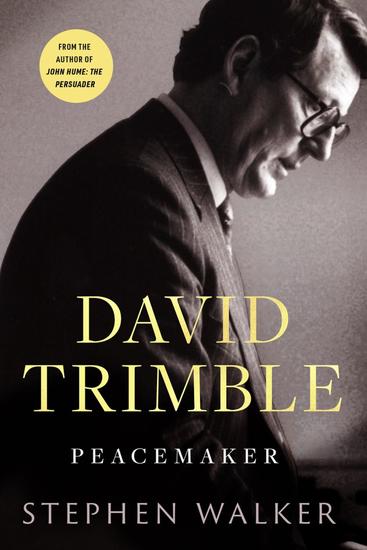
David Trimble: Peacemaker - cover

David Trimble: Peacemaker

Stephen Walker

Publisher: Gill Books

  • 1
  • 0
  • 0

Summary

Nobel laureate, party leader, peacemaker, first minister and statesman – David Trimble had many roles. But what is the real story behind the man who made headlines and changed lives?
In this definitive biography of Trimble's life and death, award-winning journalist Stephen Walker vividly details how a shy Belfast academic changed the political landscape of Northern Ireland.
Written with the cooperation of his widow, Lady Trimble, and their grown-up children, Peacemaker offers unparalleled insights into the life of the first person to be elected first minister of Northern Ireland and the most significant unionist leader since the creation of Northern Ireland in 1921. From the beginning of his political career in the dark days of the Troubles, to bringing unionism and nationalism together to end decades of division and violence and secure peace, Trimble's personal journey mirrors the story of Northern Ireland itself.
Drawing on over 100 fresh interviews, this is a colourful and personal account of the life of a key figure in Irish history and an essential companion to Stephen Walker's bestselling biography of John Hume.
Available since: 09/11/2025.
Print length: 464 pages.

Other books that might interest you

  • Project Mind Control - Sidney Gottlieb the CIA and the Tragedy of MKULTRA - cover

    Project Mind Control - Sidney...

    John Lisle

    • 0
    • 0
    • 0
    The inside story of the CIA’s secret mind control project, MKULTRA, using never-before-seen testimony from the perpetrators themselves.Sidney Gottlieb was the CIA’s most cunning chemist. As head of the infamous MKULTRA project, he oversaw an assortment of dangerous—even deadly—experiments. Among them: dosing unwitting strangers with mind-bending drugs, torturing mental patients through sensory deprivation, and steering the movements of animals via electrodes implanted into their brains. His goal was to develop methods of mind control that could turn someone into a real-life “Manchurian candidate.” In conjunction with MKULTRA, Gottlieb also plotted the assassination of foreign leaders and created spy gear for undercover agents. The details of his career, however, have long been shrouded in mystery. Upon retiring from the CIA in 1973, he tossed his files into an incinerator. As a result, much of what happened under MKULTRA was thought to be lost—until now.Historian John Lisle has uncovered dozens of depositions containing new information about MKULTRA, straight from the mouths of its perpetrators. For the first time, Gottlieb and his underlings divulge what they did, why they did it, how they got away with it, and much more. Additionally, Lisle highlights the dramatic story of MKULTRA’s victims, from their terrible treatment to their dogged pursuit of justice.The consequences of MKULTRA still reverberate throughout American society. Project Mind Control is the definitive account of this most disturbing of chapters in CIA history."Listeners will be transfixed" —AudioFile on The Dirty Tricks DepartmentA Macmillan Audio production from St. Martin’s Press.
    Show book
  • Undermining the US Constitution - How the communist manifesto of 1848 blueprints the actions of the democratic party - cover

    Undermining the US Constitution...

    Diane S. Vann

    • 0
    • 0
    • 0
    As a nurse I have been in situations where patients learned very bad news about the state of their health, news that was not received well by them, their families, or even their medical team. When preparing this book, my feelings were much the same as when I was in those situations.The bad news about the health of our nation is, like cancer in a patient's body, communism (also known as "Marxism") has grown in the United States. Like cancer, it started with an unnoticed seed and grew insidiously with little sign or symptom. Now like cancer, communism is on the brink of overwhelming us.Because I know that knowledge of their cancer is essential to my patient's first step towards survival, I believe that knowledge of our communism is essential to the United States of America's first step towards survival. So within this book, I describe: how I learned about the symptoms (The Real Communist Threat Witnessed); the disease (the Introduction and Sections 1, 2, 3 and 4 of the Communist Manifesto); the signs and symptoms and the treatment and cure (Constitution versus Communist Manifesto: The War within America).Extremist Socialists, also known as Communists, like Extremist/Radical Islamists believe their ends justify their means (that is: lying, cheating, stealing, and killing). Beware of their joint product, Interfaith Dialogue.
    Show book
  • The Coronation - cover

    The Coronation

    Charles Eisenstein

    • 0
    • 0
    • 0
    Renowned public speaker, bestselling author, social critic, and activist Charles Eisenstein offers a way forward from our present moment through a series of unforgettable essays that give us a new model of sense-making. Through a series of piercing essays, The Coronation takes listeners through the initiation of the Covid era?exploring topics like despair, hope, courage, division, and reunion?in this stunning collection. Paired with each essay is the author’s commentary locating the essay in a social, political, and spiritual journey. After all, it wasn’t only outward normality that the pandemic disrupted. Of all the social crises that COVID-19 has revealed, The Coronation addresses the most profound: the crisis in our sense-making. An old reality has disintegrated. This book reveals just how deep that breakdown is. Acknowledging it, we might build something more sound, more whole, and more sane. Underneath the shifting sands of the arguments and narratives, something else calls to us: the possibility of renewal, a revolution in the agreements and myths that organize society. *Individually, these essays have been read, shared, and discussed by tens of thousands of people around the globe, but they are collected together here for the first time!
    Show book
  • Our Common Cause - Establishing the Political Power We Lack - cover

    Our Common Cause - Establishing...

    Étienne Chouard

    • 0
    • 0
    • 0
    I want to talk to you about democracy. The real one. The one that does not exist, and the one we really need today. My research method is that of Hippocrates, who said, look for the cause of causes. In other words, to cure a disease, to solve a problem, it is useless to attack the consequences, it is useless to attack the different causes. There is always a determining cause (the one that determines all the others)—and that is our common cause.
    The first decisive battle is to push the important words "right side up":
    First. I am not a "citizen" (a citizen is autonomous; he votes himself his laws). I am only a "voter;" that is to say, a political child—because I am subject to the law voted into existence by someone other than me.
    Second. My "parents" in politics, the elected officials, do not want me to emancipate myself from them—they do not allow me to vote for or against the laws to which I have to submit myself.
    We are "the incompetents." They treat us like children. But it is our fault, because children also believe in "Santa Claus," and so voters believe in "universal suffrage," which we accept to call "democracy" (demos kratos, power belongs to the people). The so-called modern "democracy".
    Show book
  • Picking Presidents - How to Make the Most Consequential Decision in the World - cover

    Picking Presidents - How to Make...

    Gautam Mukunda

    • 0
    • 0
    • 0
    Celebrated leadership expert and political scientist Gautam Mukunda provides a comprehensive, objective, and non-partisan method for answering the most important question in the world: is someone up to the job of president of the United States? 


    In Picking Presidents, Gautam Mukunda sets his sights on presidential candidates, proposing a tested method to assess whether they will succeed or fail if they win the White House. Combining political science, psychology, organizational behavior, and economics, Picking Presidents will enable every American to cast an informed vote. 


    In his 2012 book Indispensable, which all but predicted the Trump presidency, Mukunda explained how both the very best and very worst leaders are "unfiltered"—outsiders who take power without the understanding or support of traditional elites. Picking Presidents provides deep analysis of filtered and unfiltered presidents alike, from failed haberdasher and skillful president Harry Truman, to the exceptionally well-qualified—and ultimately reviled—James Buchanan; from Andrew Johnson, who set civil rights back by a century, to Theodore Roosevelt, who evaded party opposition to transform American society. Picking Presidents lays out a clear framework that anyone can use to judge a candidate and answer the all-important question: are they up to the job?
    Show book
  • The Power of Citizenship - Why John F Kennedy Matters to a New Generation - cover

    The Power of Citizenship - Why...

    Scott D. Reich

    • 0
    • 0
    • 0
    Fifty years after John F. Kennedy's death, we find ourselves enmeshed in an era of political division and cynicism, where politicians talk past one another and the spirit of “Ask not what your country can do for you—ask what you can do for your country"" is less visible than it should be. We seem to have forgotten that we're all on the same team. Fortunately, Scott D. Reich has given us The Power of Citizenship, a timely book to bring us back on track. 
    Reich asserts that the most powerful element of Kennedy's legacy is his emphasis on the theme of citizenship, and that a rededication to the values Kennedy promoted will shine a bright path forward for our country. Evoking the hopes and aspirations of the 1960s, Reich recaptures the excitement of the Kennedy era. But what truly sets this book apart is the unique way it blends the romance of Camelot with the new frontiers of today—not only identifying modern challenges, but also offering a tangible blueprint for how we can improve our public discourse, be good citizens, and lift our nation to new heights of greatness. 
    Part history and part call to action, The Power of Citizenship hones in on the very essence of what made JFK so inspirational and timeless, reminding us once again that we must ask what we can do for our country. This is a must-read for Americans of all generations.
    Show book