Join us on a literary world trip!
Add this book to bookshelf
Grey
Write a new comment Default profile 50px
Grey
Subscribe to read the full book or read the first pages for free!
All characters reduced
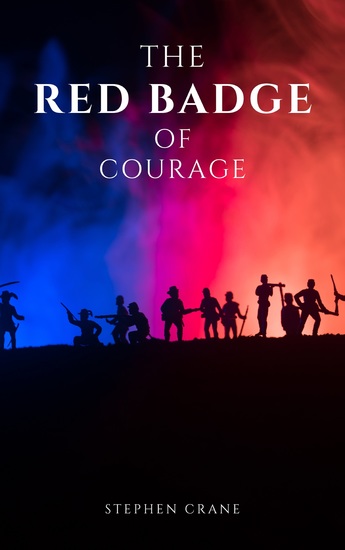
The Red Badge of Courage by Stephen Crane - A Gripping Tale of Courage Fear and the Human Experience in the Face of War - cover

The Red Badge of Courage by Stephen Crane - A Gripping Tale of Courage Fear and the Human Experience in the Face of War

Stephen Crane, Bluefire Books

Publisher: Bluefire Books

  • 0
  • 0
  • 0

Summary

Experience the raw emotions and psychological turmoil of a young soldier in "The Red Badge of Courage" by Stephen Crane, a groundbreaking novel that explores the realities of war and the depths of human courage. Set during the American Civil War, this literary classic offers a captivating glimpse into the internal struggles of a young man coming to terms with fear, bravery, and self-discovery.

Follow the journey of Henry Fleming, a young Union soldier who dreams of the glory of war but soon finds himself grappling with the harsh realities of battle. As he confronts his own fears and insecurities, Henry embarks on a path of personal growth and self-understanding. Through vivid imagery and powerful storytelling, Crane provides an intimate portrayal of the human spirit in the face of conflict.

"The Red Badge of Courage" is a poignant and thought-provoking novel that has captivated readers for generations with its realistic portrayal of the psychological impact of war. Perfect for students, history enthusiasts, and lovers of classic literature, this book is an essential addition to any collection.

Don't miss the opportunity to own this profound tale of courage and self-discovery set against the backdrop of the American Civil War. Get your copy of "The Red Badge of Courage" by Stephen Crane today and immerse yourself in this unforgettable journey of the human spirit!
Available since: 04/10/2023.
Print length: 90 pages.


Other books that might interest you

  • The Shrinking Goddess - Power Myth and the Female Body - cover

    The Shrinking Goddess - Power...

    Mineke Schipper

    • 0
    • 0
    • 0
    Wild and strange stories have been told about the female body since antiquity. While tales of poisoned hymens and witches with multiple breasts circulated, the first creation figure, Mother Earth, fell out of popular culture. Ranging from the empowering to the absurd, ancient myths about women's bodies have not only survived into the twenty-first century but continue to influence modern discourse.The Shrinking Goddess brings together myths about the female form and traces subsequent male efforts to 'tame' it. Mineke Schipper explores how women's bodies have been represented around the world, from the demon daughter of New Mexico with a toothed vagina, to the Japanese supermarkets and European festivals where 'breast puddings' are considered delicaciesDrawing from the vast reservoir of writing and art that shape how women are seen in today's world, The Shrinking Goddess reclaims the female body as a source of power.
    Show book
  • The Loss Prescription - cover

    The Loss Prescription

    Dr Chloe Paidoussis-Mitchell

    • 0
    • 0
    • 0
    'Dr Chloe helped me understand how to grieve and keep living, how to find the light in the darkest of days. I know this book will be of great comfort to many.' Zoe Ball 
    Nobody gets through life free from the pain of loss. 
    However, we aren’t very good at processing what grief does to us. If left unchecked, it can seriously damage our mental health. 
    In this book, chartered psychologist and trauma counsellor Dr Chloe Paidoussis-Mitchell offers a roadmap for grief recovery. With guidance drawn from her decades of clinical experience and work with clients, plus a series of practical tools and exercises, she will help you work through your loss so you can embrace life with hope again. 
    This is an expert source of support for anyone seeking light in the dark after loss. 
    Dr Chloe Paidoussis-Mitchell, a renowned psychologist, delves deep into the realms of grief, bereavement, and the psychology of loss. Her expertise in the field of non-fiction self-help guides shines through as she navigates the complex web of emotions surrounding death, separation, and divorce. 
    For fans of Megan Devine (How to Carry What Can't Be Fixed), Joshua Fletcher (And How Does That Make You Feel?), Donna Ashworth (Growing Brave), Sally Douglas (Good Mourning), and Matt Haig (The Comfort Book). 
    HarperCollins 2024
    Show book
  • Stable Weight - A Memoir of Hunger Horses and Hope - cover

    Stable Weight - A Memoir of...

    Lisa Whalen

    • 0
    • 0
    • 0
    Stable Weight is a story of resilience, empowerment, and the transformative power of the human-animal bond, revealing how even the most sensitive soul can ditch being a good girl for becoming an independent woman.  
    One minute, Lisa Whalen was leaping fences on horseback. The next, she was splayed in the sand, mirroring a fall at age 16 that ended in a psych ward. Whalen chased perfection in the form of an eating disorder, to the brink of suicide. Treatment helped, but her turnaround came from meeting 10 special horses. They challenged her to love her body, live in the moment, and face her fears.
    Show book
  • The Republic - cover

    The Republic

    Plato

    • 0
    • 0
    • 0
    The Republic (Greek: Politeia) is a Socratic dialogue, written by Plato around 380 BC, concerning the definition of (justice), the order and character of the just city-state and the just man, reason by which ancient readers used the name On Justice as an alternative title (not to be confused with the spurious dialogue also titled On Justice). The dramatic date of the dialogue has been much debated and though it must take place some time during the Peloponnesian War, "there would be jarring anachronisms if any of the candidate specific dates between 432 and 404 were assigned".    It is Plato's best-known work and has proven to be one of the most intellectually and historically influential works of philosophy and political theory. In it, Socrates along with various Athenians and foreigners discuss the meaning of justice and examine whether or not the just man is happier than the unjust man by considering a series of different cities coming into existence "in speech", culminating in a city (Kallipolis) ruled by philosopher-kings; and by examining the nature of existing regimes.    The participants also discuss the theory of forms, the immortality of the soul, and the roles of the philosopher and of poetry in society. Short Summary (Epilogue): X.1—X.8. 595a—608b. Rejection of Mimetic Art X.9—X.11. 608c—612a. Immortality of the Soul X.12. 612a—613e. Rewards of Justice in Life X.13—X.16. 613e—621d. Judgment of the Dead The paradigm of the city — the idea of the Good, the Agathon — has manifold historical embodiments, undertaken by those who have seen the Agathon, and are ordered via the vision. The centre piece of the Republic, Part II, nos. 2–3, discusses the rule of the philosopher, and the vision of the Agathon with the allegory of the cave, which is clarified in the theory of forms.    The centre piece is preceded and followed by the discussion of the means that will secure a well-ordered polis (City). Part II, no. 1, concerns marriage, the community of people and goods for the Guardians, and the restraints on warfare among the Hellenes. It describes a partially communistic polis. Part II, no. 4, deals with the philosophical education of the rulers who will preserve the order and character of the city-state. In Part II, the Embodiment of the Idea, is preceded by the establishment of the economic and social orders of a polis (Part I), followed by an analysis (Part III) of the decline the order must traverse. The three parts compose the main body of the dialogues, with their discussions of the "paradigm", its embodiment, its genesis, and its decline. The Introduction and the Conclusion are the frame for the body of the Republic.    The discussion of right order is occasioned by the questions: "Is Justice better than Injustice?" and "Will an Unjust man fare better than a Just man?" The introductory question is balanced by the concluding answer: "Justice is preferable to Injustice". In turn, the foregoing are framed with the Prologue (Book I) and the Epilogue (Book X). The prologue is a short dialogue about the common public doxai (opinions) about "Justice". Based upon faith, and not reason, the Epilogue describes the new arts and the immortality of the soul.
    Show book
  • The Dialectical Behavior Therapy Skills Workbook for CPTSD - Heal from Complex Post-Traumatic Stress Disorder Find Emotional Balance and Take Back Your Life - cover

    The Dialectical Behavior Therapy...

    MSW Sheri Van Dijk

    • 0
    • 0
    • 0
    Powerful and evidence-based dialectical behavior therapy (DBT) skills to help you heal from traumas, balance emotions, and feel safe in the present moment. 


    If you've experienced chronic, multiple, or ongoing instances of trauma, you may be experiencing complex post-traumatic stress disorder, or C-PTSD—and one-size-fits-all treatment methods just aren't enough. In this evidence-based workbook, dialectical behavior therapy (DBT) expert Sheri Van Dijk combines cutting-edge research and evidence-based skills to help you feel safer and more stable, and recognize and reconcile traumas, so you can take charge of your life. 


    Based in DBT, polyvagal theory, and other proven-effective modalities, this powerful and accessible workbook will help you process and manage intense emotions, free yourself from self-destructive behaviors, and feel more stable—and safe—in the present. 


    What happened to you in your past wasn't your fault, and it doesn't have to define your future. Drawing on the best practices of DBT and polyvagal theory, this vital workbook will help you begin healing and reclaim wholeness.
    Show book
  • Secrets Lies and Consequences - A Great Scholar's Hidden Past and his Protégé's Unsolved Murder - cover

    Secrets Lies and Consequences -...

    Bruce Lincoln

    • 0
    • 0
    • 0
    In 1991, Ioan Culianu was on the precipice of a brilliant academic career. Culianu had fled his native Romania and established himself as a widely admired scholar at just forty-one years old. He was teaching at the University of Chicago Divinity School where he was seen as the heir apparent to his mentor, Mircea Eliade, a fellow Romanian expatriate and the founding father of the field of religious studies, who had died a few years earlier. When Culianu began to receive threatening messages, he asked a colleague to hold onto some papers for safekeeping. A week later someone fired a bullet into the back of his head, killing him instantly. The case was never solved, though the prevailing theory is that Culianu was targeted by the Romanian secret police as a result of critical articles he wrote after the fall of Nicolae Ceausescu. 


    What was in those papers and what connection might they have to Culianu's death? The papers eventually passed into the hands of Bruce Lincoln, and their story is at the heart of this book. The documents were English translations of articles that Eliade wrote in the 1930s, some of which voiced Eliade's support for the Iron Guard. Bruce Lincoln explores what the articles reveal about Eliade's past, his subsequent efforts to conceal that past, his complex relations with Culianu, and the possible motives for Culianu's shocking murder.
    Show book