Join us on a literary world trip!
Add this book to bookshelf
Grey
Write a new comment Default profile 50px
Grey
Subscribe to read the full book or read the first pages for free!
All characters reduced
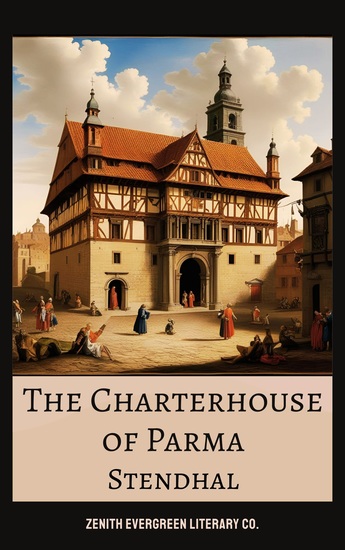
The Charterhouse of Parma - A Masterpiece of Passion Politics and Napoleonic Intrigue - cover

The Charterhouse of Parma - A Masterpiece of Passion Politics and Napoleonic Intrigue

Stendhal, Zenith Evergreen Literary Co.

Publisher: Zenith Evergreen Literary Co.

  • 0
  • 0
  • 0

Summary

Can one man survive the games of love and war in the age of Napoleon?

The Charterhouse of Parma is Stendhal's sweeping epic of romance, revolution, and personal destiny, following the life of Fabrice del Dongo, a passionate young nobleman navigating the chaos of Napoleonic Europe. From the battlefield of Waterloo to the intrigues of Parma's royal court, Fabrice's quest for love and meaning unfolds in a world where ambition, betrayal, and honor collide.

With vivid characters, sharp political commentary, and emotional depth, this novel is a pinnacle of 19th-century literature, admired by Tolstoy, Balzac, and Nietzsche.

💬 "A masterpiece of action and introspection—European literature at its finest."

🇮🇹 Why Readers Shouldn't Miss It:
A literary gem for fans of Les Misérables, The Red and the Black, and War and Peace

Blends romance, history, and philosophy with razor-sharp insight

Ideal for students and lovers of continental fiction, realism, and classic storytelling

📣 Where Love Meets Power, and History Writes the Rules.
Buy The Charterhouse of Parma today and experience a novel that shaped generations of readers and writers.
Available since: 04/22/2025.
Print length: 501 pages.


Other books that might interest you

  • A Story Without a Title - cover

    A Story Without a Title

    Anton Chekhov

    • 0
    • 0
    • 0
    "A Story Without a Title"  is an 1888 humorous story by Anton Chekhov.
    In a remote 5th century monastery the monks live and toil, led by an elderly abbot. The old man likes to play the organ, write music and compose Latin verses but is famous most of all for his eloquence and fiery, inspirational monologues which leave everybody around him enchanted. Then one night a drunkard knocks the door of the gates, saying he'd got lost on his way and asking them to give him food and wine. After the supper, instead of thanks, he rather shames the monks for spending their lives away, while the townsfolk keep on drowning themselves in debauchery and vice. The guest's speech sounds offensive, but the abbot sees the point and suggests that he makes a trip to the town himself.
    The monks wait for the old man for three months. He returns silent and morose, then spends the next seven days fasting, playing the organ and crying. Back from his cell, he tells them the appalling story of the sin raging in the town, its people indulging in all manner of pleasures, drinking wine, visiting brothels, watching lustful harlots dancing on tables. Unfortunately, one of his bouts of inspiration hits him and the monks are transfixed. Having described the charms of evil, the old man curses the devil and departs to shut himself up in his cell. When he comes out in the morning, there is not a monk left in the monastery; they had all fled to the town.
    Show book
  • In the Fourth Dimension - From their pens to your ears genius in every story - cover

    In the Fourth Dimension - From...

    Clothilde Graves

    • 0
    • 0
    • 0
    Clotilde Augusta Inez Mary Graves was born on the 3rd June 1863 at Buttevant Castle, Co. Cork, to parents with military backgrounds. 
    At age nine, the family moved to Southsea in England for yet another military posting.  Her father’s postings gave her valuable experiences that would be put to good use in later years in some of her literary works. 
    She was educated at a Catholic convent in Lourdes before returning to London in 1884 to study art in Bloomsbury.  She worked part-time at the British Museum and the Royal Female School of Art and generated further income by drawing little pen-and-ink grotesques for the comic papers.  
    A few years later a chance meeting found her writing extra lyrics for a pantomime version of Puss in Boots.  She followed up with several financially successful plays, both in London and New York, and gained a measure of notoriety in one with the comparison of marriage and prostitution.   
    Despite her dramatic success she published her first novel in 1911 under the pseudonym of Richard Dehan which she continued to use for later works.  As well as novels and plays she published collections of short stories which glow with talent and invention. 
    She was an unusual figure in London society, wearing her hair short, taking on a masculine manner and cut of clothing, and smoking cigarettes in public when such traits were considered eccentric at best.  Add to this her admired collection of Chinese and Japanese trophies, her enthusiasm for fly-fishing and her riding of a tricycle and you have a perfect image of this fascinating writer. 
    Clotilde Graves died at the convent of Our Lady of Lourdes at Hatch End in Middlesex, on the 3rd December 1932.  She was 69.
    Show book
  • Twenty-Six Men and a Girl - From their pens to your ears genius in every story - cover

    Twenty-Six Men and a Girl - From...

    Maxim Gorky

    • 0
    • 0
    • 0
    Alexei Maximovich Peshkov was born on 28th March 1868, in Nizhny Novgorod, Russia. 
    Better known as Maxim Gorky he was orphaned at 11 and ran away from home at 12.  At 19 he had already attempted suicide and thereafter travelled, by foot, across the Russian Empire for 5 years. 
    His first book ‘Essays & Stories’ in 1898 was a sensation and so began a long career as an author of short stories, novels and plays.  Gorky saw writing as a moral and political act that would help to change the unjust world around him.  He was an ardent early advocate of the emerging Marxist movement and publicly opposed the Tsarist regime leading several times to his arrest.  
    In 1904 he began his own theatre but the censor banned every play and Gorky was forced to abandon the project. 
    But Gorky was a financially successful author, editor, and playwright and gave monies to political parties as well as for civil rights and social reform.  The brutal shooting of workers, which set in motion the Revolution of 1905, pushed Gorky more decisively toward radical solutions.  
    In 1906 he went to the United States to raise funds for the Bolsheviks. Those experiences including a scandal over travelling with his lover and not his wife deepened his contempt for the ‘bourgeois soul.’ 
    Gorky now moved to Capri in Italy, both for health reasons and to escape the increasingly repressive times in Russia.  
    An amnesty for the 300th anniversary of the Romanov dynasty saw him return to Russia in 1914. His politics remained close to the Bolshevik cause.  But soon, after the 1918 revolution, his essays referred to Lenin as a tyrant for his senseless arrests and repression.  He was soon appealing to the outside world for food aid after the catastrophic crop failure. 
    In October 1921 Gorky returned to Italy, now in Fascist hands, and settled in Sorrento until 1932.  His health worsened with the onset of tuberculosis. 
    He wrote several successful books there but now decided to find an understanding with the communist regime. Stalin invited him home and his return was hailed as a major propaganda victory.  He was decorated with the Order of Lenin, and a province, a park, and various streets re-named in his honour. 
    But he had his faults too.  In 1933, Gorky co-edited a book on the White Sea-Baltic Canal and denied even a single prisoner died during its construction, but thousands had. As well, knowing that some Nazis were homosexual, a phrase was attributed to him that said ‘exterminate all homosexuals and fascism will vanish’.  Although he was himself was quoting another he was decidedly homophobic. 
    With the increase of Stalinist repression in 1935 Gorky was placed under unannounced house arrest. 
    Maxim Gorky died on the 18th June 1936 from pneumonia.  He was 68. 
    Stalin and Molotov were among those who carried Gorky's urn of ashes at his funeral.
    Show book
  • Dr Heidigger's experiment - From their pens to your ears genius in every story - cover

    Dr Heidigger's experiment - From...

    Nathaniel Hawthorne

    • 0
    • 0
    • 0
    Nathaniel Hawthorne was born on 4th July 1804 in Salem, Massachusetts, a town synonymous with the earlier Salem Witch Trials. It was instrumental in Hawthorne’s later use of American Gothic and dark romanticism in his writing. 
    He was a mere four years old when his father died and his mother took him and his two sisters to live with her family and then on to their own home in Raymond, Maine. The young Hawthorne had a passion for fiction and poetry and voraciously read the works of Ann Radcliffe, Henry Fielding and Lord Byron.  
    He was sent to college at his maternal uncle’s insistence. During these years he met and befriended Henry Wadsworth Longfellow and future U S president Franklin Pierce. These friendships were lifelong and to have a crucial impact on his writings and career.  
    At college Hawthorne had made attempts at writing short stories and essays but without opportunities to publish. It was only in 1828 that he finally published his novel ‘Franshawe’ to little success and so he began work as editor for the American Magazine of Useful and Entertaining Knowledge.  
    Hawthorne’s short stories were first published in magazines but in 1837 were collected and published as ‘Twice-Told Tales’. A steady literary career still did not come his way and so he worked in a good position at Salem’s port and married the love of his life Sophia Peabody. They moved to live in ‘The Old Manse’ at Concord, Massachusetts.   
    Finally. in 1850 came spectacular literary and commercial success with ‘The Scarlet Letter’ followed by ‘The House of the Seven Gables’ the following year.  
    In 1852, Hawthorne published a biography of presidential candidate Franklin Pierce. After Pierce’s victory he was appointed consul in Liverpool, a position that offered prestige, money and fame. At the end of this appointment he returned several times to Europe before settling in Massachusetts and resuming writing and publication. 
    During the early 1860’s his health declined and on 19th May 1864 during a trip to Plymouth, New Hampshire. He was 59 and was buried in Sleepy Hollow Cemetery in Concord, Massachusetts.
    Show book
  • Alice’s Adventures in Wonderland - cover

    Alice’s Adventures in Wonderland

    Lewis Carroll

    • 0
    • 0
    • 0
    Join Alice on a fantastical journey down the rabbit hole in Lewis Carroll's classic tale, "Alice's Adventures in Wonderland." When Alice follows a white rabbit into a mysterious and magical world, she encounters a cast of curious characters, including the Cheshire Cat, the Mad Hatter, and the Queen of Hearts. As she journeys through this strange and whimsical land, Alice learns valuable lessons about growing up and finding her way in the world. 
    This timeless classic has captivated audiences for over 150 years with its imaginative storytelling and enduring themes. Through its vivid imagery and unforgettable characters, "Alice's Adventures in Wonderland" explores the power of imagination, the importance of individuality, and the challenges of growing up. 
    Narrated by Richard Hunt, this audiobook brings the magic of Wonderland to life, inviting listeners of all ages on a journey that will leave a lasting impression. So grab your headphones and get ready for a wild ride with Alice, in "Alice's Adventures in Wonderland.
    Show book
  • Story of the Inexperienced Ghost The (Unabridged) - cover

    Story of the Inexperienced Ghost...

    H. G. Wells

    • 0
    • 0
    • 0
    Herbert George Wells (21 September 1866 - 13 August 1946) was an English writer. Prolific in many genres, he wrote dozens of novels, short stories, and works of social commentary, history, satire, biography and autobiography. His work also included two books on recreational war games. Wells is now best remembered for his science fiction novels and is often called the "father of science fiction", along with Jules Verne and the publisher Hugo Gernsback.
    THE STORY OF THE INEXPERIENCED GHOST: The scene amidst which Clayton told his last story comes back very vividly to my mind. There he sat, for the greater part of the time, in the corner of the authentic settle by the spacious open fire, and Sanderson sat beside him smoking the Broseley clay that bore his name.
    Show book