¡Acompáñanos a viajar por el mundo de los libros!
Añadir este libro a la estantería
Grey
Escribe un nuevo comentario Default profile 50px
Grey
Suscríbete para leer el libro completo o lee las primeras páginas gratis.
All characters reduced
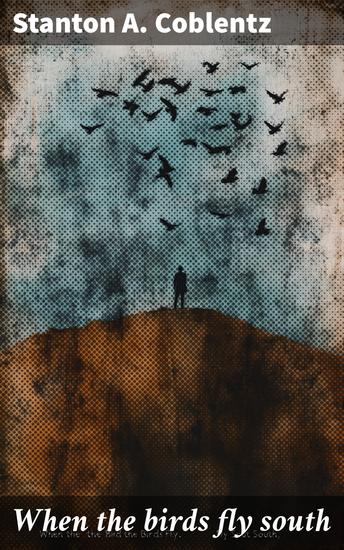
When the birds fly south - cover

When the birds fly south

Stanton A. Coblentz

Editorial: Good Press

  • 0
  • 0
  • 0

Sinopsis

In "When the Birds Fly South," Stanton A. Coblentz crafts an evocative narrative that deftly interweaves elements of science fiction and existential exploration. Set against a backdrop of societal upheaval, Coblentz's literary prose captivates with its lyrical precision and philosophical depth. Through vivid allegories and richly drawn characters, the novel delves into the psyche of humanity at a crossroads, grappling with themes of migration, survival, and the quest for identity in a changing world. The novel's intricate structure invites readers to consider the cyclic nature of life, juxtaposed with the idea of a fleeting paradise lost. Stanton A. Coblentz, an author steeped in the avant-garde literary movements of the early 20th century, sought to reflect the anxieties of his era through imaginative narratives. His early life, marked by exploration and engagement with diverse philosophies, influenced his writing style, prompting him to blend speculative elements within social commentary. Coblentz's works often echo his concerns about technological advancement and its impact on human relationships, themes that resonate strongly in this novel. This book is recommended for readers who appreciate speculative fiction that challenges conventional narratives. "When the Birds Fly South" is not just a tale of migration but a profound commentary on the human condition, making it a poignant read for anyone seeking insight into the struggles and triumphs of our shared existence.
Disponible desde: 02/03/2025.
Longitud de impresión: 190 páginas.
Otros libros que te pueden interesar

  • Les Misérables: Volume 4: The Idyll in the Rue Plumet and the Epic in the Rue St Denis - Book 12: Corinthe (Unabridged) - cover

    Les Misérables: Volume 4: The...

    Victor Hugo

    • 0
    • 0
    • 0
    Victor-Marie Hugo (26 February 1802 - 22 May 1885) was a French poet, novelist, essayist, playwright, and dramatist of the Romantic movement. During a literary career that spanned more than sixty years, he wrote abundantly in an exceptional variety of genres: lyrics, satires, epics, philosophical poems, epigrams, novels, history, critical essays, political speeches, funeral orations, diaries, and letters public and private, as well as dramas in verse and prose.
    BOOK 12: CORINTHE: The Parisians who nowadays on entering on the Rue Rambuteau at the end near the Halles, notice on their right, opposite the Rue Mondétour, a basket-maker's shop having for its sign a basket in the form of Napoleon the Great with this inscription.
    Ver libro
  • Tales from Edgar Allan Poe - Volume 1 - cover

    Tales from Edgar Allan Poe -...

    Edgar Allan Poe

    • 0
    • 0
    • 0
    Edgar Allan Poe was an American writer, poet, editor and literary critic, considered part of the American Romantic Movement.  
    Best known for his tales of mystery and the macabre, Poe was one of the earliest American practitioners of the short story and is considered the inventor of the detective-fiction genre.  He is further credited with contributing to the emerging genre of science fiction. 
    Here is a collection of some of his best stories:  "The Cask of Amontillado", "Annabel Lee", "A Tale of the Ragged Mountains", and "Morella".
    Don't miss the other volumes of Tales from Edgar Allan Poe!
    
    ©2011 Listen & Live Audio, Inc. (P)2011 Listen & Live Audio, Inc.
    Ver libro
  • About Love - From their pens to your ears genius in every story - cover

    About Love - From their pens to...

    Anton Chekhov

    • 0
    • 0
    • 0
    Anton Pavlovich Chekhov was born on 29th January 1860 in Taganrog, on the south coast of Russia.  
    His family life was difficult; his father was strict and over-bearing but his mother was a passionate story-teller, a subject Chekhov warmed to. As he later said; ‘our talents we got from our father, but our soul from our mother’.  
    At school Chekhov was distinctly average. At 16 his father mis-managed his finances and was declared bankrupt. His family fled to Moscow. Chekhov remained and eked out a living by various means, including writing and selling short sketches to newspapers, to finish his schooling. That completed and with a scholarship to Moscow University obtained he rejoined his family. 
    He was able to help support them by selling satirical sketches and vignettes of Russian lifestyles and gradually obtained further commissions. In 1884, he qualified as a physician and, although it earned him little, he often treated the poor for free, he was fond of saying ‘Medicine is my lawful wife, and literature is my mistress.’ 
    His own health was now an issue as he began to cough up blood, a symptom of tuberculosis.  Despite this his writing success enabled him to move the family into more comfortable accommodation.  
    Chekhov wrote over 500 short stories which included many, many classics including ‘The Kiss’ and ‘The Lady with a Dog’.  His collection ‘At Dusk’ won him the coveted Pushkin Prize when was only 26.  
    He was also a major playwright beginning with the huge success of ‘Ivanov’ in 1887.   
    In 1892 Chekhov bought a country estate north of Moscow. Here his medical skills and money helped the peasants tackle outbreaks of cholera and bouts of famine. He also built three schools, a fire station and a clinic.  It left him with less time for writing but the interactions with real people gained him detailed knowledge about the peasantry and their living conditions for his stories.  
    His most famous work, ‘The Seagull’ was received disastrously at its premiere in St Petersburg. It was later restaged in Moscow to highlight its psychological aspects and was a huge success. It led to ‘Uncle Vanya’, ‘The Three Sisters’ and ‘The Cherry Orchard’.  
    Chekhov suffered a major lung hemorrhage in 1897 while visiting Moscow. A formal diagnosis confirmed tuberculosis and the doctors ordered changes to his lifestyle.  
    Despite a dread of weddings the elusive literary bachelor quietly married the actress Olga Knipper, whom he had met at rehearsals for ‘The Seagull’, on 25th May 1901. 
    By May 1904 with his tuberculosis worsening and death imminent he set off for the German town of Badenweiler writing cheerful, witty letters to his family and assuring them his health was improving.  
    On 15th July 1904 Anton Chekhov died at Badenweiler.  He was 44.
    Ver libro
  • Demons Volume 2 - cover

    Demons Volume 2

    Fyodor Dostoyevsky

    • 0
    • 0
    • 0
    "Demons" by Fyodor Dostoyevsky is a gripping political and psychological novel that delves into the chaos of revolutionary ideas and moral decay in 19th-century Russia. The story follows a small provincial town infiltrated by radical ideologies, where a group of nihilists and anarchists sow discord and destruction. Through characters like Stavrogin, a troubled aristocrat, and Pyotr Verkhovensky, a manipulative revolutionary, Dostoyevsky explores themes of faith, freedom, and the dangers of unchecked ideology. As personal and societal tensions escalate, the novel examines the fragility of human morality and the consequences of rejecting traditional values. A masterful blend of suspense and philosophical depth, "Demons" critiques the destructive potential of radicalism while probing the complexities of the human soul.
    Ver libro
  • The Classic collection of Arthur C Clarke Short Stories - The Nine Billion Names of God Armaments Race Into the Comet The Sentinel Superiority and others - cover

    The Classic collection of Arthur...

    Arthur C. Clarke

    • 0
    • 0
    • 0
    The Classic Collection of Arthur C. Clarke brings together some of the most iconic and visionary short stories by one of science fiction's greatest minds. This anthology includes timeless works such as "The Nine Billion Names of God," "Armaments Race," "Into the Comet," "The Sentinel," "Superiority," and many others that showcase Clarke's unique blend of scientific imagination, philosophical depth, and subtle humor.In stories like "The Nine Billion Names of God," Clarke explores the intersection of science and spirituality, crafting narratives that are both thought-provoking and elegantly simple. Meanwhile, "Superiority" delivers a sharp critique of technological hubris, illustrating how advanced innovation can lead to unintended failure."Into the Comet" and "The Sentinel" reflect Clarke's fascination with space exploration and humanity's place in the cosmos. These tales challenge readers to think beyond Earth's boundaries and confront the mysteries of the universe with awe and humility.Clarke's writing is characterized by its clarity, optimism, and intellectual curiosity. His stories often feature plausible science and ethical dilemmas that remain relevant today.This collection is an essential read for science fiction enthusiasts and anyone interested in the future of humanity, technology, and the unknown.Contents: ReverieThe Other TigerPublicity CampaignIf I Forget Thee, Oh Earth…Who's There?The PossessedOut Of The Cradle, Endlessly Orbiting…The Nine Billion Names of GodArmaments RaceInto the CometThe SentinelSuperiority
    Ver libro
  • A Knot of Ribbon - From their pens to your ears genius in every story - cover

    A Knot of Ribbon - From their...

    Laurence Alma-Tadema

    • 0
    • 0
    • 0
    The bookshelves of British literature are incredible collections that have gathered together centuries of very talented authors.  From these Isles their fame spread and whilst among their number many are now forgotten or neglected their talents endure.  Among them is Laurence Alma-Tadema.
    Ver libro