Join us on a literary world trip!
Add this book to bookshelf
Grey
Write a new comment Default profile 50px
Grey
Subscribe to read the full book or read the first pages for free!
All characters reduced
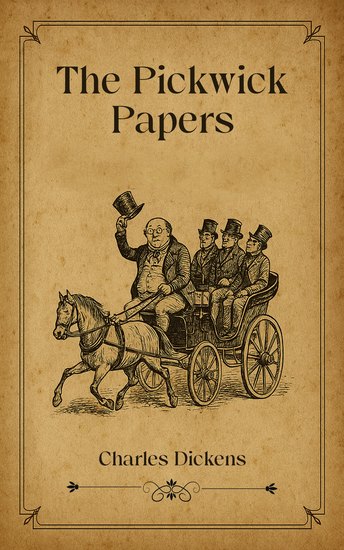
The Pickwick Papers - cover

The Pickwick Papers

Charles Dickens

Publisher: CLXBX

  • 0
  • 0
  • 0

Summary

The Pickwick Papers is the novel that launched Charles Dickens's literary career and remains one of his most joyful and entertaining works. Bursting with humor, warmth, and vivid observation, the book offers a lively portrait of English life in the early Victorian era.

The story follows the genial and good-natured Samuel Pickwick, founder of the Pickwick Club, and his fellow members as they travel through the English countryside in search of knowledge, adventure, and amusement. Along the way, they encounter an unforgettable array of characters—eccentric lawyers, boastful soldiers, sharp-tongued widows, and ordinary people whose quirks and struggles are rendered with affectionate satire.

At the heart of the novel is Dickens's keen eye for human nature. Through comic misadventures, misunderstandings, and courtroom farces, the book gently critiques social pretensions, legal absurdities, and institutional hypocrisy. The introduction of the clever and loyal servant Sam Weller adds depth and wit, creating one of the most beloved partnerships in English literature.

The Pickwick Papers is a celebration of friendship, curiosity, and good humor. Lighthearted yet insightful, it captures the spirit of a society in transition while delighting readers with its timeless comedy and rich storytelling. Endlessly readable and irresistibly charming, the novel stands as a classic introduction to Dickens's enduring genius.
Available since: 02/05/2026.
Print length: 1096 pages.

Other books that might interest you

  • The Shunned House - cover

    The Shunned House

    H P Lovecraft

    • 0
    • 0
    • 0
    One of HP Lovecrafts earliest works, "The Shunned House", first published in Weird Tales in the October of 1937, is a short novellette about a mysterious, and apparently cursed house. The Shunned House on Benefit Street has long captivated the attention of the narrator and his uncle Elihu Whipple, but they are unprepared for the full scale of the horror they are to experience when they attempt to stay the night in it's benighted basement to finally unearth it's mysterious secrets. Considered one of Lovecrafts best short stories, it is beleived to have been his first individually published book: with 250 copies made by Recluse Press in 1928. 
    Narrated by Michael Ward.
    Show book
  • North and South - cover

    North and South

    Elizabeth Cleghorn Gaskell

    • 0
    • 0
    • 0
    North and South by Elizabeth Cleghorn Gaskell: "North and South" follows the journey of Margaret Hale, a young woman who relocates from rural southern England to the industrialized northern town of Milton. As Margaret grapples with the stark contrasts between the two regions and the social issues arising from the industrial revolution, she becomes entangled with the enigmatic mill owner, John Thornton. The novel delves into the complexities of class struggle, workers' rights, and the clash between traditional values and the modern world. Elizabeth Gaskell's insightful portrayal of industrial life and her nuanced exploration of romance and social issues make "North and South" a compelling and thought-provoking work of Victorian fiction. 
    Elizabeth Gaskell, an English novelist, is known for her compassionate portrayals of Victorian social issues and her insightful examination of the human condition. Her works, such as "North and South," "Cranford," and "Wives and Daughters," explored the impact of industrialization on society and offered a nuanced understanding of class and gender dynamics during the 19th century.
    Show book
  • Valley of Spiders The (Unabridged) - cover

    Valley of Spiders The (Unabridged)

    H. G. Wells

    • 0
    • 0
    • 0
    Herbert George Wells (21 September 1866 - 13 August 1946) was an English writer. Prolific in many genres, he wrote dozens of novels, short stories, and works of social commentary, history, satire, biography and autobiography. His work also included two books on recreational war games. Wells is now best remembered for his science fiction novels and is often called the "father of science fiction", along with Jules Verne and the publisher Hugo Gernsback.
    THE VALLEY OF SPIDERS: Towards mid-day the three pursuers came abruptly round a bend in the torrent bed upon the sight of a very broad and spacious valley. The difficult and winding trench of pebbles along which they had tracked the fugitives for so long, expanded to a broad slope, and with a common impulse the three men left the trail, and rode to a little eminence set with olive-dun trees, and there halted, the two others, as became them, a little behind the man with the silver-studded bridle.
    Show book
  • Babbitt - cover

    Babbitt

    Sinclair Lewis

    • 0
    • 0
    • 0
    Lewis’ scathing satire of middle-class America, Babbitt explores the social pressures of conformity and materialism. It tells the story of George Babbitt, a middle-aged family man who becomes disillusioned with both conformity and his belated attempts at rebellion. Set in the fictional Midwestern town of Zenith, Babbitt offers a powerful critique of the American Dream and all it entails.
    Show book
  • By the Rule of Contrary - cover

    By the Rule of Contrary

    Lucy Maud Montgomery

    • 0
    • 0
    • 0
    Lucy Maud Montgomery (November 30, 1874 – April 24, 1942), published as L. M. Montgomery, was a Canadian author best known for a series of novels beginning in 1908 with Anne of Green Gables. The book was an immediate success. The title character, orphan Anne Shirley, made Montgomery famous in her lifetime and gave her an international following.
    By the Rule of Contrary: "Look here, Burton," said old John Ellis in an ominous tone of voice, "I want to know if what that old busybody of a Mary Keane came here today gossiping about is true. If it is well, I've something to say about the matter!
    Show book
  • Æpyornis Island - From their pens to your ears genius in every story - cover

    Æpyornis Island - From their...

    H G Wells

    • 0
    • 0
    • 0
    Herbert George Wells was born on September 21st, 1866 at Atlas House, 46 High Street, Bromley, Kent. He was the youngest of four siblings and his family affectionately knew him as ‘Bertie’.  
    The first few years of his childhood were spent fairly quietly, and Wells didn’t display much literary interest until, in 1874, he accidentally broke his leg and was left to recover in bed, largely entertained by the library books his father regularly brought him. Through these Wells found he could escape the boredom and misery of his bed and convalescence by exploring the new worlds he encountered in these books.  
    From these humble beginnings began a career that was, after several delays, to be seen as one of the most brilliant of modern English writers.    
    Able to write comfortably in a number of genres he was especially applauded for his science fiction works such as The Time Machine and War of the Worlds but his forays into the social conditions of the times, with classics such as Kipps, were almost as commercially successful.  His short stories are miniature masterpieces many of which bring new and incredible ideas of science fiction to the edge of present day science fact.  Wells also received four nominations for the Nobel Prize in Literature 
    Despite a strong and lasting second marriage his affairs with other women also brought the complications of fathering other children.  His writings and work against fascism, as well as the promotion of socialism, brought him into increasing doubts with and opposition to religion.  His writings on what the world could be in works, such as A Modern Utopia, are thought provoking as well as being plausible, especially when viewed from the distressing times they were written in. 
    His diabetic condition pushed him to create what is now the largest Diabetes charity in the United Kingdom.  Wells even found the time to run twice for Parliament. 
    It was a long, distinguished and powerfully successful career by the time he died, aged 79, on August 13th, 1946.
    Show book