

Join us on a literary world trip!
Add this book to bookshelf
Grey
Write a new comment Default profile 50px
Grey
Subscribe to read the full book or read the first pages for free!
All characters reduced
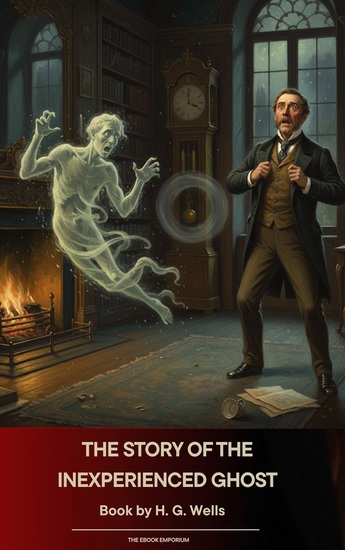
The Story of the Inexperienced Ghost - cover

The Story of the Inexperienced Ghost

H. G. Wells

Publisher: The Ebook Emporium

  • 0
  • 0
  • 0

Summary

"He wasn't a terrifying ghost; he was a pathetic one. He had forgotten how to haunt."

In the cozy, smoke-filled atmosphere of the Meridian Club, a man named Clayton recounts a remarkable encounter. He recently found himself face-to-face with a ghost—not a shrieking specter, but a shy, stuttering young man who had died of "inanition" and was now failing miserably at being scary. The ghost has forgotten the complex "passes" and gestures required to disappear back into the spirit world. As Clayton attempts to help the spirit regain his "spectral footing," the story takes a turn from the humorous to the chillingly profound, questioning the thin veil between the living and the dead.

A Satire of the Gothic Tradition: Wells subverts every trope of the 19th-century ghost story. His phantom is a "low-grade" spirit who is self-conscious about his lack of haunting skills. By treating the afterlife as a bureaucratic or technical skill that one must master, Wells brings a grounded, modern sensibility to the supernatural, making the ghost's plight relatable and strangely human.

The Fatal Curiosity: The narrative tension peaks when Clayton decided to demonstrate the ghost's secret gestures to his skeptical friends. Wells masterfully builds a sense of dread as the "inexperienced" ghost's struggle becomes a real-world danger. It is a cautionary tale about the arrogance of the living when dealing with the mysteries of the beyond.

Discover the lighter—and darker—side of the supernatural. Purchase "The Story of the Inexperienced Ghost" today and master the pass.
Available since: 01/08/2026.
Print length: 27 pages.

Other books that might interest you

  • The Wound Dresser - cover

    The Wound Dresser

    Walt Whitman

    • 0
    • 0
    • 0
    Walter Whitman was an American poet, essayist and journalist. A humanist, he was a part of the transition between transcendentalism and realism, incorporating both views in his works. Whitman is among the most influential poets in the American canon, often called the father of free verse. His work was controversial in its time, particularly his 1855 poetry collection Leaves of Grass, which was described as obscene for its overt sensuality. Whitman's own life came under scrutiny for his presumed homosexuality.Born in Huntington on Long Island, as a child and through much of his career, he resided in Brooklyn. At age 11, he left formal schooling to go to work. Later, Whitman worked as a journalist, a teacher, and a government clerk. Whitman's major poetry collection, Leaves of Grass, was first published in 1855 with his own money and became well known. The work was an attempt at reaching out to the common person with an American epic. He continued expanding and revising it until his death in 1892. During the American Civil War, he went to Washington, D.C. and worked in hospitals caring for the wounded. His poetry often focused on both loss and healing. On the death of Abraham Lincoln, whom Whitman greatly admired, he wrote his well-known poems, "O Captain! My Captain!" and "When Lilacs Last in the Dooryard Bloom'd", and gave a series of lectures. After a stroke towards the end of his life, Whitman moved to Camden, New Jersey, where his health further declined. When he died at age 72, his funeral was a public event.Whitman's influence on poetry remains strong. Mary Whitall Smith Costelloe argued: "You cannot really understand America without Walt Whitman, without Leaves of Grass ... He has expressed that civilization, 'up to date,' as he would say, and no student of the philosophy of history can do without him." Modernist poet Ezra Pound called Whitman "America's poet ... He is America.
    Show book
  • First and Last Things (Unabridged) - cover

    First and Last Things (Unabridged)

    H. G. Wells

    • 0
    • 0
    • 0
    First and Last Things is a 1908 work of philosophy by H. G. Wells setting forth his beliefs in four "books" entitled "Metaphysics," "Of Belief," "Of General Conduct," and "Some Personal Things." Parts of the book were published in the Independent Magazine in July and August 1908. Wells revised the book extensively in 1917, in response to his religious conversion, but later published a further revision in 1929 that restored much of the book to its earlier form. Its main intellectual influences are Darwinism and certain German thinkers Wells had read, such as August Weismann. The pragmatism of William James, who had become a friend of Wells, was also an influence.
    Show book
  • Runestone - An Epic Historical Adventure - cover

    Runestone - An Epic Historical...

    Don Coldsmith

    • 0
    • 0
    • 0
    A GRAND HISTORICAL ADVENTURE PITTING TWO WARRIOR CASTES AGAINST ONE ANOTHER. 
    They set sail from Norway, two swift-moving longships and their handpicked crews, following the route navigated by the legendary Leif Ericson. But for young shipmaster Nils Thorsson and his fellow Norsemen the real journey begins when they push on into the uncharted continent of Vinland. 
    There the explorers revel in the chance to penetrate a virgin land – until they trespass on the grounds of a primitive people who have seen enough of the light-hairs' cruelty to believe they are too dangerous to ignore. In one swift dawn raid, they deal with the invaders by letting go a swarm of fiery arrows. Only three men from the sailing party escape: the intrepid Nils Thorsson, the hardened seaman Svenson, and an enigmatic native guide called Odin. Now, stranded in the wilderness with their one-eyed guide, Thomson and Svenson know that to survive they must master the ways of war, of the hunt – and of a proud and fearless people. 
    “A mythically powerful story of the earliest European exploration of North America. Runestone is Don Coldsmith’s finest work to date.” – Kathleen O’Neal Gear and W. Michael Gear, authors of Flight of The Hawk.
    Show book
  • First Men in the Moon The (Unabridged) - cover

    First Men in the Moon The...

    H. G. Wells

    • 0
    • 0
    • 0
    When penniless businessman Mr Bedford retreats to the Kent coast to write a play, he meets by chance the brilliant Dr Cavor, an absent-minded scientist on the brink of developing a material that blocks gravity. Cavor soon succeeds in his experiments, only to tell a stunned Bedford the invention makes possible one of the oldest dreams of humanity: a journey to the moon. With Bedford motivated by money, and Cavor by the desire for knowledge, the two embark on the expedition. But neither are prepared for what they find - a world of freezing nights, boiling days and sinister alien life, on which they may be trapped forever.
    Show book
  • Syndicalism or Citizenship (Unabridged) - cover

    Syndicalism or Citizenship...

    H. G. Wells

    • 0
    • 0
    • 0
    Herbert George Wells (21 September 1866 - 13 August 1946) was an English writer. Prolific in many genres, he wrote dozens of novels, short stories, and works of social commentary, history, satire, biography and autobiography. His work also included two books on recreational war games. Wells is now best remembered for his science fiction novels and is often called the "father of science fiction", along with Jules Verne and the publisher Hugo Gernsback.
    SYNDICALISM OR CITIZENSHIP: "Is a railway porter a railway porter first and a man afterwards, or is he a man first and incidentally a railway porter?" That is the issue between this tawdrification of trade unionism which is called Syndicalism, and the ideals of that Great State, that great commonweal, towards which the constructive forces in our civilisation tend.
    Show book
  • History of Tom Jones a Foundling The - Book 14 (Unabridged) - cover

    History of Tom Jones a Foundling...

    Henry Fielding

    • 0
    • 0
    • 0
    A foundling of mysterious parentage brought up by Mr. Allworthy on his country estate, Tom Jones is deeply in love with the seemingly unattainable Sophia Western, the beautiful daughter of the neighboring squire though he sometimes succumbs to the charms of the local girls. When Tom is banished to make his own fortune and Sophia follows him to London to escape an arranged marriage, the adventure begins. A vivid Hogarthian panorama of eighteenth-century life, spiced with danger and intrigue, bawdy exuberance and good-natured authorial interjections, Tom Jones is one of the greatest and most ambitious comic novels in English literature.
    BOOK 14: As several gentlemen in these times, by the wonderful force of genius only, without the least assistance of learning, perhaps, without being well able to read, have made a considerable figure in the republic of letters; the modern critics, I am told, have lately begun to assert, that all kind of learning is entirely useless to a writer; and, indeed, no other than a kind of fetters on the natural sprightliness and activity of the imagination, which is thus weighed down, and prevented from soaring to those high flights which otherwise it would be able to reach.
    Show book
