Join us on a literary world trip!
Add this book to bookshelf
Grey
Write a new comment Default profile 50px
Grey
Subscribe to read the full book or read the first pages for free!
All characters reduced
The Moors in Spain: History of the Conquest 800 year Rule & The Final Fall of Granada - Enriched edition Legacy of Islamic Rule Cultural Exchange & the Granada Decline - cover

The Moors in Spain: History of the Conquest 800 year Rule & The Final Fall of Granada - Enriched edition Legacy of Islamic Rule Cultural Exchange & the Granada Decline

Stanley Lane-Poole

Publisher: Good Press

  • 0
  • 0
  • 0

Summary

In "The Moors in Spain: History of the Conquest, 800 Year Rule & The Final Fall of Granada," Stanley Lane-Poole intricately weaves a narrative that explores the profound impact of Moorish civilization on the Iberian Peninsula. This historical work is characterized by its meticulous research and engaging prose, transporting readers through the dynamic period of the Muslim conquest, the flourishing cultural advancements, and the eventual decline leading to the fall of Granada in 1492. Lane-Poole's scholarship is deeply contextualized, reflecting the scholarly debates of his time while presenting the rich tapestry of interactions among diverse cultures. Stanley Lane-Poole was not only an esteemed historian but also an influential figure in the study of Islamic history during the late 19th century, with a keen interest in the dynamics of cultural interchange and coexistence. His extensive travels and studies in the Middle East nourished his understanding of the intricate narratives he recounts in this volume. Lane-Poole's involvement in the education sector, alongside his position as a curator in the British Museum, provided him with a profound appreciation for the artifacts and texts that elucidate Spain's Moorish legacy. This book is a must-read for anyone interested in the intricate layers of Spanish history, Islamic culture, and the enduring legacy of the Moors. Lane-Poole's vivid storytelling and comprehensive analysis illuminate the complexities of a civilization that significantly shaped European history. Readers will emerge with a deeper understanding of not just the historical events, but also the cultural exchanges that defined an era.

In this enriched edition, we have carefully created added value for your reading experience:
- A succinct Introduction situates the work's timeless appeal and themes.
- The Synopsis outlines the central plot, highlighting key developments without spoiling critical twists.
- A detailed Historical Context immerses you in the era's events and influences that shaped the writing.
- An Author Biography reveals milestones in the author's life, illuminating the personal insights behind the text.
- A thorough Analysis dissects symbols, motifs, and character arcs to unearth underlying meanings.
- Reflection questions prompt you to engage personally with the work's messages, connecting them to modern life.
- Hand‐picked Memorable Quotes shine a spotlight on moments of literary brilliance.
- Interactive footnotes clarify unusual references, historical allusions, and archaic phrases for an effortless, more informed read.
Available since: 11/17/2023.
Print length: 168 pages.

Other books that might interest you

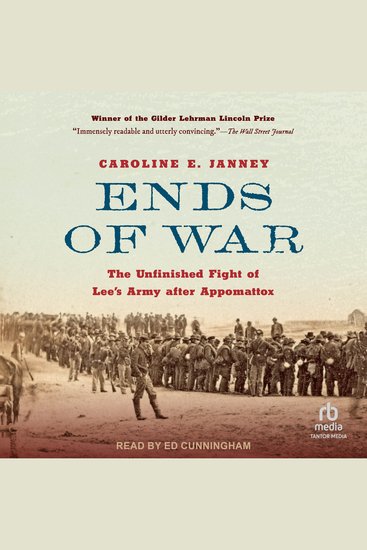
  • Ends of War - The Unfinished Fight of Lee's Army after Appomattox - cover

    Ends of War - The Unfinished...

    Caroline E. Janney

    • 0
    • 0
    • 0
    The Army of Northern Virginia's chaotic dispersal began even before Lee and Grant met at Appomattox Court House. As the Confederates had pushed west at a relentless pace for nearly a week, thousands of wounded and exhausted men fell out of the ranks. When word spread that Lee planned to surrender, most remaining troops stacked their arms and accepted paroles allowing them to return home, even as they lamented the loss of their country and cause. But others broke south and west, hoping to continue the fight. Fearing a guerrilla war, Grant extended the generous Appomattox terms to every rebel who would surrender himself. Provost marshals fanned out across Virginia and beyond, seeking nearly 18,000 of Lee's men who had yet to surrender. But the shock of Lincoln's assassination led Northern authorities to see threats of new rebellion in every rail depot and harbor where Confederates gathered for transport, even among those already paroled. While Federal troops struggled to keep order and sustain a fragile peace, their newly surrendered adversaries seethed with anger and confusion at the sight of Union troops occupying their towns and former slaves celebrating freedom. Caroline E. Janney reveals that Lee's surrender was less an ending than the start of an interregnum marked by military and political uncertainty, legal and logistical confusion, and continued outbursts of violence.
    Show book
  • The Triangle of Power - Rebalancing the New World Order - cover

    The Triangle of Power -...

    Alexander Stubb

    • 0
    • 0
    • 0
    The liberal world order that emerged after the Second World War – and expanded triumphantly following the Cold War – is unravelling. Multilateral cooperation is giving way to multipolar rivalry and conflict. Global norms are eroding. What comes next will define the rest of the century; the search is on for a new global framework – a rebalancing of power.
    In The Triangle of Power, Finnish President Alexander Stubb argues that we are living through a hinge moment in history, akin to 1918, 1945 or 1989. A new international system is taking shape, driven by three major forces: the Global West, the Global East and the Global South. At the centre is the escalating competition between the United States and China, as both try to forge bilateral deals and regional alliances, but it is the Global South that will ultimately determine whether the future tilts toward cooperation or fragmentation.
    Drawing on decades at the front lines of diplomacy, and blending personal insight with political and academic experience, Stubb delivers a passionate call for values-based realism and dignified foreign policy – and warns that unless the West learns to listen, it will lose its place in the world it once led.
    Show book
  • How To Talk To Absolutely Anyone: Your Practical Blueprint For Developing Conversation Skills Charisma Witty Banter & Mastering Small Talk To Build Meaningful Relationships In Life - cover

    How To Talk To Absolutely...

    Chris M. Brooks

    • 0
    • 0
    • 0
    How To Talk To Absolutely Anyone: Your Practical Blueprint For Developing Conversation Skills, Charisma, Witty Banter & Mastering Small Talk To Build Meaningful Relationships In Life 
    Have you ever found yourself tongue-tied in social situations? And no matter what you do, you can't seem to break free from awkward silences? If so, then keep reading… 
    This book contains the exact steps that took me from being a socially anxious introvert with zero friends to becoming a charismatic conversationalist with a thriving social circle in less than six months. 
    Want to know the biggest difference between those two time periods? I discovered the art of effortless communication. 
    The problem is—most people don't know how to initiate, maintain, and deepen conversations with strangers, acquaintances, or even friends. 
    I wrote this book to solve your communication struggles once and for all. 
    Today, I can confidently strike up a conversation with anyone, anywhere, about anything. And I do it using the "Effortless Communication" methods inside. Once you see them, you can't unsee them. They're so powerful, they work without your permission. 
    Inside you will find:The hook-engage-connect system that transforms small talk into meaningful dialogueThe six-part conversation framework that keeps people hanging on your every wordThe one question that immediately turns any stranger (no matter how intimidating) into a potential friendThe how-to-be-witty-on-demand framework that turns you into the life of any party in less than two weeks 
    And the best part is...you can use these methods to start seeing improvements in your social life within an hour of reading this book. You just have to know where to look...and the first place is inside.
    Show book
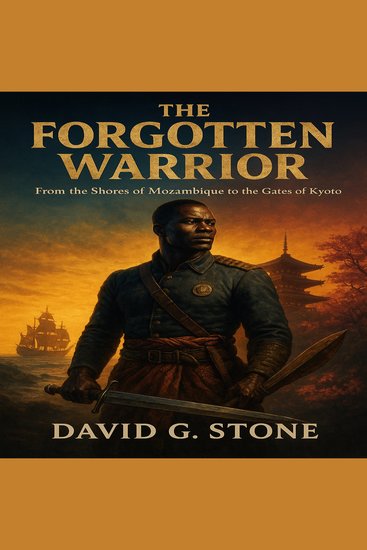
  • The Forgotten Warrior - From the Shores of Mozambique to the Gates of Kyoto - cover

    The Forgotten Warrior - From the...

    David G. Stone

    • 0
    • 0
    • 0
    This audiobook is narrated by an AI Voice.   
    What if the most important warrior in Japanese history was never supposed to be there? 
    Torn from his homeland on the shores of Mozambique, Zuberi thought his story was over. Enslaved by Portuguese raiders, forced into military service, shipwrecked on foreign shores—every twist of fate seemed designed to destroy him. 
    But destiny had other plans. 
    In feudal Japan, where honor is everything and outsiders are nothing, one man's courage will defy tradition, challenge an empire, and forge an alliance that history forgot to remember. 
    From the blood-soaked beaches of East Africa to the cherry blossom gardens of Kyoto, The Forgotten Warrior reveals the extraordinary true-to-life tale of how a Mozambican slave became a samurai legend—and how his choices shaped the course of two nations forever. 
    Some warriors are born to greatness. Others have greatness thrust upon them. 
    But the greatest warriors are forged in the fires of the impossible. 
    "A masterpiece of historical fiction that brings forgotten voices to vivid life."
    Show book
  • American Political Parties - Why They Formed How They Function and Where They're Headed - cover

    American Political Parties - Why...

    John Kenneth White, Matthew R....

    • 0
    • 0
    • 0
    American Political Parties is a core textbook on political parties in the United States that places the US party system into a framework designed around the disagreements between Alexander Hamilton and Thomas Jefferson. White and Kerbel argue that the two-party system in the United States began with a common agreement on the key values of freedom, individual rights, and equality of opportunity but that Hamilton and Jefferson disagreed—often vehemently—over how to translate these ideals into an acceptable form of governance. 


    While Hamilton wanted to marry freedom to a strong, active federal government with an energetic president who would act on behalf of all citizens, Jefferson believed that freedom should be allied to local civic virtue, with governmental responsibilities placed primarily at the local level. Today, Hamiltonian nationalism finds its home in the Democratic Party, while Republicans have espoused Jeffersonian localism since 1964. Using this historical framework, American Political Parties examines a range of topics including marketing and social media, campaign finance, reforms in the presidential nominating process, political demography, and third parties. In this new edition, the authors describe four possible futures in the wake of the 2020 election and why Americans believed it was "the most important" election in their lifetimes.
    Show book
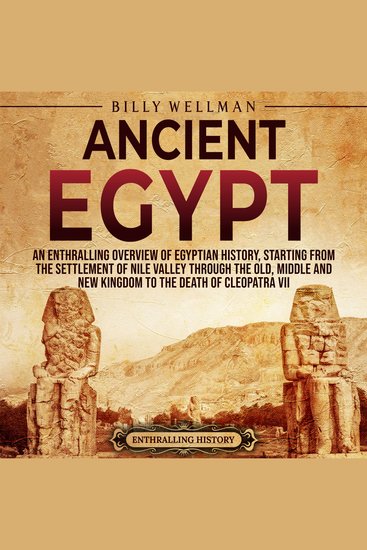
  • Ancient Egypt: An Enthralling Overview of Egyptian History Starting from the Settlement of the Nile Valley through the Old Middle and New Kingdoms to the Death of Cleopatra VII - cover

    Ancient Egypt: An Enthralling...

    Billy Wellman

    • 0
    • 0
    • 0
    Did you know that cats were extremely sacred in ancient Egypt and those who killed one could be punished by death? 
    According to many Egyptologists, the ancient Egyptians never considered animals to be gods. Instead, they were considered the personification of their powerful deities, which explained why the Egyptians often depicted their ancient gods with animal heads. The same could also be said about cats; they were most certainly not worshiped but were held in high regard. Before becoming symbols of divinity and protection, cats were often adopted by the Egyptians since they were useful predators. Cats were used to protect households from pests and dangerous animals, such as rats and snakes.  
    The Persians took advantage of the Egyptians’ love of cats. In an effort to turn the tide in a certain battle, the Persians marched to the battlefield with a great number of cats, resulting in the surrender of the Egyptian troops. Of course, whether or not this was true remains disputed, especially when many of the ancient records were either exaggerated or biased—one of the reasons why curious readers might find it slightly difficult to explore the rise and fall of ancient Egypt. 
    Here’s just a small fraction of what you’ll discover:The mysterious identities of Narmer and Menes, the first pharaoh of EgyptHow the Great Pyramid of Giza was constructed with human handsThe dangerous journey into the realm of the deadA detailed process of mummificationHow Egypt was forced to bow down to its first foreign pharaoh The biggest chariot war in history between the Egyptians and the HittitesHow Egypt’s religious beliefs played a role in its governmentThe fall of Egypt after the death of Cleopatra VII 
    Scroll up and click the “add to cart” button to learn more about ancient Egypt!
    Show book