Rejoignez-nous pour un voyage dans le monde des livres!
Ajouter ce livre à l'électronique
Grey
Ecrivez un nouveau commentaire Default profile 50px
Grey
Abonnez-vous pour lire le livre complet ou lisez les premières pages gratuitement!
All characters reduced
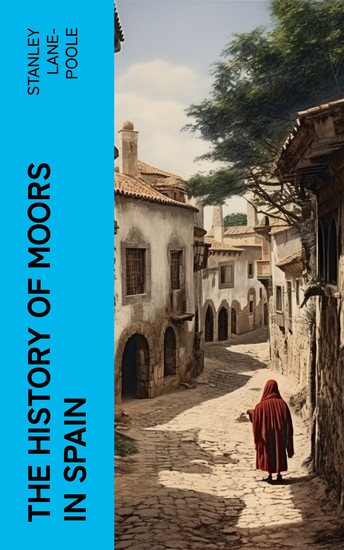
The History of Moors in Spain - The Last of the Goths Wave of Conquest People of Andalusia The Great Khalif Holy War Cid the Challenger Kingdom of Granada - cover

The History of Moors in Spain - The Last of the Goths Wave of Conquest People of Andalusia The Great Khalif Holy War Cid the Challenger Kingdom of Granada

Stanley Lane-Poole

Maison d'édition: e-artnow

  • 0
  • 0
  • 0

Synopsis

In 711 the Islamic Moors of Arab and Berber descent in North Africa crossed the Strait of Gibraltar onto the Iberian Peninsula, and in a series of raids they conquered Visigothic Christian Hispania and founded the first Muslim countries in Europe.  Contents:  The Last of the Goths The Wave of Conquest The People of Andalusia A Young Pretender The Christian Martyrs The Great Khalif The Holy War The City of the Khalif The Prime Minister The Berbers in Power My Cid the Challenger The Kingdom of Granada The Fall of Granada Bearing the Cross
Disponible depuis: 14/12/2023.
Longueur d'impression: 169 pages.

D'autres livres qui pourraient vous intéresser

  • Civil War Turning Points in the East The: The Battle of Antietam and the Battle of Gettysburg - cover

    Civil War Turning Points in the...

    Editors Charles River

    • 0
    • 0
    • 0
    The bloodiest day in American history took place on the 75th anniversary of the signing of the Constitution. On September 17, 1862, Robert E. Lee’s Confederate Army of Northern Virginia fought George McClellan’s Union Army of the Potomac outside Sharpsburg along Antietam Creek. That day, nearly 25,000 would become casualties, and Lee’s army would barely survive fighting the much bigger Northern army. Although the battle was tactically a draw, it resulted in forcing Lee’s army out of Maryland and back into Virginia, making it a strategic victory for the North and an opportune time for President Abraham Lincoln to issue the Emancipation Proclamation, freeing all slaves in the rebellious states. For those reasons, Antietam is remembered as one of the major turning points of the Civil War, even as it is often overlooked that the bloody battle only represented the climactic culmination of a 3 week campaign that saw George McClellan cautiously pull a fragmented Union army together and begin tracking Lee’s army into Maryland.  
    	Without question, the most famous battle of the American Civil War took place outside of the small town of Gettysburg, Pennsylvania, which happened to be a transportation hub, serving as the center of a wheel with several roads leading out to other Pennsylvanian towns. From July 1-3, Robert E. Lee’s Confederate Army of Northern Virginia tried everything in its power to decisively defeat George Meade’s Union Army of the Potomac, unleashing ferocious assaults that inflicted nearly 50,000 casualties in all. Day 1 of the battle would have been one of the 25 biggest battles of the Civil War itself, and it ended with a tactical Confederate victory. But over the next two days, Lee would try and fail to dislodge the Union army with attacks on both of its flanks during the second day and Pickett’s Charge on the third and final day.
    Voir livre
  • Malayland - cover

    Malayland

    Dina Zaman

    • 0
    • 0
    • 0
    What does it mean to be Malay in the 21st century? Especially in a country like Malaysia where identity politics is questioned on an almost daily basis, and policed by the state. 16 years later after the publication of I Am Muslim, Dina Zaman returns to write a memoir, writing about what it means to be Malay, and Muslim in the 21st century.  
     
    The writer embarked on Malayland during the Covid pandemic, to understand the anger and frustrations of her fellow ethnic Malays who were fighting against (imagined) enemies and a new world order impacted by a virus that killed over seven million people globally. She grew up in a Malaysia that was seething with anger, bubbling underneath the many nightclubs Malaysia was famed for in the 1980s, that witnessed how secularism killed its Malay Muslim heritage. The 1998 Reformasi movement changed Malaysia and whether for the better, is left up to Malaysians to decide.  
     
    Today race and faith are discussed and embraced frenetically, where hateful extremism is hidden under the guise of nationalism. Young Malaysians are asserting their political and birth identities through social media. And along the way, the sense of irony and humour that Malaysia is known for, has lost its way. Malayland is a reflective book: memories and flashbacks of a childhood filled with earthquakes, spooks and a sense of wonderment and curiosity about a country that is fighting for a desired identity.
    Voir livre
  • 50 States of Mind - A Journey to Discover American Democracy - cover

    50 States of Mind - A Journey to...

    Ryan Bernsten

    • 0
    • 0
    • 0
    Is America as divided as it seems? As a graduate student at Oxford, Ryan Bernsten undertook a 23,000-mile journey through all 50 states to look beyond the news cycles and see his home country from the ground. Following in the footsteps of Alexis de Tocqueville, Bernsten leads with the desire to listen and find common humanity in Americans he meets across the country.  Bernsten ultimately offers a hopeful vision for the future of America, as he embarks on a search for meaning and reflects on what it means to be American. This book is a companion to the podcast 50 States of Mind which showcases interviews from the journey and is available on all podcast platforms.
    Voir livre
  • RMS Titanic Lifeboat No 6 - The Story of Julia Cavendish who Survived - cover

    RMS Titanic Lifeboat No 6 - The...

    William Cavendish

    • 0
    • 0
    • 0
    Tyrell and Julia booked to travel on the Titanic with their two sons to introduce them to their American grandfather, but the children were too ill to travel. Julia persisted in going without them. The fatal and tragic decision not only led to the unnecessary loss of her husband, it was to haunt her for the next fifty years. Why was she so determined to go? In a letter written to her sons, as her death approached, she claimed the purpose of the visit was 'to gain her wealthy father's support for his son-in-law's ambition to stand as a Member of Parliament.' Yet Tyrell had shown no enthusiasm for making the journey, as Julia had already made the trip alone, the previous year quite safely. From the Carpathia Julia cabled her father, Henry Siegel, to have clothes from his department stores ready for the Titanic's survivors. In 1992 and 2002 her son and grandson learnt from chance encounters with New Yorkers of Julia's father's shocking fall from grace, the grandfather who owned a famous department store with a 'soda fountain meeting place'. Now can be revealed the true reason for her mission.
    Voir livre
  • Potlatch as Pedagogy - Learning Through Ceremony - cover

    Potlatch as Pedagogy - Learning...

    Sara Florence Davidson, Robert...

    • 0
    • 0
    • 0
    In 1884, the Canadian government enacted a ban on the potlatch, the foundational ceremony of the Haida people. The tradition, which determined social structure, transmitted cultural knowledge, and redistributed wealth, was seen as a cultural impediment to the government’s aim of assimilation. 
    The tradition did not die, however; the knowledge of the ceremony was kept alive by the Elders through other events until the ban was lifted. In 1969, a potlatch was held. The occasion: the raising of a totem pole carved by Robert Davidson, the first the community had seen in close to 80 years. From then on, the community publicly reclaimed, from the Elders who remained to share it, the knowledge that has almost been lost. 
    Sara Florence Davidson, Robert’s daughter, would become an educator. Over the course of her own education, she came to see how the traditions of the Haida practiced by her father — holistic, built on relationships, practical, and continuous — could be integrated into contemporary educational practices. From this realization came the roots for this book.
    Voir livre
  • American History - Details about the Revolution John Adams Benjamin Franklin and Alexander Hamilton - cover

    American History - Details about...

    Kelly Mass

    • 0
    • 0
    • 0
    This set of books contains the following titles: 
    1: Benjamin Franklin was an author, physicist, innovator, statesman, diplomat, printer, publisher, and political thinker who resided in America. Franklin was just one of the Founding Fathers of the United States, a drafter and signer of the US Declaration, and the first postmaster general of the United States. 
    2: Alexander Hamilton was a Caribbean-born American leader, political leader, legal scholar, army leader, legal representative, lender, and economic expert who lived from January eleventh, 1755 or 1757 till July twelfth, in 1804. He was a founding father of the US of America. 
    3: John Adams was the 2nd president of the United States, serving from 1797 to 1801. He was an American leader, lawyer, diplomat, author, and Founding Father. He was the first vice president of the U.S.A. and a leader of the American Revolution, which caused the nation's independence from Great Britain. 
    4: Between 1765 to 1791, the American Revolution was an ideological and political revolution in British America. In the American Revolutionary War (between 1775 to 1783), the Americans in the Thirteen Groups established sovereign countries that beat the British, getting independence from the British Crown and establishing the USA of America, the first modern-day constitutional liberal democracy. 
    5: The Industrial Revolution was a period of shift in Britain, continental Europe, and the USA from around 1760 till at some point between 1820 and 1840, when new production innovations were introduced. The shift from hand to device production, new chemical and iron production strategies, increased use of steam and waterpower, the development of device tools, and the rise of the mechanized factory system were all part of this change. The Industrial Revolution also introduced a period of remarkable population growth.
    Voir livre