Join us on a literary world trip!
Add this book to bookshelf
Grey
Write a new comment Default profile 50px
Grey
Subscribe to read the full book or read the first pages for free!
All characters reduced
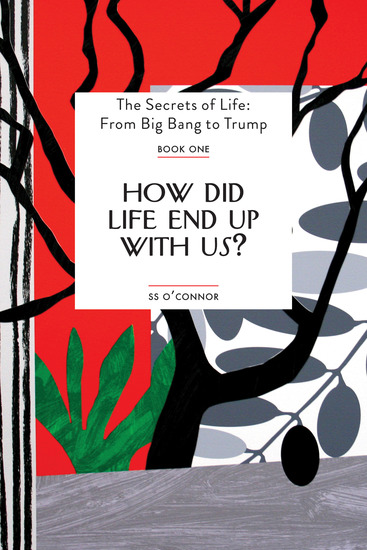
How Did Life End Up With Us? - The Secrets of Life: From Big Bang to Trump - cover

How Did Life End Up With Us? - The Secrets of Life: From Big Bang to Trump

Ss O'Connor

Publisher: Otium Press

  • 0
  • 0
  • 0

Summary

Why does the gene behave like a hedge fund manager? Why are mutations like a gambling scam? Why does nothing ever become top dog in life and win forever? Humans only arrived after 99.99% of the time there’s been life on earth. So what was here before us? And how did these species, and the evolutionary process that created them, end up with the unpromising creatures that were our ancestors?In this, the first book of The Secrets of Life quartet, SS O’Connor brings his outsider’s, questioning eye to reveal the great forces that lie behind life: from the laws that arose with Big Bang, through to the ‘decisions’ that organisms make to determine their chances.But how did everything come about? And what made some life forms succeed - while others would join the 99.9% of species that appeared, yet went on to become extinct? The story goes right back to our single-celled forebears - the only things that were on the planet for 80% of its existence, and then continues as it lays out the ways that successive transmissions built increasing complexity, and how the resulting species found their synergistic ways of coexisting.  In an easy-going, conversational style, O'Connor explains in lay-man's language how the gene is the great conductor of life’s orchestra, how it helped millions of life forms to refine themselves - yet why it also sees failure, death and extinctions as opportunities rather than disasters.  Last, the book tells the story of the men who unpicked the mysteries, what they meant by fitness and ‘the fittest’, but why they continued to be baffled by organisms that broke the rules by helping each other. Why would some even choose to be sterile when producing the next generation was the overriding compulsion in life? And why would the answer to this question explain why altruism is the proof for the ‘gene-based theory of evolution’ - and why cooperation was to become the strongest force in life?
Available since: 03/31/2023.
Other books that might interest you

  • Dissidently Speaking - Change the Words Change the War - cover

    Dissidently Speaking - Change...

    Brent Hamachek

    • 0
    • 0
    • 0
    Mostly Americans need to take a fresh look at ourselves. To do that we need to apply critical thinking, add some skepticism, and be willing to replace answers with questions. 
    Compiled from a decade of writings and contemplation, and further aided by a forty-year career in the world of business dealing with hundreds of companies, this book represents a synthesis between the theoretical and the empirical. Each chapter stands entirely on its own, but each stands stronger when joined with the others. The author’s goal is simply to have the reader challenge their preconceived notions. 
    This book is for you if you feel confident enough to challenge everything you might think about the American political dynamic, how honestly and effectively you communicate with others, and how you process what you find in the news or on social media. Do you have what it takes to become a political dissident? Find out. Finally, and most difficult of all, are you up to taking a look into the mirror and asking yourself: Am I ethical? 
    Get ready to have your toy box dumped all over the floor. Prepare to check all your premises. Be willing to think!
    Show book
  • 7 Areas Without Laws - Exploring the World's Last Anarchic Zones - cover

    7 Areas Without Laws - Exploring...

    John Harpoon

    • 0
    • 0
    • 0
    Laws are the invisible threads that hold societies together, shaping behavior, enforcing order, and establishing the boundaries of right and wrong. Yet, scattered across the world, there are rare places where laws hold little to no authority—zones where governments have little presence, where no single entity enforces regulations, and where the concept of governance is fluid or entirely absent. These places, whether by accident of history, geopolitical disputes, or deliberate rejection of authority, exist on the fringes of civilization.  
      
    This book explores seven of these anarchic zones, each with its own unique circumstances and challenges. From the open ocean, where maritime law is a complex tangle of loopholes and jurisdictions, to the frozen expanse of Antarctica, where no country claims true ownership, these areas defy traditional governance. Some, like Bir Tawil—a small strip of land between Egypt and Sudan—are unclaimed due to border disputes, while others, like Slab City in California or Freetown Christiania in Denmark, are self-declared autonomous communities that reject the rules of mainstream society.  
      
    The existence of these lawless zones raises important questions: Can true freedom exist without laws? Is lawlessness always synonymous with chaos, or can people thrive outside the framework of government? In some of these areas, the absence of enforcement has led to disorder, crime, and exploitation. Pirates take advantage of international waters to operate freely, and smugglers use ungoverned territories to traffic goods and people. In other places, however, the lack of laws has fostered alternative communities built on mutual cooperation, artistic expression, and self-sufficiency. 
    Show book
  • As the Stage Turned - A Front Row Theatre Memoir - cover

    As the Stage Turned - A Front...

    Jeannie Emser Schultz

    • 0
    • 0
    • 0
    Sammy Davis, Jr. opened it. Luther Vandross closed it. During the 19 years in between, a who’s who of the world’s top entertainers and speakers performed on the novel revolving stage of the Front Row Theatre, from Liberace to Alice Cooper, Jay Leno to Jerry Seinfeld, Marlene Dietrich to Dolly Parton, Presidents Ford and Carter and culinary grand dame Julia Child. Many were unknown opening acts, like Whitney Houston. Another, the legendary Roy Orbison, would unknowingly perform the final concert of his life there. 
    Cleveland Landmarks Press’ newest release, As the Stage Turned: A Front Row Theatre Memoir, captures the dynamic energy that sprung from one of the most unique entertainment venues in the country – a theater-in-the-round located in the sleepy suburb of Highland Heights, just outside of Cleveland. 
    Jeannie Emser Schultz, the venue’s longtime former director of marketing and publicity, has written a memoir capturing the star power and draw of the Front Row. It’s an homage to seemingly everything related to show business and the cultural significance of that famed theater that drew the biggest and brightest stars of its day. 
    For instance, where else would you learn that several days into Sammy Davis’s opening run at the Front Row in 1974, he received a phone call threatening his life? Or that the only way Frank Sinatra would agree to perform there was if he and his entire entourage could rent out the Shaker Heights home of Larry Dolin, the founder and president of the Front Row? Or that comedian Bob Newhart always kept a nude picture on his dressing room table of Anthony Newley looking backwards through his legs (Newhart told Emser Schultz it was one of the funniest pictures he ever saw)? 
    Emser Schultz’s narrative takes readers on a detailed and behind-the-scenes firsthand journey of the almost 20-year history of what was considered one of America’s most significant entertainment venues. Revisit your own fond memories of a lost Cleveland classic.
    Show book
  • A Rare Recording of John Wanamaker Telling a Leo Tolstoy Anecdote - cover

    A Rare Recording of John...

    John Wanamaker

    • 0
    • 0
    • 0
    Unable to make the 1908 Pennsylvania German Society's annual gathering due to illness, their president-- businessman, religious leader, and politician, John Wanamaker--sent in a message he recorded "through this wonderful invention of Mr. Edison on the Edison phonograph." This recording recalls an anecdote of Leo Tolstoy's, in which the Russian writer stopped at the roadside and asked a farmer who was ploughing, "Friend, what would you do today if you knew positively you would die tomorrow?" 
     
    John Wanamaker (July 11, 1838 - December 12, 1922), born in Philadelphia, was a religious, civic, and political figure, as well as, founder of one of the first American department stores. He was considered a proponent of advertising and a "pioneer in marketing." In addition, Wanamaker served as U.S. Postmaster General from 1889 to 1893 during the term of U.S. President Benjamin Harrison.
    Show book
  • Mosquito Men - The Elite Pathfinders of 627 Squadron - cover

    Mosquito Men - The Elite...

    David Price

    • 0
    • 0
    • 0
    The story of one of the most remarkable – and feared – British aircraft of the Second World War: the de Havilland DH.98 Mosquito fighter-bomber. 
     
    Nicknamed the 'wooden wonder' for its balsawood frame, the two-man Mosquito excelled in several different roles, from reconnaissance to the bombing of sensitive priority targets. Following a Mosquito raid on the main Berlin broadcasting station on 30 January 1943, which succeeded in removing Hermann Goering from the airwaves, the Luftwaffe chief observed ruefully: 'It makes me furious when I see the Mosquito. I turn green and yellow with envy.' From the summer of that year, as RAF Bomber Command intensified its saturation-bombing campaign against German cities and industrial centres, Mosquitos were used by the RAF Pathfinder Force, which marked targets for night-time bombing, to potent and devastating effect. 
     
    David Price's involving and fast-paced narrative traces the contrasting wartime fortunes of a number of Mosquito crews, alongside which the development and operational history of the aeroplane (especially with the Pathfinder Force) forms a descant to the principal human narrative. Like the author's earlier book The Crew, Mosquito Men is rich in evocative and technically authoritative accounts of individual missions flown by an aircraft that ranks alongside the Spitfire, the Hurricane and the Avro Lancaster as one of the RAF's greatest ever.
    Show book
  • Eco-Anxiety (and What to Do About It) - Practical Tips to Allay Your Fears and Live a More Environmentally Friendly Life - cover

    Eco-Anxiety (and What to Do...

    Harriet Dyer

    • 0
    • 0
    • 0
    Be kind to the planet, but most of all, be kind to yourself 


    When you feel the weight of the world on your shoulders, grab this book for a dose of calm and courage. Packed with reassuring tips and advice, from mindfulness exercises to practical steps you can take to make a difference, this guide will ease your eco-anxiety and help you to live a more environmentally friendly life.
    Show book