¡Acompáñanos a viajar por el mundo de los libros!
Añadir este libro a la estantería
Grey
Escribe un nuevo comentario Default profile 50px
Grey
Suscríbete para leer el libro completo o lee las primeras páginas gratis.
All characters reduced
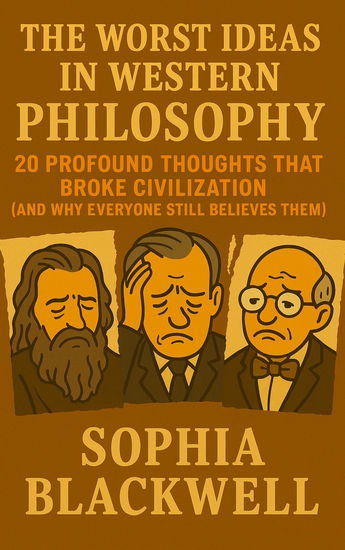
The Worst Ideas In Western Philosophy - 20 Profound Thoughts That Broke Civilization - cover

The Worst Ideas In Western Philosophy - 20 Profound Thoughts That Broke Civilization

Sophia Blackwell

Editorial: Cogito Ergo Nope

  • 0
  • 0
  • 0

Sinopsis

The funniest philosophy book you'll ever read—and the most devastating.For 2,500 years, Western civilization's brightest minds have been having spectacularly terrible ideas and convincing everyone else they're profound wisdom. From Plato's reality-denying Forms to postmodernism's truth-denying everything, philosophers have turned the simple act of being human into an impossibly complicated nightmare of bad theories and worse consequences.This book is your hilarious, savage, and surprisingly educational tour through philosophy's greatest disasters:
 
Why Plato thought your entire life was fake (and why tech bros still believe him)
 
How Descartes split humans into ghosts driving meat robots
 
Why Kant's moral system would let Nazis murder your family rather than tell a lie
 
How Marx explained all of history through economics while mooching off his capitalist friend
 
Why philosophers convinced themselves that nothing matters while still caring very much about tenure
 
With biting wit and savage humor, this book exposes the elaborate nonsense that passes for profound wisdom in philosophy departments worldwide. You'll learn to spot bad ideas before they ruin your worldview, understand why smart people believe stupid things, and discover why that one philosophy major at every party is always so insufferable.Perfect for:
 
Students suffering through Philosophy 101
 
Anyone who's ever wondered if philosophers are just making it up
 
People who suspect their existential crisis was manufactured by dead Europeans
 
Readers who like their enlightenment with a side of entertainment
 
Anyone who's ever thought "this makes no sense" while reading philosophy (you were right)
 
Warning: This book may cause uncontrollable eye-rolling at philosophy majors, clarity of thought, and the sudden ability to spot intellectual BS from across a crowded room. Side effects include laughing at ideas you're supposed to take seriously and realizing your community college dropout uncle understands life better than most German philosophers.
Disponible desde: 24/08/2025.
Longitud de impresión: 222 páginas.

Otros libros que te pueden interesar

  • Marco Polo: A short biography - 5 Minutes: Short on time - long on info! - cover

    Marco Polo: A short biography -...

    5 Minutes, 5 Minute Biographies,...

    • 0
    • 0
    • 0
    Marco Polo, first European traveler in Asia: Life and work in a short biography! Everything you need to know, brief and concise. Infotainment, education and entertainment at its best!
    Ver libro
  • My Cousin Rachel by Daphne du Maurier (Book Analysis) - Detailed Summary Analysis and Reading Guide - cover

    My Cousin Rachel by Daphne du...

    Bright Summaries

    • 0
    • 0
    • 0
    Unlock the more straightforward side of My Cousin Rachel with this concise and insightful summary and analysis!This engaging summary presents an analysis of My Cousin Rachel by Daphne du Maurier, which tells the story of Philip Ashley, a young man consumed with guilt and confusion over his treatment of his cousin's widow, Rachel. The novel traces Philip's memories of Rachel and the development of their relationship: although Philip initially believes that his cousin's death was caused by Rachel poisoning him, he is drawn to her like a moth to a flame, and quickly falls in love with her – only to fall prey to the suspicion that he will be her next victim… My Cousin Rachel is one of the best-known works by Dame Daphne du Maurier, whose enduring influence on the Gothic and horror genres has earned her a place in the canon of 20th-century literature.Find out everything you need to know about My Cousin Rachel in a fraction of the time!This in-depth and informative reading guide brings you:• A complete plot summary• Character studies• Key themes and symbols• Questions for further reflectionWhy choose BrightSummaries.com?Available in print and digital format, our publications are designed to accompany you on your reading journey. The clear and concise style makes for easy understanding, providing the perfect opportunity to improve your literary knowledge in no time.See the very best of literature in a whole new light with BrightSummaries.com!
    Ver libro
  • Wars of Classical Greece The: The History of the Conflicts that Led to the Rise and Fall of the Greeks’ Dominance - cover

    Wars of Classical Greece The:...

    Charles River Editors

    • 0
    • 0
    • 0
    The ancient Greeks have long been considered the forefathers of modern Western Civilization, but the Golden Age of Athens and the spread of Greek influence across much of the known world only occurred due to one of the most crucial battles of antiquity: the Battle of Marathon. In 491 B.C., following a successful invasion of Thrace over the Hellespont, the Persian emperor Darius sent envoys to the main Greek city-states, including Sparta and Athens, demanding tokens of earth and water as symbols of submission, but Darius didn’t exactly get the reply he sought. 
    	The Peloponnesian War, as the great historian Thucydides wrote in the introduction to his eponymous book, which has become one of the greatest historical treatises of antiquity, was an event of such calamitous magnitude that Greece had never witnessed its like in all of recorded history. Not the Trojan War, not the Dorian Invasion, not even the recent Persian invasions – which had devastated mainland Greece and seen Athens herself evacuated and put to the flame, the buildings on her Acropolis razed into dust – could compare to the scale of the devastation that engulfed all of Greece for almost three decades, causing the deaths of tens, perhaps hundreds of thousands.  
    	Entire populations were displaced, whole cities destroyed, and mountainous sums of money spent, all in order for Greece’s two most famous city-states to establish who had dominion over Greece. Sparta, whose invincible armies had recently led the Greeks to victory against Xerxes’s hordes at Plataea was at the head of the Peloponnesian League. Their opponents were led by proud Athens, possessor of a fleet that virtually dominated the entire Mediterranean and decimated the Persian navy at Salamis and Mycale, at the head of the Delian League. Sparta was insular and old-fashioned, while Athens was dynamic and democratic, but both were bent on imperialistic expansion.
    Ver libro
  • The Last Kings of Macedonia and the Triumph of Rome - cover

    The Last Kings of Macedonia and...

    Ian Worthington

    • 0
    • 0
    • 0
    In the history of ancient Macedonia, the last three Antigonid kings—Philip V, his son Perseus, and the pretender Andriscus or Philip VI—are commonly overlooked in favor of their predecessors Philip II and his son Alexander the Great, who established a Macedonian empire. By the time Philip V became king, Macedonia was no longer an imperial power and Rome was fast spreading its dominance over the Mediterranean. Viewed as postscripts to the kingdom's heyday, the last Macedonian kings are often denounced for self-serving ambitions, flawed policies, and questionable personal qualities by hostile ancient writers. They are condemned for defeats by Rome that saw both the end of the monarchy and the fall of the formidable Macedonian phalanx before the Roman legion. 


    Producing the first full-scale treatment of Philip V in eighty years and the first in English of Perseus and Andriscus in more than fifty, Ian Worthington argues that this period was far from a postscript to Macedonia's Classical greatness and disagrees that the last Antigonid kings were merely collateral damage in Rome's ascendancy in the east. Despite superior Roman manpower and resources, Philip and Perseus often had the upper hand in their wars against Rome. As Worthington asserts, these kings deserve to be remembered for striving to preserve their kingdom's independence against staggering odds.
    Ver libro
  • Executive-Level Leadership - Strategic Leadership and Integration in the Academic Setting - cover

    Executive-Level Leadership -...

    David Maguire

    • 0
    • 0
    • 0
    This book is filled with strategies and tools for taking command over your life and your career. I don’t care if you’re a high-potential individual, an early executive looking for a head start, or a seasoned executive. If you have a growth mindset and are looking to up your game and gain an edge, this book is a goldmine. You will become a better, more effective leader. Not just little adjustments, but new perspectives and tools that will take you to the next level and make you an example of self-improvement to those around you.
    Ver libro
  • It Doesn't Suck: Showgirls - cover

    It Doesn't Suck: Showgirls

    Adam Nayman

    • 0
    • 0
    • 0
    A new edition of the first book in the acclaimed Pop Classics series The Worst. Movie. Ever. is a masterpiece. Seriously. Enough time has passed since Showgirls flopped spectacularly that it’s time for a good hard look back at the sequined spectacle. A salvage operation on a very public, very expensive train wreck, It Doesn’t Suck argues that Showgirls is much smarter and deeper than it is given credit for. In an accessible and entertaining voice, the book encourages a shift in critical perspective on Paul Verhoeven’s Showgirls, analyzing the film, its reception, and rehabilitation. This in-depth study of a much-reviled movie is a must-read for lovers and haters of the 1995 Razzie winner for Worst Picture. This expanded edition includes an exclusive interview between the author and Showgirls director Paul Verhoeven, as well as a new preface.
    Ver libro