Join us on a literary world trip!
Add this book to bookshelf
Grey
Write a new comment Default profile 50px
Grey
Subscribe to read the full book or read the first pages for free!
All characters reduced
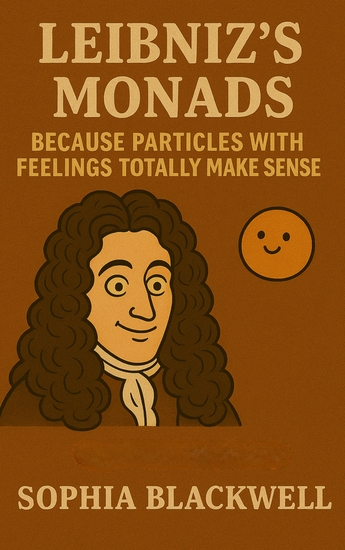
Leibniz’s Monads - Because Particles with Feelings Totally Make Sense - cover

Leibniz’s Monads - Because Particles with Feelings Totally Make Sense

Sophia Blackwell

Publisher: Cogito Ergo Nope

  • 0
  • 0
  • 0

Summary

Ever wondered what reality is made of? If you're thinking atoms, molecules, or maybe regret and caffeine, think again. According to Gottfried Wilhelm Leibniz—17th-century genius, calculus co-inventor, and metaphysical madlad—the universe is made of tiny, windowless soul-particles called monads. They don’t touch, don’t talk, and yet still manage to reflect the entire cosmos like cosmic disco balls of divine insight.In Leibniz’s Monads: Because Particles with Feelings Totally Make Sense, Sophia Blackwell (author of Kant You Not) returns with another brutally honest, laugh-out-loud, actually-informative tour through one of philosophy’s weirdest, most ambitious systems. From the problem of evil to quantum physics, ecology to ethics, this book unpacks Leibniz’s windowless wonders and shows how his soul-marbles still haunt modern science, spirituality, and your existential crisis at 2am.Perfect for students, armchair philosophers, or anyone who wants to understand metaphysics without crying in German.Inside, you’ll learn:
 
What monads are (and why they’re basically metaphysical Tamagotchis)
 
Why your soul is pre-synced with the universe like a divine group project
 
How this is somehow the best possible world (yes, even with all of… this)
 
What quantum physics, computer science, and modern consciousness studies owe to a guy who never left Leipzig
 
And why Leibniz remains philosophy’s most lovable, logic-obsessed optimist
 
If you like philosophy that doesn’t take itself too seriously—but still takes ideas seriously—this book is for you.Warning: May cause sudden belief in soul-particles. Or at least very polite existential confusion.
Available since: 04/16/2025.
Print length: 51 pages.

Other books that might interest you

  • Margaret Thatcher - The Iron Lady - cover

    Margaret Thatcher - The Iron Lady

    50 50minutes

    • 0
    • 0
    • 0
    Keen to learn but short on time? Get to grips with the life of Margaret Thatcher in next to no time with this concise guide.50Minutes.com provides a clear and engaging analysis of Margaret Thatcher. In the 1970s, the United Kingdom was struggling economically in comparison with its stronger European counterparts. Thatcher, the country's first female Prime Minister, recognised the need for drastic economic reform, despite its potential to cause social upheaval. Known for her inflexible and unemotional stance in the face of strikes, the deaths of IRA prisoners, a violent war in the Falklands and even a narrow escape from a bomb in her bedroom, Thatcher remains a divisive figure in politics.In just 50 minutes you will: • Learn about the background of the United Kingdom's famous first female Prime Minister, the Iron Lady • Gain a deeper understanding of Thatcherism, the collective name for Thatcher's economic and social reform policies • Discover the measures taken by Thatcher during her time in power in both domestic and foreign policyABOUT 50MINUTES.COM|History & Culture50MINUTES.COM will enable you to quickly understand the main events, people, conflicts and discoveries from world history that have shaped the world we live in today. Our publications present the key information on a wide variety of topics in a quick and accessible way that is guaranteed to save you time on your journey of discovery.
    Show book
  • Some Damn Fool's Signed the Rubens Again - cover

    Some Damn Fool's Signed the...

    Norman Thelwell

    • 0
    • 0
    • 0
    The artist Norman Thelwell (1923–2004) was famous for his horse and pony cartoons, but his work was far more wide ranging. He focused his exceptional talent and humour on many diverse subjects, with his witty and wry observations providing amusement and sharp social comment.
    
    Some Damn Fool's Signed the Rubens Again is Thelwell's look at life in Britain's stately homes, and what happens when they are opened to the public. Here are the castles, country estates, and the quirks of the British class system all depicted in the artist's inimitable style.
    
    When an ancestral home is crumbling, or an aristocratic family is debt-ridden, the solution calls for drastic action. It is time to welcome in the paying public. Thelwell's cartoons capture the comic situations that result when the noble residents come face to face with the curious visitors. See the duke in his tower preparing to repel the coachloads with boiling oil; a ghost train in the family vault; toddlers wrecking treasured heirlooms; and animals in the safari park watching the hilarious human spectacle unfold.
    Show book
  • Charles Dickens: A short biography - 5 Minutes: Short on time - long on info! - cover

    Charles Dickens: A short...

    5 Minutes, 5 Minute Biographies,...

    • 0
    • 0
    • 0
    Charles Dickens, English novelist of the Victorian Age: Life and work in a short biography! Everything you need to know, brief and concise. Infotainment, education and entertainment at its best!
    Show book
  • Horace - A Very Short Introduction - cover

    Horace - A Very Short Introduction

    Llewelyn Morgan

    • 0
    • 0
    • 0
    Horace was one of the greatest poets during the reign of Augustus and is seen as mark of cultural sophistication since this time. This Very Short Introduction examines how Horace's poetry has exerted enormous influence but argues that it is best understood within the traditions of ancient literature. 


    Llewellyn Morgan guides the listener through the dizzying vagaries of Horace's biography, which reflects the political and social instability of the period. His poetry, and the life he artfully constructs and presents to us in it, engages both with the greatest crisis that Rome had ever faced, and its resolution by the first Emperor. Horace is Rome's laureate, and through him we experience the anxieties and triumphs of his age. For posterity, Horace has served for a model of the good life, a promoter of enlightened retirement, but has also exemplified poetic artistry, and is the most creative manipulator of the Latin language, even among his remarkable contemporaries.
    Show book
  • Authoritarianism and Totalitarianism - Examining the Structure and Influence of Authoritarian Regimes (3 in 1) - cover

    Authoritarianism and...

    Arlo Holders

    • 0
    • 0
    • 0
    This bundle consists of the following books: 
      - Totalitarianism Unmasked: Totalitarianism is a political system in which the state holds total control over every aspect of public and private life, leaving no room for opposition or individual freedoms. Unlike other forms of governance, where political competition and individual rights are somewhat preserved, totalitarianism demands absolute loyalty and conformity. The concept of totalitarianism emerged in the early 20th century, though its roots can be traced back to ancient and medieval periods. In its modern form, it is most closely associated with dictatorial regimes that arose in the aftermath of World War I and throughout the 20th century. 
      - Kleptocracy: Kleptocracy, derived from the Greek words kleptēs (thief) and kratos (rule), refers to a system of governance where leaders exploit their positions of power to enrich themselves at the expense of the public. It is a regime of theft, where corruption is not merely an incidental byproduct of governance but a fundamental aspect of its operation. In kleptocratic systems, the state becomes a tool for personal and collective gain for a small elite, often at the cost of societal well-being and economic development. 
      - Corporatism: Corporatism, as a political and economic system, refers to the integration of corporate and governmental interests, where the lines between the state and private enterprises often blur. It involves the collaboration of various sectors, such as businesses, government, and occasionally labor unions, to form policies and frameworks that benefit the economy and society, but sometimes at the expense of democratic processes. 
    Take advantage of this discounted box set right now!
    Show book
  • Ireland - Historical Background and Interesting Facts - cover

    Ireland - Historical Background...

    Kelly Mass

    • 0
    • 0
    • 0
    This is a combo of two titles, which are about the following topics: 
    The Partition of Ireland: The Federal government of the U.K. of Great Britain and Ireland segmented Ireland into 2 independent polities: Northern Ireland and Southern Ireland. The government of Ireland Act 1920 was handed down May third, 1921. Both parts were to stay inside the UK, and the Act included arrangements for supreme reunification. 
    Northern Ireland was established with a devolved federal government and stayed a part of the U.K. Most occupants of Southern Ireland didn't recognize the self-proclaimed Irish Republic, choosing to recognize the larger Northern Ireland. The area of Southern Ireland withdrew from the U.K. and ended up being the Irish Free State, which is today the Republic of Ireland, following the Anglo-Irish Treaty. 
    The Irish Potato Famine: The year 1847, at times called "Black '47," was the absolute worst year of the period. Around 1 million people died and over a million left the nation throughout the Great Cravings, triggering the nation's population to come by 20% to 25%, with certain cities coming by as much as 67 percent between 1841 and 1851. And between the years 1845 and 1855, about 2.1 million people were leaving Ireland, primarily aboard package ships but also on steamboats and barks. This actually made it one of the biggest mass migrations from a single isle in all of history. 
    Let’s explore this tragic event in history, and let’s see what led up to this, what happened afterwards, and how historians look at it now.
    Show book