Join us on a literary world trip!
Add this book to bookshelf
Grey
Write a new comment Default profile 50px
Grey
Subscribe to read the full book or read the first pages for free!
All characters reduced
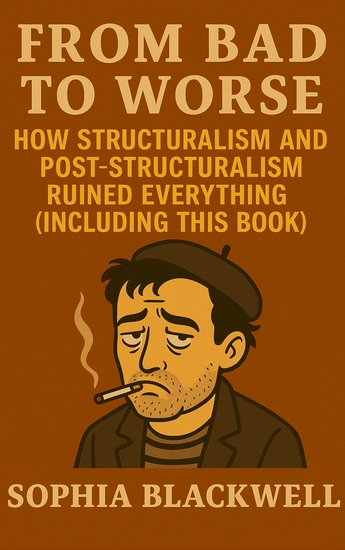
From Bad to Worse - How Structuralism and Post-Structuralism Ruined Everything - cover

From Bad to Worse - How Structuralism and Post-Structuralism Ruined Everything

Sophia Blackwell

Publisher: Cogito Ergo Nope

  • 0
  • 0
  • 0

Summary

Finally, an academic roast that's more entertaining than a faculty meeting where someone brought donuts! "From Bad to Worse" mercilessly skewers the most pretentious philosophical movements of the 20th century with savage wit and zero academic mercy.Journey through the incomprehensible world of structuralism and post-structuralism, where French intellectuals transformed simple ideas into impenetrable word salads while chain-smoking and looking disappointed with everyone. From Saussure's arbitrary signs to Derrida's made-up words, from Lévi-Strauss finding patterns nobody asked for to Foucault seeing power dynamics in your breakfast cereal, this book translates academic gibberish into hilarious plain English.Whether you're a traumatized humanities student seeking revenge on the theorists who destroyed your GPA, a curious reader wondering why anyone takes these ideas seriously, or just someone who enjoys watching pretentious nonsense get thoroughly roasted, this irreverent guide delivers. You'll learn why binary oppositions are the intellectual equivalent of sorting blocks, how to deconstruct everything except your own bank statements, and why academic writing became a competition to see who could be least understood.Warning: Reading this book in public may cause uncontrollable snorting, concerned looks from strangers, and the disturbing realization that despite everything, these insufferable French people occasionally stumbled onto something useful. Side effects include never being able to hear the word "problematize" without eye-rolling.
Available since: 04/30/2025.
Print length: 55 pages.

Other books that might interest you

  • The Matryoshka Memoirs - A Story of Ukrainian Forced Labour the Leica Camera Factory and Nazi Resistance - cover

    The Matryoshka Memoirs - A Story...

    Sasha Colby

    • 0
    • 0
    • 0
    “[Colby] breathes new life into well-trodden WWII tropes, building a vivid, novelistic narrative focused on memory and family.” — Publishers Weekly
    		 
    “The writing is vivid and lyrical, the narratives are arresting, and the women are unforgettable.” — Craig Howes, Director, Center for Biographical Research, University of Hawaiʻi at Mānoa
    		 
    A remarkable story of strength and resilience in the crucible of Nazi Germany
    		 
    Irina Nikifortchuk was 19 years old and a Ukrainian schoolteacher when she was abducted to be a forced laborer in the Leica camera factory in Nazi Germany. Eventually pulled from the camp hospital to work as a domestic in the Leica owners’ household, Irina survived the war and eventually found her way to Canada.
    		 
    Decades later Sasha Colby, Irina’s granddaughter, seeks out her grandmother’s story over a series of summer visits and gradually begins to interweave the as-told-to story with historical research. As she delves deeper into the history of the Leica factory and World War II forced labor, she discovers the parallel story of Elsie Kühn-Leitz, Irina’s rescuer and the factory heiress, later imprisoned and interrogated by the Gestapo on charges of “excessive humanity.”
    		 
    This is creative nonfiction at its best as the mystery of Irina’s life unspools skillfully and arrestingly. Despite the horrors that the story must tell, it is full of life, humor, food, and the joy of ordinary safety in Canada. The Matryoshka Memoirs takes us into a forgotten corner of history, weaving a rich and satisfying tapestry of survival and family ties and asking what we owe those who aid us.
    Show book
  • Philosophy - Exploring Life's Big Questions and Timeless Wisdom - cover

    Philosophy - Exploring Life's...

    Coral Nunez

    • 0
    • 0
    • 0
    Philosophy, at its core, is the study of fundamental questions about existence, knowledge, values, reason, and the human condition. It is not merely an academic subject but a way of thinking, questioning, and understanding the world. The term "philosophy" comes from the Greek words "philo" (love) and "sophia" (wisdom), meaning "the love of wisdom." This pursuit of wisdom has been a defining aspect of human civilization for thousands of years, shaping our perspectives on reality, morality, and truth. 
    One of the key aspects of philosophy is its role in fostering critical thinking. Philosophers do not accept ideas at face value but engage in rational inquiry, examining beliefs and assumptions. This is why philosophy often begins with questions rather than answers. What is real? How do we know what we know? What is the purpose of life? These questions are not easily answered, yet they push us to think deeply about our existence. 
    Philosophy is divided into several branches, each focusing on different aspects of human thought. Metaphysics explores the nature of reality, asking questions about existence, time, and the universe. Epistemology deals with the nature and limits of knowledge—how we acquire it and whether absolute truth exists. Ethics examines the principles of right and wrong, guiding moral behavior. Logic studies the structure of reasoning, ensuring that arguments are sound and rational. Political philosophy and aesthetics, while sometimes considered separate disciplines, also fall under the broader philosophical umbrella, dealing with justice, governance, and beauty.
    Show book
  • Cam's Chance - cover

    Cam's Chance

    Lisa Oliver

    • 0
    • 0
    • 0
    Arrowtown Book 5 
    Can be listened to as a standalone 
    Camden "Cam" Stone had a long past and a hard life. For the past ten years he'd kept up the façade of a businessman, running the only bar in Arrowtown. The hours were long, but the people were friendly and if he didn't share much about himself, no one seemed to care. But all that changed when a new baker came to town - a baker with a flippant personality and skills the whole town were soon talking about. Nobody could be that perfect, could they? 
    "Fabulous" Fergus Ferdinand was a bull shifter, and yes, his momma did have a sense of humor, once. Having been away from his fold for years, he'd come to the shifter town, in the hopes of building a business that would be good enough to convince his momma to come and live with him. From the moment he opened his bakery doors, people flocked to buy from him, eager for the new sweet sensations his business offered. So, it was understandable, when the gruff bar owner seemed immune to his sweet things and his sunny personality, that Fergus was a bit surprised.  
    Unfortunately, Cam's suspicious nature, and his subsequent investigation into Fergus creates a whole stack of problems for the unlikely pair. Throw in a pair of pink unicorn pants, a momma in desperate need of saving, and a wolf with an éclair addiction and the couple are kept busy twenty-four seven. Just when they get to the point where the two men can take a breath, Fergus gets sick... and a whole stack of new challenges crop up.  
    This is an MM Mpreg Fated Mates story. Although, it can be read as a standalone, reading the previous books will give you more understanding of the secondary characters. There is snarky humor, some violence, and a lot of sweet treats. As this book is intended for adults only, please store your entertainment responsibly. 
    Show book
  • Predator - A Memoir a Movie an Obsession - cover

    Predator - A Memoir a Movie an...

    Ander Monson

    • 0
    • 0
    • 0
    In his first memoir, Ander Monson guides listeners through a scene-by-scene exploration of the 1987 film Predator, which he has watched 146 times. Some fighters might not have time to bleed, but Monson has the patience to consider their adventure, one frame at a time. He turns his obsession into a lens through which he poignantly examines his own life, formed by mainstream, white, male American culture. Between scenes, Monson delves deeply into his adolescence in Michigan's Upper Peninsula and Riyadh, his role as a father and the loss of his own mother, and his friendships with men bound by the troubled camaraderie depicted in action and sci-fi blockbusters. Along with excursions into the conflicted pleasures of cosplay and first-person shooters, he imagines himself beside the poet and memoirist Paul Monette, who wrote the novelization of the movie while his partner was dying of AIDS. 


    A sincere and playful book that lovingly dissects the film, Predator also offers questions and critiques of masculinity, fandom, and their interrelation with acts of mass violence. In a stirring reversal, one chapter exposes Monson through the Predator's heat-seeking vision, asking him, "What do you know about the workings of the hidden world?" As Monson brings us into the brilliant depths of the film and its universe, the hunt begins.
    Show book
  • The 6 Pillars of Intimacy Conflict Resolution - The Secret to Breaking the Conflict Cycle in Your Marriage - cover

    The 6 Pillars of Intimacy...

    Alisa DiLorenzo, Tony DiLorenzo

    • 0
    • 0
    • 0
    Get a proven marriage expert-designed formula to help you resolve arguments in a healthy way! 
    Do you feel like you and your spouse are tip-toeing around each other? When you disagree, do you often find yourselves in one of these common scenarios - walking away completely or blowing up at one another? Haven’t found that missing puzzle piece yet, and feel stuck in the same old rut of arguments that go round and round and never get resolved? 
    It’s time for you to have a healthy way of tackling conflict when it arises. Why? Because you deserve to have a respectful, loving marriage where each of you can hold space for different opinions. 
    Authors Alisa and Tony DiLorenzo are passionate about helping couples create their own extraordinary marriages. They do this through their books and their top-rated marriage podcast, "The ONE Extraordinary Marriage Show," through which they connect with an audience of over 50,000 listeners around the world. The 6 Pillars of Intimacy Conflict Resolution is based on their personal experience and from seeing the marriages of countless people they have worked with improve. They have discovered key principles that have kept many marriages alive and flourishing. Let them do the same for you! 
    Inside, you’ll discover:How to visualize what’s actually happening to you and your spouse during the conflict cycle, and know when to stop, reflect, and redirect before a disagreement spirals out of controlHow to understand the key triggers behind the thoughts, emotions, and feelings that typically arise when you are in opposition with your spouseHow to recognize patterns in ‘how’ you argue so you can identify a more effective way to interrupt themAnd more… 
    Conflict is a natural occurrence in all thriving relationships. And if you weren’t taught how to handle it effectively, you’re not to blame. Break the cycle of dysfunctional arguments today.
    Show book
  • Race to the Moon The: The History and Legacy of the Cold War Competition Between the Soviet Union and the United States - cover

    Race to the Moon The: The...

    Editors Charles River

    • 0
    • 0
    • 0
    Today the Space Race is widely viewed poignantly and fondly as a race to the Moon that culminated with Apollo 11 “winning” the Race for the United States. In fact, it encompassed a much broader range of competition between the Soviet Union and the United States that affected everything from military technology to successfully launching satellites that could land on Mars or orbit other planets in the Solar System. Moreover, the notion that America “won” the Space Race at the end of the 1960s overlooks just how competitive the Space Race actually was in launching people into orbit, as well as the major contributions the Space Race influenced in leading to today’s International Space Station and continued space exploration. 
    	In fact, the Soviet Union had spent much of the 1950s leaving the United States in its dust (and rocket fuel). President Eisenhower and other Americans who could view Soviet rockets in the sky were justifiably worried that Soviet satellites in orbit could soon be spying on them, or, even worse, dropping nuclear bombs on them. And in 1960, when Eisenhower’s administration began planning and funding for the famous Apollo program that would land the first men on the Moon in 1969, the Soviet Union was already thinking further ahead to Mars. 
    	During the 1960s, NASA would spend tens of billions on the Apollo missions, the most expensive peacetime program in American history to that point, and even though Apollo 11 was only one of almost 20 Apollo missions, it was certainly the crown jewel. only one of nearly 20 Apollo missions conducted by NASA. And to make Apollo 11 a success, it would take nearly a decade of planning by government officials, hard work by NASA scientists, intense training by the astronauts, and several missions preceding Apollo 11. It also cost over $20 billion, making the Apollo program the most expensive peacetime program in American history at the time.
    Show book