Join us on a literary world trip!
Add this book to bookshelf
Grey
Write a new comment Default profile 50px
Grey
Subscribe to read the full book or read the first pages for free!
All characters reduced
Summary and Analysis of Man's Search for Meaning - A Study Guide to Viktor Frankl's Book - cover

Summary and Analysis of Man's Search for Meaning - A Study Guide to Viktor Frankl's Book

Snap Read

Publisher: Snap Read

  • 0
  • 0
  • 0

Summary

Too busy to read it all? This quick summary and analysis of Man's Search for Meaning provides key insights, making it ideal for before or after reading Viktor Frankl's book. Snap Read provides you with quality resources to become a well-informed reader.

In Man's Search for Meaning, Viktor Frankl, a psychiatrist and Holocaust survivor, reflects on his experiences in concentration camps and explores the human capacity to find meaning even in the most dire circumstances. He introduces the concept of logotherapy, a form of psychotherapy that focuses on helping individuals discover their unique purpose in life.

This short summary and analysis includes:

	Background information about the book.
	Chapter-to-chapter summaries.
	Analyses.
	Important Quotes
	A helpful guide to better understand the original work.

The summary and analysis in this e-book are here to enhance your reading experience and help you appreciate a great book.
Available since: 05/06/2024.
Other books that might interest you

  • For Whom the Bell Tolls by Ernest Hemingway (Book Analysis) - Detailed Summary Analysis and Reading Guide - cover

    For Whom the Bell Tolls by...

    Bright Summaries

    • 0
    • 0
    • 0
    Unlock the more straightforward side of For Whom the Bell Tolls with this concise and insightful summary and analysis!This engaging summary presents an analysis of For Whom the Bell Tolls by Ernest Hemingway, one of the author's most famous and widely acclaimed novels. It draws on the author's own experience as a war correspondent during the Spanish Civil War, and tells the story of Robert Jordan, a demolitions specialist who is sent to blow up a bridge and unexpectedly finds love, comradeship and a greater understanding of humanity in the three days that follow. For Whom the Bell Tolls was unanimously recommended for the Pulitzer Prize for Fiction in 1941, but and after a complaint was lodged over the novel's explicit content, no award was given that year. Hemingway won the Nobel Prize for Literature in 1954 and, along with contemporaries such as F. Scott Fitzgerald and John Steinbeck, is considered one of the most important writers of the so-called "Lost Generation".Find out everything you need to know about For Whom the Bell Tolls in a fraction of the time!This in-depth and informative reading guide brings you:• A complete plot summary• Character studies• Key themes and symbols• Questions for further reflectionWhy choose BrightSummaries.com?Available in print and digital format, our publications are designed to accompany you on your reading journey. The clear and concise style makes for easy understanding, providing the perfect opportunity to improve your literary knowledge in no time.See the very best of literature in a whole new light with BrightSummaries.com!
    Show book
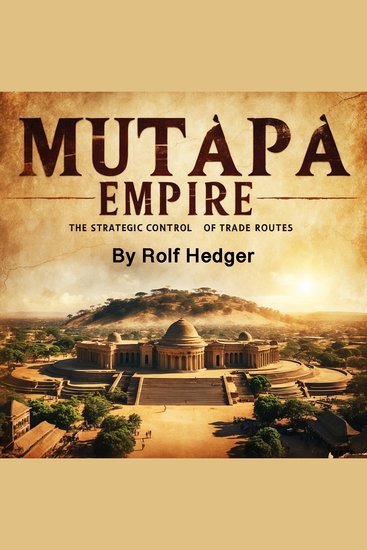
  • Mutapa Empire - The Strategic Control of Trade Routes - cover

    Mutapa Empire - The Strategic...

    Rolf Hedger

    • 0
    • 0
    • 0
    The Mutapa Empire, also known as the Kingdom of Mutapa, emerged in the 15th century as a powerful Shona state in southern Africa. Its origins are deeply rooted in the earlier civilizations of the region, particularly the Kingdom of Great Zimbabwe, from which it inherited its political structures, trade networks, and cultural traditions. As Great Zimbabwe began to decline due to overpopulation, resource depletion, and internal conflicts, new centers of power arose, with Mutapa becoming the most dominant. 
    According to oral tradition, the empire was founded by a prince named Nyatsimba Mutota, who left Great Zimbabwe in search of new resources, particularly salt. His journey led him northward, where he conquered smaller communities and established a new political center. Mutota’s leadership allowed him to unite different groups under his rule, forming the early foundations of the Mutapa Empire. His successors, particularly his son Matope, expanded the empire further, consolidating power over a vast territory that included present-day Zimbabwe, Mozambique, and parts of Zambia and South Africa. 
    The name “Mutapa” itself carries significant meaning, often interpreted as “conqueror” or “master pillager,” reflecting the empire’s expansionist nature. The title “Mwene Mutapa” was given to its rulers, signifying supreme authority over both the people and the land. Under this leadership, the empire became highly centralized, with the Mwene Mutapa holding absolute power while relying on regional chiefs to manage local governance. This political structure allowed for effective control over its vast territories and trade networks.
    Show book
  • Hidden History of Rockland & St George - cover

    Hidden History of Rockland & St...

    Jane Merrill

    • 0
    • 0
    • 0
    Down East Maine is well known for its breathtaking scenery and art museums. However, much of the history in the traditional mining and fishing area of Rockland and St. George remains untold.  Hanson Gregory from Clam Cove invented the donut. Mary Brown Patten sailed a clipper around Cape Horn. Captain Albert Keller was shipwrecked on Easter Island and Effie Canning of Rockland composed the lullaby "Rock a Bye Baby." Captain Charles Holbrook of Tenants Harbor and his ship, the Hattie Dunn, fell victim to a German U-boat in the Atlantic.  Local author Jane Merrill uncovers the forgotten stories and personalities that bring this unique area's history into focus.
    Show book
  • Sex and Race - A History of White Negro and Indian Miscegenation in the Two Americas Volume 2: The New World - cover

    Sex and Race - A History of...

    J. A. Rogers

    • 0
    • 0
    • 0
    In the Sex and Race series, first published in the 1940s, historian Joel Augustus Rogers questioned the concept of race, the origins of racial differentiation, and the root of the "color problem." Rogers surmised that a large percentage of ethnic differences are the result of sociological factors and in these volumes he gathered what he called "the bran of history"—the uncollected, unexamined history of black people—in the hope that these neglected parts of history would become part of the mainstream body of Western history. Drawing on a vast amount of research, Rogers was attempting to point out the absurdity of racial divisions. Indeed his belief in one race—humanity—precluded the idea of several different ethnic races. The series marshals the data he had collected as evidence to prove his underlying humanistic thesis: that people were one large family without racial boundaries. Self-trained and self-published, Rogers and his work were immensely popular and influential during his day, even cited by Malcolm X. The books are presented here in their original editions.
    Show book
  • Vegetius: Epitome of Military Science - Epitome of Military Science - cover

    Vegetius: Epitome of Military...

    Flavius Vegetius Renatus

    • 0
    • 0
    • 0
    The only Latin art of war to survive, Vegetius’ Epitome was for long a part of the medieval prince’s military education. The core of his proposals, the maintenance of a professional standing army, was revolutionary for medieval Europe, while his theory of deterrence through strength remains the foundation of modern Western defence policy.
    Show book
  • The Importance of Being Educable - A New Theory of Human Uniqueness - cover

    The Importance of Being Educable...

    Leslie Valiant

    • 0
    • 0
    • 0
    If we hope to share our planet successfully with one another and the AI systems we are creating, we must reflect on who we are, how we got here, and where we are heading. The Importance of Being Educable puts forward a provocative new exploration of the extraordinary facility of humans to absorb and apply knowledge. The remarkable "educability" of the human brain can be understood as an information processing ability. It sets our species apart, enables the civilization we have, and gives us the power and potential to set our planet on a steady course. While we can readily absorb systems of thought about worlds of experience beyond our own, we struggle to judge correctly what information we should trust. 


    In this visionary book, Leslie Valiant argues that understanding the nature of our own educability is crucial to safeguarding our future. After breaking down how we process information to learn and apply knowledge, and drawing comparisons with other animals and AI systems, he explains why education should be humankind's central preoccupation. 


    Will the unique capability that has been so foundational to our achievements and civilization continue to drive our progress, or will we fall victim to our vulnerabilities? If we want to protect our collective future, we must better understand and prioritize the importance of being educable.
    Show book