Join us on a literary world trip!
Add this book to bookshelf
Grey
Write a new comment Default profile 50px
Grey
Subscribe to read the full book or read the first pages for free!
All characters reduced
Summary and Analysis of Hillbilly Elegy - A Study Guide to J D Vance's Book - cover

Summary and Analysis of Hillbilly Elegy - A Study Guide to J D Vance's Book

Snap Read

Publisher: Snap Read

  • 0
  • 0
  • 0

Summary

Too busy to read it all? This quick summary and analysis of Hillbilly Elegy: A Memoir of a Family and Culture in Crisis provides key insights, making it ideal for before or after reading J. D. Vance's book. Snap Read provides you with quality resources to become a well-informed reader.

In Hillbilly Elegy, Vance shares his personal story of growing up in a poor, white working-class family in Appalachia. He explores the social, economic, and cultural factors that have contributed to the struggles of his community, offering a raw and honest look at the challenges and complexities of the "hillbilly" identity.

This short summary and analysis includes:

	Background information about the book.
	Chapter-to-chapter summaries.
	Analyses.
	Important Quotes
	A helpful guide to better understand the original work.

The summary and analysis in this e-book are here to enhance your reading experience and help you appreciate a great book.
Available since: 08/07/2024.

Other books that might interest you

  • Insane Consequences - How the Mental Health Industry Fails the Mentally Ill - cover

    Insane Consequences - How the...

    DJ Jaffe, MD E. Fuller Torrey

    • 0
    • 0
    • 0
    This well-researched and highly critical examination of the state of our mental health system by the industry's most relentless critic presents a new and controversial explanation as to why—in spite of spending $147 billion annually—140,000 seriously mentally ill are homeless, 390,000 are incarcerated, and even educated, tenacious, and caring people can't get treatment for their mentally ill loved ones. DJ Jaffe blames the mental health industry and the government for shunning the 10 million adults who are the most seriously mentally ill—mainly those who suffer from schizophrenia and severe bipolar disorder—and, instead, working to improve "mental wellness" in 43 million others, many of whom are barely symptomatic. Using industry and government documents, scientific journals, and anecdotes from his thirty years of advocacy, Jaffe documents the insane consequences of these industry-driven policies: psychiatric hospitals for the seriously ill are still being closed; involuntary commitment criteria are being narrowed to the point where laws now require violence rather than prevent it; the public is endangered; and the mentally ill and their families are forced to suffer.
    Show book
  • Profit over Privacy - How Surveillance Advertising Conquered the Internet - cover

    Profit over Privacy - How...

    Matthew Crain

    • 0
    • 0
    • 0
    In Profit over Privacy, Matthew Crain gives internet surveillance a much-needed origin story by chronicling the development of its most important historical catalyst: web advertising. 


    Profit over Privacy uses the 1990s as its backdrop to show how the massive data-collection infrastructure that undergirds the internet today is the result of twenty-five years of technical and political economic engineering. Crain considers the social causes and consequences of the internet's rapid embrace of consumer monitoring, detailing how advertisers and marketers adapted to the existential threat of the internet and marshaled venture capital to develop the now-ubiquitous business model called "surveillance advertising." He draws on a range of primary resources from government, industry, and the press and highlights the political roots of internet advertising to underscore the necessity of political solutions to reign in unaccountable commercial surveillance. 


    Surveillance advertising is the result of political choices—not the inevitable march of technology. Unlike many other countries, the United States has no internet privacy law. A fascinating prehistory of internet advertising giants like Google and Facebook, Profit over Privacy argues that the internet did not have to turn out this way and that it can be remade into something better.
    Show book
  • The Art of Poetry - cover

    The Art of Poetry

    Rachel Lawson

    • 0
    • 0
    • 0
    nice poems read by the author
    Show book
  • Between Two Rivers - Ancient Mesopotamia and the Birth of History - cover

    Between Two Rivers - Ancient...

    Moudhy Al-Rashid

    • 0
    • 0
    • 0
    Thousands of years ago, in a part of the world we now call ancient Mesopotamia, people began writing things down for the very first time. 


    What they left behind, in a vast region between the Tigris and Euphrates rivers, preserves leaps in human ingenuity. But they also capture breathtakingly intimate, raw, and relatable moments, like a dog's paw prints as it accidentally stepped into fresh clay, or the imprint of a child's teeth. 


    In Between Two Rivers, historian Dr. Moudhy Al-Rashid reveals what these ancient people chose to record about their lives. We find a lullaby to soothe a baby, countless receipts for beer, and the messy writing of preschoolers. We meet an enslaved person negotiating their freedom, an astronomer tracing the movement of the planets, a princess who may have created the world's first museum, and a working mother struggling with "the juggle" in 1900 BCE. 


    Millennia ago, Mesopotamians saw the world's first cities, the first writing system, early seeds of agriculture, and groundbreaking developments in medicine and astronomy. With breathtaking intimacy and grace, Al-Rashid brings their lives―with all their anxieties, aspirations, and intimacies―vividly close to our own.
    Show book
  • Sophist - cover

    Sophist

    Plato

    • 0
    • 0
    • 0
    In "Sophist," Plato explores the nature of sophistry and the elusive concept of being. Through engaging dialogues, the characters delve into the intricacies of language, existence, and the art of persuasion. The pursuit of truth and the examination of reality unfold in this philosophical exploration. Read in English, unabridged.
    Show book
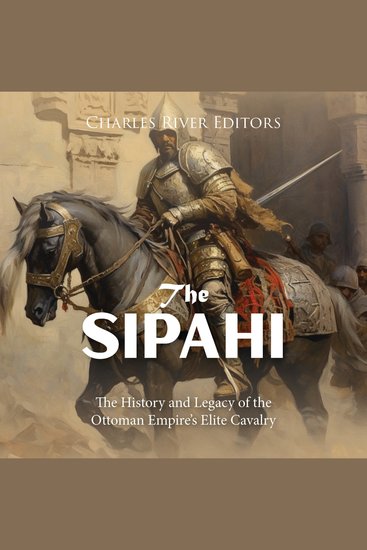
  • Sipahi The: The History and Legacy of the Ottoman Empire’s Elite Cavalry - cover

    Sipahi The: The History and...

    Editors Charles River

    • 0
    • 0
    • 0
    Among those who were responsible for the projection of Ottoman power, few deserve as much credit as the Sipahi. Civilizations across the steppes and the Middle East relied heavily on cavalry, and the Sipahi were elite cavalry units during medieval times for a couple of powers. That said, they were a massive contributor to the success of Ottoman warfare, and during good times for the empire, the Sipahi were rewarded, to the extent that they became their own social class, much like the Janissaries. In fact, much the way the Janissaries became less effective over time as being one denoted social status, the Sipahi and Janissaries had class resentments among each other, one of the various cracks in the Ottoman Empire that would help bring about its decline.  
    	As a result, the Sipahi’s private lives in the Ottoman Empire were varied and complex, depending on their social status, wealth, education, and religion. Their homes were often luxuriously decorated, and they were usually portrayed as highly-educated and sophisticated people. The Sipahi frequently had several wives and concubines, and their houses were equipped to accommodate their many guests. They had harems, where they kept their concubines and slaves, and the maintenance of their harems was important for each Sipahi's reputation and status. Their wives and concubines were often confined to the harem, and they did not have much freedom, but in some cases, especially in wealthier families, the women were educated and had an active social life. Furthermore, the Sipahi were often involved in art, music, and writing poetry. They had castles and villas they used for parties and social events, and they were also known for organizing hunts and other sporting activities. Many of them were also highly educated and engaged in the sciences, such as mathematics, astronomy, and philosophy.
    Show book