Join us on a literary world trip!
Add this book to bookshelf
Grey
Write a new comment Default profile 50px
Grey
Subscribe to read the full book or read the first pages for free!
All characters reduced
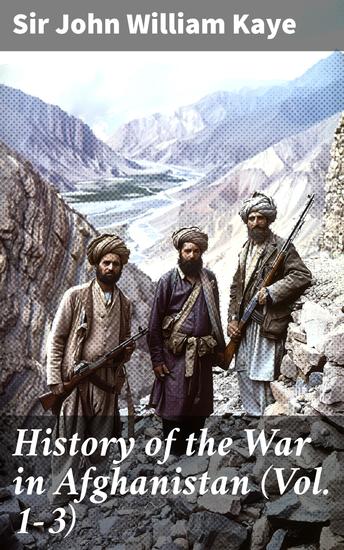
History of the War in Afghanistan (Vol 1-3) - Complete Edition - cover

History of the War in Afghanistan (Vol 1-3) - Complete Edition

Sir John William Kaye

Publisher: Good Press

  • 0
  • 0
  • 0

Summary

In "History of the War in Afghanistan (Vol. 1-3)," Sir John William Kaye presents a rigorous and detailed examination of the First Anglo-Afghan War (1839-1842), unfolding the political and military complexities that characterized this tumultuous period. Kaye employs a blend of meticulous historical research and vivid narrative to explore the intricacies of British imperial ambitions, Afghan resistance, and the socio-political dynamics at play. His work is noted for its analytical depth and its incorporation of a variety of sources, including official documents, personal narratives, and contemporary accounts, providing readers with a comprehensive understanding of the war's implications within the broader context of British colonial policy in South Asia. Kaye, an accomplished historian and soldier himself, drew from his firsthand experiences in India and his intimate knowledge of the region and its people. His scholarly pursuits were deeply influenced by his complex relationships with both British military expeditions and Afghan society, imbuing his work with a balanced perspective that considers the nuances of culture and conflict. Those experiences allowed him to craft a narrative that is not just a military account, but a deeper commentary on the socio-political landscape of the time. This compelling work is indispensable for anyone seeking to comprehend the roots of modern geopolitical tensions in Afghanistan and the historical context of British imperialism. Kaye'Äôs insightful narrative not only enriches our understanding of a pivotal moment in history but also invites readers to reflect on the timeless themes of ambition, tragedy, and the consequences of war. History enthusiasts, students, and scholars alike will find Kaye'Äôs meticulous research and engaging style both informative and thought-provoking.
Available since: 12/18/2023.
Print length: 1175 pages.
Other books that might interest you

  • The Revolution Betrayed - What Is the Soviet Union and Where Is It Going? - cover

    The Revolution Betrayed - What...

    Leon Trotsky

    • 0
    • 0
    • 0
    It is June 1936. Leon Trotsky (1879-1940) has finally been granted a visa for asylum in Norway, having been banned first from living in Paris, and then the whole of France. With him comes the draft of The Revolution Betrayed: What Is the Soviet Union and Where Is It Going?, which is completed and sent to the publishers on the 4th of August. The book, published by Faber in 1937, is considered to be Trotsky’s major work on Stalinism. Trotsky’s passion for the spirit of the Revolution he co-founded, his disgust and sadness at how the people of Russia have been betrayed by Stalin and his acolytes, shows us the bleak lives of 170 million Russians under the absolute control of ‘the Ten Thousand’ of the bureaucracy.  
     
    Trotsky reminds us of the high concepts of the 1917 October Revolution, (Marx’s 'From each according to his ability, to each according to his needs') with the sharing of the nation’s resources for the benefit of all. Prominent among such forward thinking was the commitment to lift women out of the trap of housework and childbirth by communal refectories and creches in the workplace. He praises the positive economic advances of the USSR since the death of Lenin - the growth in areas such as industrial and electrical output. But he notes the continued and inevitable low productivity (much lower than the capitalist West, he acknowledges) that is the result of lack of incentive for the Soviet worker. This, he argues, will never allow the country to lift itself up to full potential, despite Stalin’s ever-changing Five-Year Plans. 
     
    Indeed, it is this zig-zagging of panicked policy and bovine directionlessness that frustrates Trotsky so much. It is bad enough that Stalin and his self-serving cohorts have formed a Thermidorian regime of brutal repression and conservative nest-feathering. But even worse, their economic adventurism is carrying ‘the nation to the edge of disaster’.  
     
    Trotsky brings us a clear picture of the miserable existence of the vast majority of Russians, barely surviving on bad rations, endemic corruption and fear, and the promise of a tomorrow that will never come. He laments the lack of a proletarian uprising in the West that might encourage Russians to change their own off-course regime. He notes the rise of Hitler and Mussolini, and seems, even in 1936, to see war as inevitable. He predicts the toppling of Stalinism but would have wept at how many decades it took and how many millions of lives would be wasted by stupidity and war.  
     
    Only 10 days after Trotsky sent this book to the publishers, Stalin announced the first of the Moscow show trials that began the Great Purge. Trotsky and his wife were badly treated and muzzled by the Norwegians to prevent his protesting at Stalin’s actions, and they moved to Mexico City in early 1937. There they lived, terrorized by Stalin’s determination to assassinate his old rival, until Trotsky’s death following a blow from an ice pick on 20th August 1940. The Revolution Betrayed, with its vivid translation by Max Eastman, is presented with clarity and commitment by Jonathan Booth.
    Show book
  • Manipulation - What It Is Why It's Bad What to Do About It - cover

    Manipulation - What It Is Why...

    Cass R. Sunstein

    • 0
    • 0
    • 0
    New technologies are offering companies, politicians, and others unprecedented opportunity to manipulate us. Sometimes we are given the illusion of power—of freedom—through choice, yet the game is rigged, pushing us in specific directions that lead to less wealth, worse health, and weaker democracy. In Manipulation, nudge theory pioneer and New York Times bestselling author Cass Sunstein offers a new definition of manipulation for the digital age, explains why it is wrong, and shows what we can do about it. He reveals how manipulation compromises freedom and personal agency, while threatening to reduce our well-being; he explains the difference between manipulation and unobjectionable forms of influence, including "nudges"; and he lifts the lid on online manipulation and manipulation by artificial intelligence, algorithms, and generative AI, as well as threats posed by deepfakes, social media, and "dark patterns," which can trick people into giving up time and money. Drawing on decades of groundbreaking research in behavioral science, this landmark book outlines steps we can take to counteract manipulation in our daily lives and offers guidance to protect consumers, investors, and workers.
    Show book
  • Who's Really Driving Your Emotional Bus? - cover

    Who's Really Driving Your...

    Ph.D. James Henman

    • 0
    • 0
    • 0
    -You can learn to recognize who is REALLY driving your emotional bus in the most difficult "traffic" areas of your life. 
    -You can learn how to relax into making healthy changes in the present by approaching life with No-Fault Learning. 
    -You can learn how to recognize and change faulty Perceptual Filters that rob you of a healthy power and awareness. 
    -You can learn how to apply the Fundamental Principles of Healthy Change and develop core Self-Esteem. 
    -You can gain the tools and skills necessary to empower your own Inner Coach as you shift from survival mode into living consciously.
    Show book
  • The Gospel Crux - The Hidden Torah of Jesus - cover

    The Gospel Crux - The Hidden...

    J K Vaidyan

    • 0
    • 0
    • 0
    The Gospel Crux is a fresh look at the teachings of Jesus in the context of their Hebrew origins.The current versions are not working. If they were, the world around us would not keep going to pieces every now and then. Lost in translation, disoriented through cultural appropriation and transmitted across millennia, the versions handed down to us are both enhanced and redacted, far removed from its original context and blurred by the passage of time.Hebrew is a language rich in metaphors and literary devices like synonymous parallelism and hyperbole that emphasize and reinforce key messages. It does not easily lend itself to translation into Greek, Latin or English. The Gospel Crux re-interprets Hebrew words and metaphors used by Jesus to explore what his teachings would have meant to those hearing him firsthand. Words and phrases like Gospel, Heaven, Hell, Love, Soul, Holy Spirit and Eternal Life take on new meanings when viewed from this frame of reference.A key example is the command to love your neighbor as yourself. When asked “who is my neighbor”, Jesus relates the parable of the Good Samaritan. All the characters are strangers to each other. Love does not show up in this parable. Acts of service and of going the extra mile for a stranger are our takeaways. Jesus tops it up with the instruction to go and do likewise.This brings us to the concept of self. “Deny yourself. Take up your cross and follow me.” This is our understanding of what Jesus had said. “Deny yourself” is not two words. “Deny your Self” has three words. And the cross is the execution stake of self-negation. When all of this is read and understood together it reveals a well-kept secret of Jewish, Buddhist, Hindu and Lao Tzu’s philosophies. That our “I” is a story we tell ourselves.Through this alternate rendering of the words of Jesus, The Gospel Crux explores how we can find the peace of God that surpasses all understanding in our lives; the truth that will set your “I” free.
    Show book
  • Politics: Book Summary & Analysis - cover

    Politics: Book Summary & Analysis

    Briefly Summaries

    • 0
    • 0
    • 0
    This is a concise summary and analysis of Politics, by Aristotle.
    It is not the original book and is not affiliated with or endorsed by 
    Aristotle.
     
    Ideal those seeking a quick and insightful overview.
     
    Delve into the timeless exploration of human society and governance in Politics, a foundational work of political philosophy. This seminal text examines the nature of citizenship, justice, and the ideal forms of government, offering profound insights into the complexities of human organization and the pursuit of the common good. With reflections on ethics, economics, and the interplay of individual and collective interests, Politics remains a vital resource for understanding the philosophical roots of modern political systems.
    Show book
  • The Art of War - Niccolò Machiavelli - cover

    The Art of War - Niccolò...

    Niccolò Machiavelli

    • 0
    • 0
    • 0
    Discover Niccolò Machiavelli's "The Art of War", a timeless treatise on military strategy, politics, and the principles of governance. 
     
    In this profound work, Machiavelli examines the relationship between war, power, and the stability of the state, offering insights that remain relevant for leaders and strategists today. 
     
    This audiobook presents a compelling exploration of the balance between military strength and civic virtue, making it an essential listen for those interested in history, politics, and the art of leadership.
    Show book