Join us on a literary world trip!
Add this book to bookshelf
Grey
Write a new comment Default profile 50px
Grey
Subscribe to read the full book or read the first pages for free!
All characters reduced
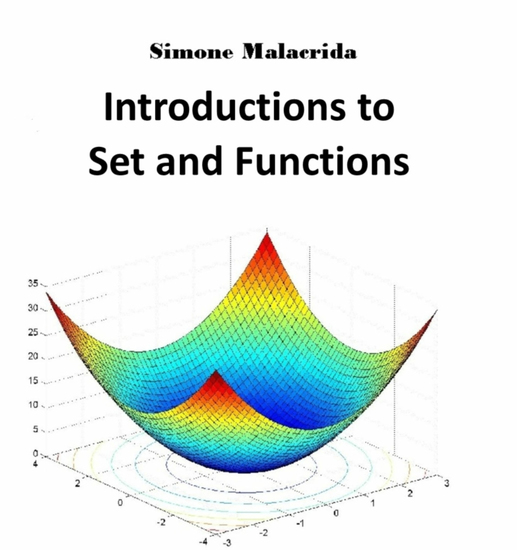
Introduction to Set and Functions - cover

Introduction to Set and Functions

Simone Malacrida

Publisher: BookRix

  • 0
  • 0
  • 0

Summary

The theoretical assumptions of the following mathematical topics are presented in this book:
mathematical logic
set theory
function theory
literal calculus
properties of powers and radicals
monomial and polynomial calculus
Each topic is covered by emphasizing practical applications and solving some significant exercises.
Available since: 04/18/2023.
Print length: 31 pages.

Other books that might interest you

  • Biology - The Science of Life and the Organisms That Shape Our World - cover

    Biology - The Science of Life...

    Mike Crawford

    • 0
    • 0
    • 0
    Biology, often described as the science of life, is a vast field that explores living organisms and the processes that sustain them. It examines everything from microscopic cells to complex ecosystems, providing insights into how life evolves, functions, and interacts with its surroundings. The foundations of biology are built on understanding the principles that govern life, the methods scientists use to study living systems, and the role biology plays in addressing real-world challenges. By exploring these core aspects, we gain a clearer picture of the intricate web of life that shapes our world. 
    The principles of biology encompass key ideas that serve as a framework for understanding all living things. One fundamental concept is the cell theory, which states that all living organisms are composed of one or more cells, and the cell is the basic unit of life. Another foundational principle is the theory of evolution, which explains how species change over time through natural selection. Genetics, the study of heredity, reveals how traits are passed from one generation to the next through DNA. Additionally, homeostasis describes how living organisms maintain stable internal conditions despite external fluctuations. Together, these principles provide a structured understanding of life, from its smallest components to its most complex systems. 
    To explore these principles, biologists rely on the scientific method—a systematic approach used to investigate natural phenomena. The process begins with making observations and asking questions about the living world. These questions lead to hypotheses, which are testable explanations. Experiments are then designed to test these hypotheses under controlled conditions, gathering data that either supports or refutes the initial assumptions. Analysis of the results allows scientists to draw conclusions, which can lead to new hypotheses and further experimentation.
    Show book
  • When Elephants Weep - The Emotional Lives of Animals - cover

    When Elephants Weep - The...

    Jeffrey Moussaief Masson

    • 0
    • 0
    • 0
    In the late 19th century, Charles Darwin was sure that humans and animals showed emotion through remarkably similar behaviors, noting, "The Indian elephant is said sometimes to weep." For over 100 years, animal lovers have known that their dogs, cats, and other pets have complex emotional lives. When Elephants Weep is the first book since Darwin's to thoroughly and effectively explore the full range of emotions throughout the animal kingdom.
    Scholar and psychoanalyst Masson, with the help of Susan McCarthy, presents scientific evidence, fascinating anecdotes, and illuminating insights that offer powerful proof of the existence of animal emotion. When Elephants Weep draws upon the illuminating experiences of animal trainers and pet owners to create riveting and revolutionary stories that will permanently change and enrich the way we look at animals.
    Show book
  • Empty Cages - Facing the Challenge of Animal Rights - cover

    Empty Cages - Facing the...

    Tom Regan

    • 0
    • 0
    • 0
    Described by Jeffrey Masson as "the single best introduction to animal rights ever written, Tom Regan's EMPTY CAGES stands as an essential guide to the ongoing animal rights debate. In a style at once simple and elegant, Regan dispels the negative image of animal rights advocates as portrayed by the mass media, unmasks the fraudulent rhetoric of "humane treatment" favored by animal exploiters in both familiar and less well-documented contexts, and explains why existing laws function to legitimize institutional cruelty. In so doing, Regan invites readers to join the struggle for animal rights—one person at a time, one step at a time. Written by the leading philosophical spokesperson for animal rights, Tom Regan's shocking exposé of animal abuse makes an essential and lasting contribution to how animal rights is viewed in the United States and around the world. 
    "Tom Regan delivers a searing indictment of the way we treat animals in the world we have made for ourselves, and presents a trenchant case that animals have or should have rights in the same way that human beings have."—J. M. Coetzee, winner of the 2003 Nobel Prize for Literature 
    "Every so often a book is written that is destined to change the way people think. Tom Regan has written just such a book. EMPTY CAGES is compelling because it is logical, rational, and written in an elegantly simple style. Please buy this book, read it, and tell your friends about it. Everyone needs a copy on their bookshelf."—Jane Goodall 
    "Tom Regan's EMPTY CAGES is a powerful call for justice on one of the most urgent issues human society faces. Calmly, lucidly, he asks readers to confront the miserable conditions we have inflicted on animals, leaving us with three choices: find a flaw in the argument, work for change, or throw the book away and try to forget it. The indelible force of Regan's argument makes the third course very difficult."—Martha C. Nussbaum, University of Chicago
    Show book
  • Hidden Valley Road: Book Summary & Analysis - cover

    Hidden Valley Road: Book Summary...

    Briefly Summaries

    • 0
    • 0
    • 0
    This is a concise summary and analysis of Hidden Valley Road, by Robert Kolker.
     
    It is not the original book and is not affiliated with or endorsed by Robert Kolker.
     
    Ideal those seeking a quick and insightful overview.
     
    Hidden Valley Road tells the powerful true story of a family whose lives were deeply affected by mental illness. The book follows the Galvin family, where six of their twelve children were diagnosed with schizophrenia, offering a poignant look into the struggles, heartbreak, and resilience that defined their lives. It also explores the scientific and medical journey to understand the condition, shedding light on how the family’s experience shaped research and the understanding of mental health.
    Show book
  • E-Commerce & Dropshipping Business: Roadmap to Profitability - cover

    E-Commerce & Dropshipping...

    Sachin Naha

    • 0
    • 0
    • 0
    Are you tired of traditional retail limitations? E-Commerce & Dropshipping Business: Roadmap to Profitability unlocks the secrets to building a booming online store without the burden of inventory! This comprehensive guide empowers you to navigate every step, from market research to cutting-edge technology, to establish a thriving dropshipping business. Learn how to identify profitable products, create high-converting websites, leverage powerful marketing strategies, and maximize profits. Packed with actionable insights and practical strategies, this book equips you to become an e-commerce leader in the dynamic world of dropshipping. 
    Show book
  • Third Ear - Reflections on the Art and Science of Listening - cover

    Third Ear - Reflections on the...

    Elizabeth Rosner

    • 0
    • 0
    • 0
    This illuminating book weaves personal stories of a multilingual upbringing with the latest scientific breakthroughs in interspecies communication to show how the skill of deep listening enhances our curiosity and empathy toward the world around us 


    Third Ear braids together personal narrative with scholarly inquiry to examine the power of listening to build interpersonal empathy and social transformation. A daughter of Holocaust survivors, Rosner shares stories from growing up in a home where six languages were spoken to interrogate how psychotherapy, neurolinguistics, and creativity can illuminate the complex ways we are impacted by the sounds and silences of others. 


    Drawing on expertise from journalists, podcasters, performers, translators, acoustic biologists, spiritual leaders, composers, and educators, this hybrid text moves fluidly along a spectrum from molecular to global to reveal how third-ear listening can be a collective means for increased understanding and connection to the natural world.
    Show book