Join us on a literary world trip!
Add this book to bookshelf
Grey
Write a new comment Default profile 50px
Grey
Subscribe to read the full book or read the first pages for free!
All characters reduced
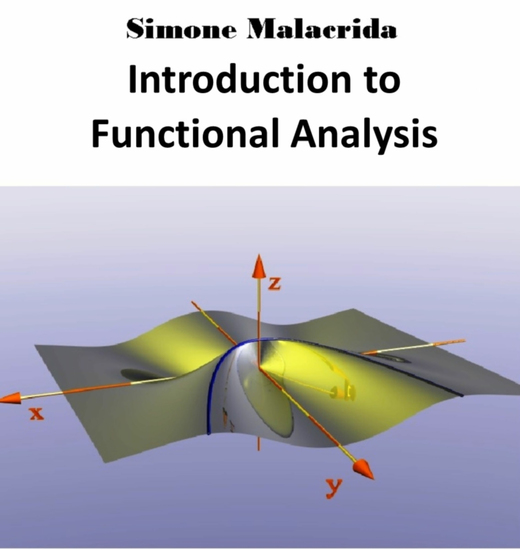
Introduction to Functional Analysis - cover

Introduction to Functional Analysis

Simone Malacrida

Publisher: BookRix

  • 0
  • 0
  • 0

Summary

In this book, aspects of functional analysis are presented with respect to:
Banach, Hilbert and Lebesgue spaces
measure according to Lebesgue and Lebesgue integral
operator view
discrete and continuous transforms
distributions and Sobolev spaces
Available since: 04/18/2023.
Print length: 30 pages.

Other books that might interest you

  • Launch Your First Podcast: A Beginner’s Guide From Mic to Publish - cover

    Launch Your First Podcast: A...

    Roy Harrison

    • 0
    • 0
    • 0
    Start your podcast with confidence — and turn your idea into a published show. 
    In Launch Your First Podcast, Roy Harrison guides beginners through the complete podcast creation journey, from choosing a clear niche and planning episodes to recording, editing, publishing, and promoting a first show. With practical, step-by-step guidance, this audiobook helps you build a repeatable process for creating episodes that sound natural, connect with listeners, and keep moving from idea to launch. 
    Written and narrated by Roy Harrison, this audiobook is your companion for navigating the technical and creative decisions behind podcasting — including scripting, microphone setup, recording habits, audio editing, and getting your episodes ready for the world. Whether you are starting from scratch or looking for a clearer way to bring your show to life, Launch Your First Podcast gives you the practical roadmap to press record and begin.
    Show book
  • Weaponizing Non-Human Technology - A Groundbreaking Investigation Into The Biggest Cover-Up In American History - cover

    Weaponizing Non-Human Technology...

    Brian Anderson

    • 0
    • 0
    • 0
    This audiobook is narrated by an AI Voice. WEAPONIZING NON-HUMAN TECHNOLOGY: A Groundbreaking Investigation Into The Biggest Cover-Up In American History. When decorated military officers testify under oath about crash retrievals and non-human technology, when intelligence officials risk careers to expose illegal programs, when defense contractors kill disclosure legislation—this isn't science fiction. It's the biggest cover-up in American history.  
     
    Featured on Apple TV, History Channel, Amazon Prime Video and Hulu! 
     
    THIS ISN'T ABOUT ALIENS. IT'S ABOUT POWER, MONEY, AND CONSTITUTIONAL CRISIS. This isn't about whether extraterrestrial life exists. It's about who controls the technology and who profits from keeping it secret. 
     
    Meet the Whistleblowers: David Grusch, intelligence officer whose crash retrieval testimony was deemed credible and urgent. Commander David Fravor, Top Gun pilot who witnessed the Tic Tac UAP. Ryan Graves, fighter pilot who encountered UAPs daily. Luis Elizondo, Pentagon official who ran the secret UFO program. Plus Chris Mellon, George Knapp, Ross Coulthart, and more. 
    What This Investigation Reveals: How Special Access UAP Programs operate beyond congressional oversight with billions in untraceable spending. The five observables that define UAP technology. Why Mike Turner and Mike Rogers gutted the UAP Disclosure Act after receiving millions from defense contractors. What's been weaponized from reverse-engineering at Skunk Works. The constitutional crisis of secret programs spending taxpayer money. 
     
    FOLLOW THE MONEY. FOLLOW THE BLOCKERS. FOLLOW THE TRUTH. Based on sworn congressional testimony exposing financial incentives driving secrecy. Featured in Dan Farah's documentary Age of Disclosure on Amazon Prime Video. The secrecy system is collapsing.
    Show book
  • Your Stone Age Brain in the Screen Age - Coping with Digital Distraction and Sensory Overload - cover

    Your Stone Age Brain in the...

    MD Richard E. Cytowic

    • 0
    • 0
    • 0
    An award-winning neurologist on the Stone-Age roots of our screen addictions, and what to do about them.The human brain hasn't changed much since the Stone Age, let alone in the mere thirty years of the Screen Age. That's why, according to neurologist Richard Cytowic—who, Oliver Sacks observed, "changed the way we think of the human brain"—our brains are so poorly equipped to resist the incursions of Big Tech: They are programmed for the wildly different needs of a prehistoric world. In Your Stone Age Brain in the Screen Age, Cytowic explains exactly how this programming works—from the brain's point of view. What he reveals in this book shows why we are easily addicted to screen devices; why young, developing brains are particularly vulnerable; why we need silence; and what we can do to push back.In the engaging storytelling style of his popular TED Talk, Cytowic draws an easily comprehensible picture of the Stone Age brain's workings—the function of neurotransmitters like dopamine in basic instincts for survival such as desire and reward; the role of comparison in emotion, and emotion in competition; and, most significantly, the orienting reflex, one of the unconscious circuits that automatically focus, shift, and sustain attention. Given this picture, the nature of our susceptibility to digital devices becomes clear, along with the possibility of how to break their spell.Full of practical actions that we can start taking right away, Your Stone Age Brain in the Screen Age offers compelling evidence that we can change the way we use technology, resist its addictive power over us, and take back the control we have lost.
    Show book
  • True Deathbed Stories End-of-Life Visions - cover

    True Deathbed Stories...

    Tales Of Afterlife

    • 0
    • 0
    • 0
    This audiobook is narrated by an AI Voice. What if the final moments of life reveal humanity's greatest mystery? Journey through extraordinary documented cases of deathbed visions that challenge everything we think we know about death and dying. From Steve Jobs's profound final words "Oh wow" to scientifically documented encounters with deceased loved ones, this compelling exploration examines end-of-life experiences that transcend cultural, religious, and medical boundaries. Drawing from the groundbreaking Osis-Haraldsson study of over 50,000 dying patients, discover how hospice workers, doctors, and researchers have documented remarkably consistent patterns in deathbed visions across the globe. These aren't random hallucinations or medication-induced fantasies—they're coherent, meaningful encounters that bring profound peace to the dying and challenge our understanding of consciousness itself. Witness accounts of patients who see deceased relatives they've never met, describe burial clothes they never saw, and experience transformative visions that replace fear with wonder. Medical professionals share their most compelling cases, from children who meet grandparents who died before they were born to skeptics whose final moments reveal unexpected spiritual dimensions. Through careful scientific analysis and deeply moving personal stories, explore how these near-death phenomena offer comfort to grieving families and potentially revolutionary insights into human consciousness. Whether you're facing your own mortality, supporting a loved one through their final journey, or simply curious about life's greatest mystery, these true accounts provide both scientific rigor and profound emotional healing about what may await us all.
    Show book
  • Tenacious Beasts - Wildlife Recoveries That Change How We Think about Animals - cover

    Tenacious Beasts - Wildlife...

    Christopher J. Preston

    • 0
    • 0
    • 0
    The news about wildlife is dire—more than 900 species have been wiped off the planet since industrialization. Against this bleak backdrop, however, there are also glimmers of hope and crucial lessons to be learned from animals that have defied global trends toward extinction: bears in Italy, bison in North America, whales in the Atlantic. These populations are back from the brink, some of them in numbers unimaginable in a century. How has this happened? What shifts in thinking did it demand? In crisp, transporting prose, Christopher Preston reveals the mysteries and challenges at the heart of these resurgences. 


    Drawing on compelling personal stories from the researchers, Indigenous people, and activists who know the creatures best, Preston weaves together a gripping narrative of how some species are taking back vital, ecological roles. Each section of the book offers a philosophical shift in how humans ought to think about animals, passionately advocating for the changes in attitude necessary for wildlife recovery. 


    Tenacious Beasts is quintessential nature writing for the Anthropocene, touching on different facets of ecological restoration from Indigenous knowledge to rewilding practices. More important, perhaps, the book offers a road map—and a measure of hope—for a future in which humans and animals can once again coexist.
    Show book
  • The New Empire of AI - The Future of Global Inequality - cover

    The New Empire of AI - The...

    Rachael Adams

    • 0
    • 0
    • 0
    As AI takes hold across the planet and wealthy nations seek to position themselves as global leaders of this new technology, the gap is widening between those who benefit from it and those who are subjugated by it. As Rachel Adams shows in this hard-hitting book, growing inequality is the single biggest threat to the transformative potential of AI. Not only is AI built on an unequal global system of power, it stands poised to entrench existing inequities, further consolidating a new age of empire. 


    AI's impact on inequality will not be experienced in poorer countries only: it will be felt everywhere. The effects will be seen in intensified international migration as opportunities become increasingly concentrated in wealthier nations; in heightened political instability and populist politics; and in climate-related disasters caused by an industry blind to its environmental impact across supply chains. 


    We need to act now to address these issues. Only if the current inequitable trajectory of AI is halted, the incentives changed, and the production and use of AI decentralized from wealthier nations will AI be able to deliver on its promise to build a better world for all.
    Show book