Join us on a literary world trip!
Add this book to bookshelf
Grey
Write a new comment Default profile 50px
Grey
Subscribe to read the full book or read the first pages for free!
All characters reduced
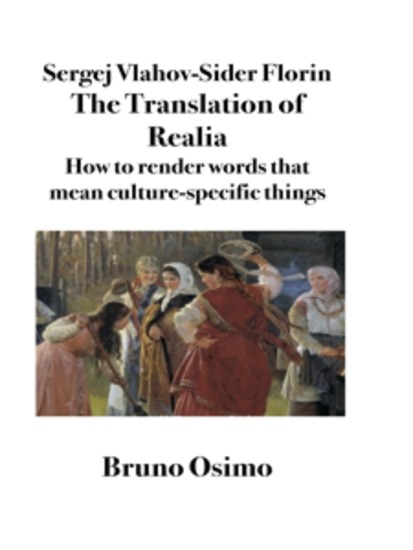
The Translation of Realia - How to render words that mean culture-specific things - cover

The Translation of Realia - How to render words that mean culture-specific things

Sergej Vlahov, Sider Florin

Publisher: Bruno Osimo

  • 0
  • 2
  • 0

Summary

The concept of 'translation of realia' is doubly conventional: realia are normally untranslatable (from a dictionary perspective) and, again, are normally not rendered (in context) by means of translation.With respect to dictionary translation, however, "there are no words that could not be translated into another language, at least descriptively, i.e. by means of a widespread combination of words of the given language", and "what is not possible with respect to a single element, is possible with respect to a complex whole", i.e. with respect to a contextual translation.
Available since: 03/23/2023.
Print length: 94 pages.

Other books that might interest you

  • Workplace NeuroDiversity Rising 20 - cover

    Workplace NeuroDiversity Rising 20

    Lyric Rivera

    • 0
    • 0
    • 0
    Having a supportive environment can be the difference between employee success and failure. When we supoport the diverse minds within an organization, everyone on the team benefits (because much of what is necessary for NeuroDivergent success, will benefit everyone in a company). 
      
    That's why I've written ths handy guide for you, to help empower other people and organizations to consider what they can do to support NeuroDivergent employees. 
      
    This book is designed to be read front to back, but is also organized in sections, to allow you to skip to your organizaton's specific problem areas (since every organization is unique). I've also included a handy glossary of terms at the back of this book.
    Show book
  • Tiwanaku - The Mysterious Builders of Bolivia's Sacred City - cover

    Tiwanaku - The Mysterious...

    Rolf Hedger

    • 0
    • 0
    • 0
    The ancient ruins of Tiwanaku have fascinated explorers, scholars, and travelers for centuries. Nestled on the altiplano of Bolivia near the southern shore of Lake Titicaca, Tiwanaku has been a site of mystery and intrigue since its rediscovery by European chroniclers. However, long before outsiders arrived, indigenous Andean communities revered the site as a sacred place, connecting it to their ancestors and the origins of civilization in the region. 
    Spanish chroniclers in the sixteenth century were among the first Europeans to record accounts of Tiwanaku. Conquistadors like Pedro Cieza de León described the ruins with awe, noting the massive stone blocks and intricate carvings scattered across the landscape. They speculated that such a monumental city could not have been built by the indigenous people they encountered, leading to myths of lost civilizations and supernatural origins. Some even believed that Tiwanaku predated the Great Flood, a theory influenced by biblical narratives. These early interpretations, though often misguided, helped cement Tiwanaku’s reputation as one of the most enigmatic ancient sites in the Americas. 
    During the nineteenth and early twentieth centuries, explorers and archaeologists began conducting more systematic investigations of Tiwanaku. Travelers such as Ephraim Squier and Arthur Posnansky documented the ruins extensively, producing sketches and maps that revealed the scale and complexity of the site. Posnansky, in particular, developed theories suggesting that Tiwanaku was over ten thousand years old, arguing that its architectural alignments reflected advanced astronomical knowledge. Though modern research has debunked these extreme claims, his work brought significant attention to Tiwanaku and laid the groundwork for future archaeological studies.
    Show book
  • Montgolfier Brothers: A short biography - 5 Minutes: Short on time - long on info! - cover

    Montgolfier Brothers: A short...

    5 Minutes, 5 Minute Biographies,...

    • 0
    • 0
    • 0
    Montgolfier Brothers, Inventors of the hot air balloon: Life and work in a short biography! Everything you need to know, brief and concise. Infotainment, education and entertainment at its best!
    Show book
  • Fascism - What It Is and How to Fight It - cover

    Fascism - What It Is and How to...

    Leon Trotsky

    • 0
    • 0
    • 0
    Fascism: What It Is and How to Fight It, written by Leon Trotsky in 1933, is a critical analysis of the rise of fascist movements in Europe, particularly focusing on Nazi Germany under Adolf Hitler. Trotsky argues that fascism is not a sudden, irrational outburst of violence but rather the result of deep structural crises in capitalist society, which the ruling class seeks to resolve through authoritarian means. He explains that fascism arises when the traditional political establishment is unable to suppress revolutionary movements from below (such as workers' uprisings or socialist revolutions) and when the capitalist system is threatened by economic collapse. 
    Trotsky highlights that fascism is a tool of the bourgeoisie, aimed at preserving the existing social order through terror, militarism, and the suppression of democratic freedoms. However, it is not simply a reactionary force; it has its own set of internal contradictions, as fascists simultaneously defend capitalist interests while attacking the political establishment and the working class. 
    Trotsky warns of the dangers of fascism's rise and stresses the importance of building a united front of the working class and the Left to prevent its spread. He critiques both Stalinism and social democracy for their failures to adequately respond to the fascist threat, emphasizing the need for a revolutionary approach to combat the fascist menace.
    Show book
  • Manifesting Justice - Wrongly Convicted Women Reclaim Their Rights - cover

    Manifesting Justice - Wrongly...

    Valena Beety, Koa Beck

    • 0
    • 0
    • 0
    When Valena Beety first became a federal prosecutor, her goal was to protect victims, especially women, from cycles of violence. What she discovered was that not only did prosecutions often fail to help victims, they frequently relied on false information, forensic fraud, and police and prosecutor misconduct. 


    Seeking change, Beety began working in the Innocence Movement, helping to free factually innocent people through DNA testing and criminal justice reform. Manifesting Justice focuses on the shocking story of Beety's client Leigh Stubbs—a young, queer woman in Mississippi, convicted of a horrific crime she did not commit because of her sexual orientation. Beety weaves Stubbs's harrowing narrative through the broader story of a broken criminal justice system. 


    Drawing on interviews with both innocence advocates and wrongfully convicted women, along with Beety's own experiences as an expert litigator and a queer woman, Manifesting Justice provides a unique outsider/insider perspective. Beety expands our notion of justice to include not just people who are factually innocent, but those who are over-charged, pressured into bad plea deals, and over-sentenced. The result is a riveting and timely book that will transform our very ideas of crime and punishment, what innocence is, and who should be free.
    Show book
  • Sahih Al Bukhari English Translation Volume 3 Book 26-54 Hadith 1773-2737 of 7563 - Most Authentic Hadith English Translation (Audio Collection) - cover

    Sahih Al Bukhari English...

    Imam Bukhari, Translator - Dr....

    • 0
    • 0
    • 0
    Ṣaḥīḥ al-Bukhārī is a collection of hadīth compiled by Abu Abdullāh Muhammad Ibn Ismā`īl al-Bukhārī(rahimahullāh). The translation provided here is by Dr. M. Muhsin Khan. 
    Volume 3 contains hadith 1773-2737 of 7563 in book 26-54: 
    26 Al-Umrah (Minor pilgrimage) Hadith 1773-1805 
    27 Al-Muhsar (Pilgrims Prevented from Completing the Pilgrimage) H 1806-1820 
    28 penalty for hunting (by a muhrim) and similar things Hadith 1821-1866 
    29 Virtues of Madinah Hadith 1867-1890 
    30 The Fasting (As Saum) Hadith 1891-2007 
    31 Taraweeh Prayers at Night in Ramadaan Hadith 2008-2013 
    32 Superiority of the Night of Qadr Hadith 2014-2024 
    33 Retiring to a Mosque for Remembrance of Allah (Itikaf) Hadith 2025-2046 
    34 Sales (Bargains) Hadith 2047-2238 
    35 The Sales in Which a Price is Paid for Goods to be Delivered Later(As-Salam) Hadith 2239-2256 
    36 Right of First Refusal, re-emption (ash-shuf'a) Hadith 2257-2259 
    37 Hiring (Concerning Hiring) Hadith 2260-2286 
    38 Transferance of a Debt from One Person to Another (Al-Hawaalat) H 2287-2289 
    39 Kafalah Hadith 2290-2298 
    40 Representation (or Authorization) Hadith 2299-2319 
    41 Cultivation and Agriculture Hadith 2320-2350 
    42 Watering (Distribution of Water) Hadith 2351-2384 
    43 Loans, payment of loans, Freezing of Property, Bankruptcy Hadith 2385-2409 
    44 quarrels, disputes Hadith 2410-2425 
    45 Lost Things Picked up by Someone (Al-Luqatah) Hadith 2426-2439 
    46 Oppressions, Injustices (Al-Mazalim) Hadith 2440-2482 
    47 Partnership Hadith 2483-2507 
    48 mortgaging in places occupied by settled population Hadith 2508-2516 
    49 Manumission of Slaves Hadith 2517-2559 
    50 Al Mukatab Hadith 2560-2565 
    51 gifts and the superiority of giving gifts H 2566-2636 
    52 Witnesses, Testimonies Hadith 2637-2689 
    53 Peacemaking, Reconciliation Hadith 2690-2710 
    54 Conditions Hadith 2711-2737
    Show book