Join us on a literary world trip!
Add this book to bookshelf
Grey
Write a new comment Default profile 50px
Grey
Subscribe to read the full book or read the first pages for free!
All characters reduced
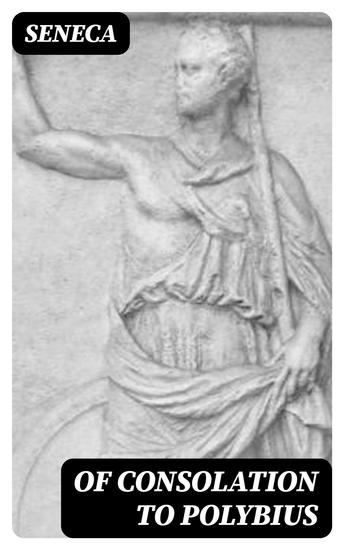
Of Consolation to Polybius - cover

Of Consolation to Polybius

Seneca

Translator Aubrey Stewart

Publisher: DigiCat

  • 0
  • 0
  • 0

Summary

Seneca's "Of Consolation to Polybius" is a profound work that explores the themes of suffering, loss, and the human condition through the lens of Stoic philosophy. Written in a time marked by personal and political upheaval, Seneca employs a reflective and poetic prose style that intertwines rhetoric and philosophical inquiry. The dialogue, intended for his friend Polybius, serves both as a personal letter and a universal meditation on how to cope with misfortune, drawing heavily on tradition and the wisdom of Greek philosophical schools, amplifying themes of resilience and inner peace amid adversity. Lucius Annaeus Seneca, a Stoic philosopher, statesman, and playwright, lived during the tumultuous reign of Emperor Nero. His experiences with loss, exile, and the complexities of human emotion deeply informed his writings. "Of Consolation to Polybius," crafted during a period of personal distress, reflects his commitment to using philosophical discourse as a means to alleviate suffering, revealing his capacity to merge personal grief with broader philosophical insights. I highly recommend "Of Consolation to Polybius" to readers seeking solace through literature. Seneca's eloquence and sincerity provide not only comfort but also a practical framework for confronting life's inevitable tribulations, making this work a timeless guide for those grappling with existential despair.
Available since: 08/10/2022.
Print length: 24 pages.

Other books that might interest you

  • How to Listen - An Ancient Guide to Learning from Others - cover

    How to Listen - An Ancient Guide...

    Plutarch, Jeffrey Beneker

    • 0
    • 0
    • 0
    A lively new translation of Plutarch’s charming and timeless essay on how to be a good listener—and why listening is essential to learning and living wellListening is a skill—even an art—and it’s essential to learning and to life. Indeed, as Plutarch writes in How to Listen, “listening well is the foundation for living well.” In this volume, Jeffrey Beneker presents a vivid and accessible new translation of Plutarch’s classic essay about how to become a skilled listener, complete with an inviting introduction and the original Greek on facing pages.Plutarch is most famous as the author of Parallel Lives, a series of biographies of Greek and Roman statesmen. But he was also an expert on teaching and learning and How to Listen is arguably one of his best pedagogical works. A proponent of active listening well before its time, Plutarch explains the skills we need—and the obstacles and distractions we must overcome—to become effective listeners. Good listening requires, above all, an acknowledgement of our own ignorance in certain subjects and a commitment to gaining knowledge. We must set aside pride and envy so we can respect the expertise of others. We must also train ourselves to see through style and focus on substance, to discriminate between weak and strong arguments, and to criticize ideas fairly and accurately.Filled with shrewd insights and advice, How to Listen shows how to cultivate a skill that everyone who wants to learn and live well must master.
    Show book
  • People Performance and Succeeding as a Manager - cover

    People Performance and...

    Harvard Business Review

    • 0
    • 0
    • 0
    Be the boss people want to work for. 


    Being a manager is no easy task. You must measure and track your team members' performance toward goals and objectives while also providing opportunities for growth and development. You have to be empathetic to your team's needs and concerns while also maintaining your authority. How do you navigate these tensions? People, Performance, and Succeeding as a Manager is filled with practical advice from HBR experts who can help you answer these and other questions like: 


    ● How do I earn the trust of my team? 


    ● When and how should I deliver constructive feedback? 


    ● What's the best way to motivate my employees? 


    ● How can I take care of myself so I don't burn out? 


    This book will help you figure out what kind of manager you want to be so that you can feel comfortable in your role, encourage the success of your people, and grow in your own career.
    Show book
  • The Invisible Machine - The Startling Truth About Trauma and the Scientific Breakthrough That Can Transform Your Life - cover

    The Invisible Machine - The...

    MD Eugene Lipov, Jamie Mustard,...

    • 0
    • 0
    • 0
    Despite its prevalence, post-traumatic stress, PTSD, is often seen as an unbeatable lifelong mental disorder. Leading trauma doctors and neuroscientists now understand that the result of trauma is not a disorder, but rather a physical injury to the body—invisible but tangible, and most importantly, treatable. 


    Meet Dr. Eugene Lipov. His research and partnerships have led to an amazing discovery that all trauma has at its root a single piece of human hardware: the stellate ganglion. The symptoms of post-traumatic stress are the same for all of us, whether from childhood poverty or abandonment, the ravages of war, or the brutality of sexual assault. Dr. Lipov's pioneering procedure appears to treat injury to the stellate ganglion, relieving even the worst symptoms of PTSD—irritability, hypervigilance, insomnia, and more—in a fifteen-minute treatment. 


    Weaving hard science with moving human stories, The Invisible Machine reveals how this treatment was developed. It also tells the incredible story of the unlikely team, including the doctor, an artist, Special Forces leadership, and a sheriff, who are working together to change our understanding of post-traumatic stress and why it matters to society.
    Show book
  • Schmalkaldic War The: The History of the Civil War Between Catholics and Lutherans in the Holy Roman Empire - cover

    Schmalkaldic War The: The...

    Editors Charles River

    • 0
    • 0
    • 0
    It has been famously pointed out that the Holy Roman Empire was neither holy, nor Roman, but it was also not an empire in the sense people expect when hearing the term. In theory, the emperor was the highest prince in Christendom, and his dominion extended the length and breadth of Western Europe. The empire had been created by the papacy in 801 when Pope Leo III famously crowned the supposedly unwitting Charlemagne in Saint Peter’s Basilica, intending to recreate the Western Roman Empire. In truth, the imperial power did not extend beyond central Europe, which by the beginning of the 16th century included Germany, northern Italy and the Netherlands. Even in these lands, however, the emperor struggled to command obedience. His dominion over northern Italy was theoretical only, the cities of the Netherlands were deeply conscious of their ancient rights and privileges, and Germany had long ceased to be compliant. The latter had become a collection of principalities, dukedoms and bishoprics which vied with each other and pursued their own agendas. They were, however, united in only one sense: denying the emperor power and resisting attempts to centralize the government.  
    	At the same time, major religious changes were happening within Germany in the early 16th century. Born shortly after the invention of the printing press, Martin Luther became one of Europe’s best selling authors, along with others like Erasmus, and his theology was mass produced across Europe. He strongly disputed the claim that freedom from God's punishment of sin could be purchased with money, known as indulgences, and he confronted indulgence salesman Johann Tetzel with his Ninety-Five Theses in 1517, one of the most important religious writings of all time. His refusal to retract all of his writings at the demand of Pope Leo X in 1520 and the Holy Roman Emperor Charles V at the Diet of Worms in 1521 resulted in his excommunication by the Pope and condemnation as an outlaw.
    Show book
  • Laptop from Hell: Book Summary & Analysis - cover

    Laptop from Hell: Book Summary &...

    Briefly Summaries

    • 0
    • 0
    • 0
    This is a concise summary and analysis of Laptop from Hell , by Miranda Devine.
     
    It is not the original book and is not affiliated with or endorsed by Miranda Devine .
     
    Ideal those seeking a quick and insightful overview.
     
    Laptop from Hell reveals the explosive contents of a mysterious laptop abandoned by the son of a prominent political figure. This investigative account uncovers a tangled web of international business deals, personal controversies, and hidden connections that shake the foundations of power and influence. Through meticulous research and compelling storytelling, the book delves into a scandal that captured global attention, offering an eye-opening examination of corruption and its far-reaching implications.
    Show book
  • A Rare Recording of Otto Frank Father of Anne Frank - cover

    A Rare Recording of Otto Frank...

    Otto Frank

    • 0
    • 0
    • 0
    Otto Heinrich Frank (May 12, 1889 - August 19, 1980) was a German businessman, and the father of Anne Frank. He edited and published the first edition of her diary in 1947 (subsequently known in English as The Diary of a Young Girl) and advised on its later theatrical and cinematic adaptations. In the 1950s and the 1960s, he established European charities in his daughter's name and founded the trust which preserved his family's wartime hiding place, the Anne Frank House, in Amsterdam. The following first two audio clips are in English; the third is in Dutch.
    Show book