Join us on a literary world trip!
Add this book to bookshelf
Grey
Write a new comment Default profile 50px
Grey
Subscribe to read the full book or read the first pages for free!
All characters reduced
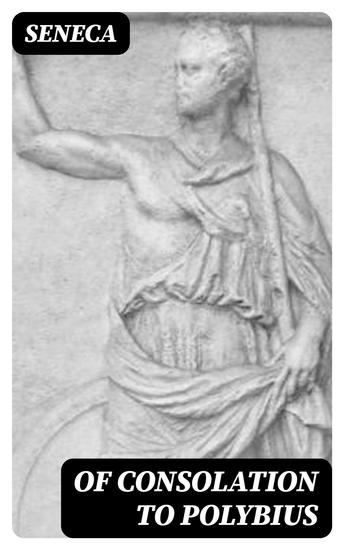
Of Consolation to Polybius - cover

Of Consolation to Polybius

Séneca

Translator Aubrey Stewart

Publisher: DigiCat

  • 0
  • 0
  • 0

Summary

Seneca's "Of Consolation to Polybius" is a profound work that explores the themes of suffering, loss, and the human condition through the lens of Stoic philosophy. Written in a time marked by personal and political upheaval, Seneca employs a reflective and poetic prose style that intertwines rhetoric and philosophical inquiry. The dialogue, intended for his friend Polybius, serves both as a personal letter and a universal meditation on how to cope with misfortune, drawing heavily on tradition and the wisdom of Greek philosophical schools, amplifying themes of resilience and inner peace amid adversity. Lucius Annaeus Seneca, a Stoic philosopher, statesman, and playwright, lived during the tumultuous reign of Emperor Nero. His experiences with loss, exile, and the complexities of human emotion deeply informed his writings. "Of Consolation to Polybius," crafted during a period of personal distress, reflects his commitment to using philosophical discourse as a means to alleviate suffering, revealing his capacity to merge personal grief with broader philosophical insights. I highly recommend "Of Consolation to Polybius" to readers seeking solace through literature. Seneca's eloquence and sincerity provide not only comfort but also a practical framework for confronting life's inevitable tribulations, making this work a timeless guide for those grappling with existential despair.
Available since: 08/10/2022.
Print length: 24 pages.

Other books that might interest you

  • Test-Enhanced Learning - A practical guide to improving academic outcomes for all students - cover

    Test-Enhanced Learning - A...

    Kristian Still

    • 0
    • 0
    • 0
    Written by Kristian Still,Test-Enhanced Learning: A practical guide to improving academic outcomes for all studentsis an informative guidebook that explores the wealth of evidence behind and the benefits of test-enhanced learning, spaced retrieval practice and personalisation.
    Detailing the most up to date research into improving learning and retention, it takes us on a journey into test-enhanced learning, spaced retrieval practice, motivation, metacognition and personalisation. In so doing, the book provides a blueprint for all teachers and schools to improve the academic outcomes of their students and to achieve this in ways that improve the motivation of learners and reduces the workload for teachers.
    Kristian Still has been developing these ideas with his classes for many years and has achieved considerable success in terms of thedirect learning gains, and improved assessment grades of his pupils and the indirect gains instudentsgrowing confidence in lessons, with a wider group of pupils contributing to class and improved classroom behaviour. Consequently, students are finding greater comfort in class and experiencing less pressure or underpreparedness when a question is asked.
    The book is supported by the freeRemembermoreapp which uses digital flashcards as an aid to deliver the learning gains of personalised, spaced retrieval practice, providing teachers with insights into the effectiveness of their own teaching. It also contains a number of practical case studies from teachers using these techniques and the app to produce great results in their schools.
    Spaced retrieval practice is a highly effective but counter intuitive revision technique in that it involves forgetting and relearning knowledge.Test-Enhanced Learningprovides a blueprint for motivating students to adopt this technique in favour of seemingly easier but less effective techniques such as re-reading. Moreover, theRemembermoreapp does most of the convincing for you. It is a tool, not only to provide the flashcards for retrieval practice, but also to demonstrate the power of the technique to pupils.
    The book goes a step beyond mere retrieval practice, offering a fresh approach to test-enhanced learning, both pretesting and post testing, supported by real, classroom-based routines that have been tried and tested by both Primary and Secondary teachers across a range of subjects. Exploring the research behind test-enhanced learning, it reveals that both pretesting and post testing (retrieval practice) offers improved memorisation and secures long-term learning.
    Suitable for all teachers in all settings.
    Show book
  • Conflicted - Pulling Back the Curtain on Public Education - cover

    Conflicted - Pulling Back the...

    John Stamper

    • 0
    • 0
    • 0
    At what point can a Christian teacher no longer be part of a public education system that requires them to participate in teaching destructive ideologies and advancing immoral agendas on young children? 
     
    John Stamper reached that tipping point as a teacher in the Chicago Public School System and made the decision to quit his job and pull back the curtain on what’s happening in public schools today. 
     
    You’ve seen the stories on the news – our national education system has an agenda, being implemented under the guise of fairness, equality, and racial justice to children. However, this book will open your eyes to: 
     
    The indoctrination process through mandatory teacher training that implements these radical ideologies in schools without parental knowledgeThe danger and division created by critical race theory and gender theory being promoted in public schoolsHow Marxist, socialist, and communist ideologies are dominating public schools, and how you move forward with homeschooling your children 
     
    For generations, teachers have been excellent role models, investing their time and energy into fundamental lessons. However, today a growing number think they, the school board, and their school system know more than parents about what should be taught to students. You need to know what is going on in your child’s school and be prepared for the conflict of values that you may have to face. 
     
    You have options.
    Show book
  • Private Government - How Employers Rule Our Lives (and Why We Don't Talk about It) - cover

    Private Government - How...

    Elizabeth Anderson

    • 0
    • 0
    • 0
    Why our workplaces are authoritarian private governments—and why we can't see it 


    One in four American workers says their workplace is a "dictatorship." Yet that number almost certainly would be higher if we recognized employers for what they are—private governments with sweeping authoritarian power over our lives. Many employers minutely regulate workers' speech, clothing, and manners on the job, and employers often extend their authority to the off-duty lives of workers, who can be fired for their political speech, recreational activities, diet, and almost anything else employers care to govern. In this compelling book, Elizabeth Anderson examines why, despite all this, we continue to talk as if free markets make workers free, and she proposes a better way to think about the workplace, opening up space for discovering how workers can enjoy real freedom.
    Show book
  • When Washington Burned - The British Invasion of the Capital and a Nation's Rise from the Ashes - cover

    When Washington Burned - The...

    Robert P. Watson

    • 0
    • 0
    • 0
    Perhaps no other single day in United States history was as threatening to the survival of the nation as August 24, 1814, when British forces captured Washington, DC. This unique moment might have significantly altered the nation's path forward, but the event and the reasons why it happened are little remembered by most Americans. 


    When Washington Burned narrates and examines the British campaign and American missteps that led to the fall of Washington during the War of 1812. Watson analyzes the actions of key figures on both sides, such as President James Madison and General William Winder on the United States side and Rear Admiral George Cockburn and Major General Robert Ross on the British side. He pinpoints the reasons the campaign was such a disaster for the United States but also tells the redeeming stories of the courageous young clerks and the bold first lady, Dolley Madison, who risked their lives to save priceless artifacts and documents from the flames, including the Constitution. The British invasion was repulsed over the coming weeks and months, and the United States ultimately emerged stronger. 


    General listeners interested in the history of Washington, United States history, and military history will be fascinated by this book.
    Show book
  • Epicurus - Pleasure Atoms and the Good Life - cover

    Epicurus - Pleasure Atoms and...

    Hector Davidson

    • 0
    • 0
    • 0
    Epicurus, a Greek philosopher born in 341 BCE on the island of Samos, founded the school of philosophy known as Epicureanism, which emphasized the pursuit of happiness through the cultivation of pleasure and the avoidance of pain. His teachings were revolutionary for their focus on the individual’s inner peace and well-being, rather than devotion to the gods or the pursuit of wealth and power. Epicurus advocated for a life of simple pleasures, good friendships, and intellectual contemplation, arguing that these were the true sources of happiness. 
      
    His philosophy was grounded in atomism, the belief that everything in the universe is made up of small, indivisible particles, or atoms, moving through the void. For Epicurus, the natural world was not governed by divine intervention, but by laws that could be understood through reason and observation. He believed that by understanding the workings of nature, individuals could free themselves from irrational fears, especially the fear of death and the gods. 
      
    Epicurus placed great importance on pleasure, defining it not as indulgence in material excess, but as the absence of pain (ataraxia) and the pursuit of a serene and balanced life. He argued that physical and mental pleasures, when experienced in moderation, contributed to a life of tranquility. Furthermore, he saw pain not as an inherent part of life, but as something to be minimized or avoided through thoughtful living and wise choices.
    Show book
  • A Man of Bad Reputation - The Murder of John Stephens and the Contested Landscape of North Carolina Reconstruction - cover

    A Man of Bad Reputation - The...

    Drew A. Swanson

    • 0
    • 0
    • 0
    Five years after the Civil War, North Carolina Republican state senator John W. Stephens was found murdered inside the Caswell County Courthouse. Stephens fought for the rights of freedpeople, and his killing by the Ku Klux Klan ultimately led to insurrection, Governor William W. Holden's impeachment, and the early unwinding of Reconstruction in North Carolina. In recounting Stephens's murder, the subsequent investigation and court proceedings, and the long-delayed confessions that revealed what actually happened at the courthouse in 1870, Drew A. Swanson tells a story of race, politics, and social power shaped by violence and profit. The struggle for dominance in Reconstruction-era rural North Carolina, Swanson argues, was an economic and ecological transformation. Arson, beating, and murder became tools to control people and landscapes, and the ramifications of this violence continued long afterward. The failure to prosecute anyone for decades after John Stephens's assassination left behind a vacuum, as each side shaped its own memory of Stephens and his murder. 


    The malleability of and contested storytelling around Stephens's legacy presents a window into the struggle to control the future of the South.
    Show book