Join us on a literary world trip!
Add this book to bookshelf
Grey
Write a new comment Default profile 50px
Grey
Subscribe to read the full book or read the first pages for free!
All characters reduced
Vietnam Conflict - cover

Vietnam Conflict

Sebastian Farnham

Translator A AI

Publisher: Publifye

  • 0
  • 0
  • 0

Summary

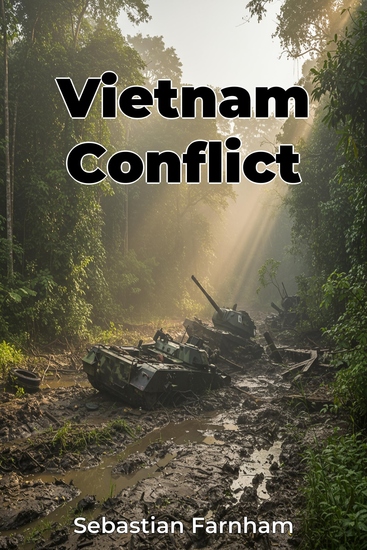
"Vietnam Conflict" explores the complex history of U.S. involvement in Vietnam, examining the war's profound impact on American society and foreign policy during the Cold War era. The book analyzes how the U.S. military strategy evolved, influenced by political factors in both Washington and Saigon. It provides historical context, tracing Vietnamese nationalism, French colonialism, and the domino theory, to understand the Geneva Accords and Ho Chi Minh's rise.

 
The book argues that Cold War anxieties and flawed assumptions significantly contributed to the U.S. failure, challenging conventional narratives by examining overlooked factors. The book unfolds systematically, beginning with historical context and key players. It analyzes military strategies like search and destroy missions and bombing campaigns, then explores the political dimensions, including presidential administrations and the anti-war movement. It uses declassified documents, military records, and firsthand accounts to support its arguments.

 
The book concludes with an assessment of the war's long-term consequences, including its influence on American foreign policy and its impact on veteran affairs. Targeting students and history enthusiasts, this book offers insights into modern warfare complexities and interventionist foreign policy challenges. It provides a balanced viewpoint, avoiding simplistic narratives and engaging with the conflict's complexities, making it a valuable resource for understanding this pivotal chapter in global history.
Available since: 03/21/2025.
Print length: 65 pages.
Other books that might interest you

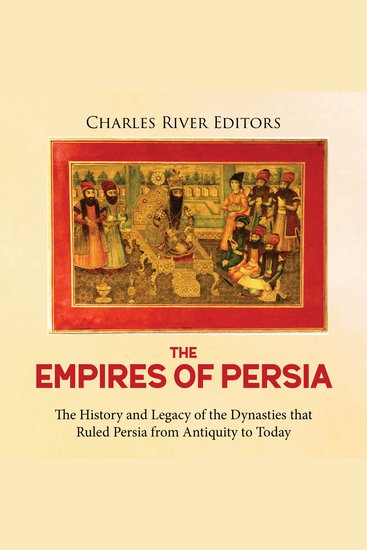
  • Empires of Persia The: The History and Legacy of the Dynasties that Ruled Persia from Antiquity to Today - cover

    Empires of Persia The: The...

    Editors Charles River

    • 0
    • 0
    • 0
    Lying in the middle of a plain in modern day Iran is a forgotten ancient city: Persepolis. Built two and a half thousand years ago, it was known in its day as the richest city under the sun. Persepolis was the capital of Achaemenid Persian Empire, the largest empire the world had ever seen, but after its destruction, it was largely forgotten for nearly 2,000 years, and the lives and achievements of those who built it were almost entirely erased from history. Alexander the Great’s troops razed the city to the ground in a drunken riot to celebrate the conquest of the capital, after which time and sand buried it for centuries. 
    The Parthian people created an empire that lasted almost 500 years, from the mid-3rd century BCE until 224 CE, and it stretched from the Euphrates River in the west to Central Asia and the borders of Bactria in the east. In fact, the expansive empire challenged the Romans on numerous occasions for supremacy in the Near East. 
    During the first half of the 1st millennium CE, an empire arose in Persia that extended its power and influence to Mesopotamia in the east, Arabia in the south, the Caucasus Mountains in the north, and as far east as India. This empire, known alternatively as the Sasanian Empire or Sassanid Empire, was the last of three great dynasties in Persia—the Achaemenid and the Parthian being the first two dynasties—before the rise of Islam. 
    Amid the upheaval in the Islamic world following Muhammad’s death, the Umayyad Caliphate lasted for less than a century, but in that time it managed to become one of the most influential of the major caliphates established following him. 	The Umayyads would be replaced by the far more intelligent and crafty Abbasids, who managed to wield powerful tools like propaganda to undermine their opponents, but eventually, the Ottomans would consolidate control of the area for nearly 500 years.  
    Show book
  • Esther - The World English Bible Book 17 (Unabridged) - cover

    Esther - The World English Bible...

    Various Authors

    • 0
    • 0
    • 0
    The Book of Esther, also known in Hebrew as "the Scroll" ("the Megillah"), is a book in the third section of the Jewish Tanakh (the Hebrew Bible). It is one of the five Scrolls (Megillot) in the Hebrew Bible and later became part of the Christian Old Testament.
    The book relates the story of a Hebrew woman in Persia, born as Hadassah but known as Esther, who becomes queen of Persia and thwarts a genocide of her people. The story forms the core of the Jewish festival of Purim, during which it is read aloud twice: once in the evening and again the following morning. The books of Esther and Song of Songs are the only books in the Hebrew Bible that do not mention God.
    Show book
  • How To Talk To Anyone - Learn How To Improve Communication Skills And Talk To Women Men In Public At Work At Anytime And Anywhere With Confidence Increase Your Self-Esteem Manage Shyness - cover

    How To Talk To Anyone - Learn...

    Mind Change Academy

    • 0
    • 0
    • 0
    Do you know How to Talk to Anyone? Do you want to know How to Talk to Anyone? 
    It doesn’t have to be someone important who is speaking to us to make us feel important…or not. Even the person sitting next to us on the bus has the ability to make us feel significant, or, like we don’t matter at all. Regardless of how we may try to wiggle around it, while the ultimate goal of your communication may be to inform or express, you are never going to succeed at doing so if the person you are talking to feels you have no value for him or her. 
    Every (good) speaker knows that the best delivery is one that makes each person in the audience feel every word was just for him or her. 
    In the art of effective conversation as well as public speaking, it is imperative to take an interest in the person or persons you are talking to. 
    Know what they like and what they don’t like. 
    Learn what interests them. 
    When you are uptight about speaking, be it publicly or privately, people sense your fear. While you work on getting over your anxiety of talking through measures taken in this book, you can fake it until you make it. Just pretending that you are not so nervous will help relax the person or persons you are speaking to and it might calm you as well. 
    Are you excited? Look no more! 
    Grab your copy today and know everything about How to Talk to Anyone!
    Show book
  • Mummies and Magic - The Preservation of Ancient Egyptian Bodies - cover

    Mummies and Magic - The...

    Omar Khalil

    • 0
    • 0
    • 0
    Mummification is one of the most fascinating and iconic aspects of ancient Egyptian culture. The practice, rooted in both religious beliefs and practical preservation techniques, developed over thousands of years. Understanding the origins of mummification requires a look into early burial practices, the evolution of the methods used, and the profound spiritual significance behind this ancient tradition. 
    In the Predynastic period, before the rise of the Pharaohs, ancient Egyptians buried their dead directly in the hot, dry desert sands. The natural arid conditions acted as a primitive form of preservation, desiccating the bodies and preventing decomposition. These simple burials, often in shallow pits, led to accidental mummification as the desert sands rapidly absorbed moisture. Early communities likely noticed that bodies buried in this way remained intact, sparking the realization that dryness was key to preservation. 
    As Egyptian society evolved, so did burial practices. The transition from pit burials to more elaborate tombs posed new challenges, as the enclosed environments led to faster decomposition. To counter this, early experiments with artificial preservation began. Initially, these efforts were rudimentary, involving simple wrappings and the use of resins. Over time, embalmers refined their techniques, experimenting with salts, oils, and various substances to dry and protect the body. By the Old Kingdom period, the practice had transformed into a highly ritualized and sophisticated process.
    Show book
  • A Drama in Mexico - cover

    A Drama in Mexico

    Jules Verne

    • 0
    • 0
    • 0
    A Drama in Mexico is a vivid and engaging short work by Charles Dickens that combines travel writing with historical reflection. Based on Dickens's experiences and observations during his journey to North America, the piece offers a sharply written account of a real-life political execution he witnessed while in Mexico.
    
    Through powerful narrative detail, Dickens recounts the tense atmosphere surrounding the public execution of a political figure, capturing the emotional weight of the moment and the reactions of the crowd. Rather than focusing solely on the event itself, the story reflects Dickens's deep concern with justice, authority, and the human cost of political conflict.
    
    The work stands out for its immediacy and moral seriousness. Dickens uses the event as a lens through which to examine themes of power, violence, and public spectacle, questioning the effectiveness and humanity of capital punishment. His prose is direct and compelling, blending journalistic observation with emotional insight.
    
    A Drama in Mexico is a striking example of Dickens's ability to transform real-world experiences into meaningful commentary. Short yet impactful, the piece offers readers a rare glimpse into Dickens as an eyewitness to history and serves as a thought-provoking reflection on justice, punishment, and human dignity.
    Show book
  • Being Eclipsed - Women Under The 'Care' Of The Patriarchy - cover

    Being Eclipsed - Women Under The...

    Dörthe Dolata

    • 0
    • 0
    • 0
    BEING ECLIPSED describes women’s lives under the care of the Church and State in Ireland at the beginning of the mid-19th century throughout the 20th century. It gives an overview of women who had to turn to prostitution out of necessity in order to survive, and also on nuns who were put in charge of them under catholic church rule creating a double-standard. Women were treated as the “Social Evil” when they were not considered pure and innocent by State and Church. This ignorant behaviour let basically to failing women instead of protecting them within society.
    Show book