Join us on a literary world trip!
Add this book to bookshelf
Grey
Write a new comment Default profile 50px
Grey
Subscribe to read the full book or read the first pages for free!
All characters reduced
Liberation Movements - cover

Liberation Movements

Sebastian Farnham

Translator A AI

Publisher: Publifye

  • 0
  • 0
  • 0

Summary

Liberation Movements explores Africa's journey to independence in the 20th century, examining the driving forces behind the dismantling of colonial empires. It highlights the rise of nationalist movements, the diverse strategies employed to achieve self-determination, and the lasting consequences of liberation. Pan-Africanism served as a unifying ideology, fostering a sense of shared identity among disparate groups striving for freedom as sovereign nations.

 
The book emphasizes that Africa’s independence was not a singular event, but a complex process shaped by local conditions and the responses of colonial powers. The book challenges simplistic narratives by highlighting the agency of African people in shaping their own history. It traces the origins of European colonialism and its profound impact on pre-existing African societies.

 
The approach is comparative, analyzing similarities and differences between various liberation movements such as those in Ghana, Algeria, Kenya and South Africa. Strategies ranged from peaceful resistance to armed struggle, reflecting pragmatic choices driven by specific circumstances.

 
Liberation Movements progresses logically, first introducing key concepts like colonialism and nationalism. Then, it examines specific case studies across the continent before analyzing the culmination of these movements and their long-term consequences. This approach provides a comprehensive understanding of a pivotal period in world history, valuable for anyone interested in Politics, World History, and History World.
Available since: 03/19/2025.
Print length: 67 pages.

Other books that might interest you

  • Systemic - How Racism Is Making Us Sick - cover

    Systemic - How Racism Is Making...

    Layal Liverpool

    • 0
    • 0
    • 0
    Layal Liverpool spent years bouncing from doctor to doctor, each one failing to diagnose her dermatological complaint. Just when she'd grown used to the idea that she had an extremely rare and untreatable skin condition, one dermatologist, after a quick exam, told her that she had a classic (and common) case of eczema and explained that it often appears differently on darker skin. Her experience stuck with her, making her wonder whether other medical conditions might be going undiagnosed in darker-skinned people and whether racism could, in fact, make people sick. 


    The pandemic taught us that diseases like Covid disproportionately affect people of color. Here, Liverpool goes a step further to show that this disparity exists for all types of illness and that it is caused by racism. In Systemic, she shares her journey to show how racism, woven into our societies, as well as into the structures of medicine and science, is harmful to our health. Refuting the false belief that there are biological differences between races, she goes on to show that racism-related stress and trauma can however, lead to biological changes that make people of color more vulnerable to illness, debunking the myth of illness as the great equalizer. Liverpool reveals the fatal stereotypes that keep people of color undiagnosed, untreated, and unsafe, and tells us what we can do about it.
    Show book
  • Benjamin Franklin - The Great Founding Father of the United States - cover

    Benjamin Franklin - The Great...

    Kelly Mass

    • 0
    • 0
    • 0
    Benjamin Franklin was an author, physicist, innovator, statesman, diplomat, printer, publisher, and political thinker who resided in America. Franklin was just one of the Founding Fathers of the United States, a drafter and signer of the US Declaration, and the first postmaster general of the United States. For his discoveries and views about electrical energy, he was an essential player in the American Knowledge and the history of physics as a researcher. He is most prominent for his developments like as the lightning arrester, bifocals, and the Franklin hotplate. 
    Many Americans know Benjamin Franklin to be an important political figure. Let’s explore more about his life and mission. Let’s see what his legacy is.
    Show book
  • Caribbean Economics - Challenges and Opportunities (3 in 1) - cover

    Caribbean Economics - Challenges...

    Anya Solace

    • 0
    • 0
    • 0
    Challenges and Opportunities (3 in 1) offers an in-depth exploration of the complex economic conditions and future prospects in Puerto Rico, Mexico, and Venezuela. This volume takes readers through the dynamic and turbulent economic histories of these three regions, shedding light on their shared struggles, unique opportunities, and the challenges they face in a rapidly changing global economy. 
    The economic landscape of Puerto Rico is deeply impacted by its unique status as a U.S. territory, grappling with fiscal crises, high debt, and questions about its political future. Mexico presents a story of transformation, navigating economic instability, labor issues, and its path toward modernization, while balancing global trade agreements like NAFTA with internal challenges such as inequality and corruption. Venezuela’s economic troubles, once driven by vast oil wealth, now tell a cautionary tale of mismanagement, political instability, hyperinflation, and a humanitarian crisis, making it one of the most pressing economic cases in Latin America. 
    This book provides critical insights into the economic landscapes of these nations, offering a broad understanding of the factors shaping their economies, the policy choices they face, and the challenges and opportunities that lie ahead.
    Show book
  • Hypnosis - Unlocking the Power of the Subconscious Mind - cover

    Hypnosis - Unlocking the Power...

    Coral Nunez

    • 0
    • 0
    • 0
    Hypnosis has long captured the imagination of people worldwide. From ancient shamanic rituals to modern therapeutic practices, the concept of influencing the subconscious mind has evolved significantly. But what is hypnosis, and why does it hold such intrigue? This chapter sets the stage for an exploration of hypnosis, dispelling myths, uncovering truths, and providing a foundation for understanding its power and potential.  
      
    At its core, hypnosis is a state of focused attention and heightened suggestibility, often accompanied by deep relaxation. Contrary to popular belief, hypnosis is not about losing control or being at the mercy of someone else’s will. Instead, it is a collaborative process in which the subject actively engages with their subconscious mind. Hypnosis allows access to a realm of untapped potential within us, where behaviors, emotions, and even memories reside.  
      
    One of the most persistent myths surrounding hypnosis is its portrayal as mystical or magical. Popular culture has often depicted hypnotists as enigmatic figures wielding a pendulum to control unsuspecting subjects. These dramatizations have fueled skepticism and fear, overshadowing the scientific principles that underpin hypnosis. Understanding hypnosis requires recognizing that it is a natural phenomenon deeply rooted in human psychology and neuroscience. 
    Show book
  • Maritime Strike - The Untold Story of the Royal Navy Task Group Off Libya in 2011 - cover

    Maritime Strike - The Untold...

    John Kingwell

    • 0
    • 0
    • 0
    Leadership under pressure: the personal account of the commander of the Royal Naval Task Group deployed to Libya in 2011.In April 2011, the newly created Royal Navy Response Force Task Group deployed to the Mediterranean to provide a range of military options in response to the Arab Spring. For the next six months the group planned and prepared for a range of potential operations including noncombatant evacuations from Libya, Yemen and Syria, maritime interdiction operations off the Libyan coast, and amphibious landings.  On 3 June the group began launching attack helicopter strikes into Libya and in the nights that followed planned 47 and executed 22 strikes destroying a range of targets including: 54 vehicles, 2 rigid hull boats, 2 BM 21 rocket launchers, 4 main battle tanks, 1 zsu antiaircraft vehicle and 3 command and control nodes. The operation saw the first operational use of Apaches from the sea and the first embarkation of US Army combat search and rescue teams and Blackhawk helicopters in an RN warship.  This is a personal account by the Group’s Commander, which brings to life the challenges of command – including authorizing strikes and mitigating risk to UK aircrew – in a complex and challenging environment. It reveals how closely the RN Group worked with its French counterpart, the support provided by the United States, together with the complexity of working alongside NATO and of simultaneously dealing with a range of UK authorities.  This is a story of leadership under pressure and the remarkable professionalism of all involved and the bravery of Army aircrew. It was modern defense and joinery at its best – British Army and USAF helicopters operating from RN ships, supported by Fleet Air Arm aircraft and fixed wing jets as part of a largely air campaign.
    Show book
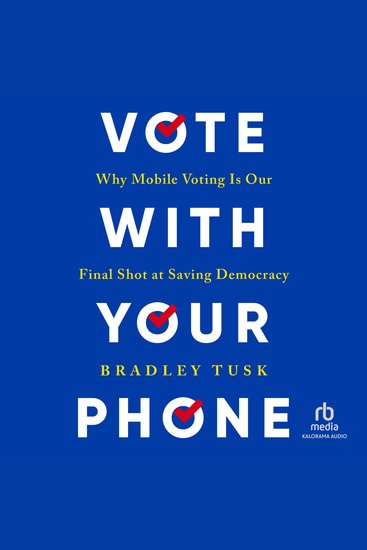
  • Vote With Your Phone - Why Mobile Voting Is Our Final Shot at Saving Democracy - cover

    Vote With Your Phone - Why...

    Bradley Tusk

    • 0
    • 0
    • 0
    Gun Control. Abortion. From the halls of Congress, it may seem that Americans are bitterly polarized on the biggest policy issues of the day. But Americans are not as divided as we think, and polls show that most of us largely agree on even the most divisive issues. The problem lies in how we vote. 


    Politics is more extreme because only the most extreme voters turn out in primaries. And with politicians prioritizing reelection above all else, they shun compromise, feed this extremism, and get rewarded for it. If a lot more people vote, the views of the electorate become more mainstream, and our politicians and policies will shift to the center. 


    Mobile voting is the solution. We do just about everything on our phones, and yet we still can't use them to vote. But the technology exists, provides enhanced security over traditional paper ballots, and it could exponentially increase voter turnout. 


    Including essays by Martin Luther King Jr. III, David Hogg, and other prominent political figures, Vote with Your Phone shows us that a solution to restoring faith in our representative democracy is right in the palm of our hands.
    Show book