
Join us on a literary world trip!
Add this book to bookshelf
Grey
Write a new comment Default profile 50px
Grey
Subscribe to read the full book or read the first pages for free!
All characters reduced
Famous Speeches - cover

Famous Speeches

Sebastian Farnham

Translator A AI

Publisher: Publifye

  • 0
  • 0
  • 0

Summary

Famous Speeches explores the profound impact of history's most important orations, examining how leaders have used rhetoric to ignite social change and shape political landscapes. Delving into the power of words, the book analyzes how speeches become transformative, focusing on elements like leadership, rhetoric, and the crucial historical context in which they were delivered. Discover how carefully constructed words, delivered with conviction, can topple empires and unite nations.

 
The book progresses chronologically, beginning with the principles of rhetoric and leadership, and then dedicates sections to pivotal historical moments, such as the American Revolution and the Civil Rights era. Each section includes exemplary political speeches, analyzed for their rhetorical strategies and historical impact. The book highlights how effective speeches often articulate unspoken desires of populations, offering visions of a better future.

 
Readers will gain insight into the mechanisms of political history and social change, understanding how language shapes our world. What sets this book apart is its holistic approach, combining rhetorical analysis, historical context, and leadership theory. Famous Speeches provides a unique perspective on the art of persuasion, making it valuable for anyone interested in history, politics, or the power of public speaking. The book draws upon primary sources and scholarly research to provide a nuanced understanding of each speech and its lasting legacy.
Available since: 03/06/2025.
Print length: 60 pages.

Other books that might interest you

  • Bernhard Sindberg - The Schindler of Nanjing - cover

    Bernhard Sindberg - The...

    Peter Harmsen

    • 0
    • 0
    • 0
    In December 1937, the Chinese capital, Nanjing, falls and the Japanese army unleash an orgy of torture, murder, and rape. Over the course of six weeks, hundreds of thousands of civilians and prisoners of war are killed. At the very onset of the atrocities, the Danish supervisor at a cement plant just outside the city, 26-year-old Bernhard Arp Sindberg, opens the factory gates and welcomes in 10,000 Chinese civilians to safety. He becomes an Asian equivalent of Oskar Schindler, the savior of Jews in the Holocaust. 


    This biography follows Sindberg from his childhood and on his first adventures as a sailor and a Foreign Legionnaire to the 104 days as a rescuer of thousands of helpless men, women, and children in the darkest hour of the Sino-Japanese War. After his remarkable achievement, he receded back into obscurity, spending decades at sea and becoming a naturalized American citizen, before dying of old age in Los Angeles in 1983. 


    The book sets the record straight by providing the first complete account of Sindberg's life in English. What emerges is the surprising tale of a person who was average in every respect but rose to the occasion when faced with unimaginable brutality, discovering an inner strength and courage that transformed him into one of the great humanitarian figures of the twentieth century and an inspiration for our modern age.
    Show book
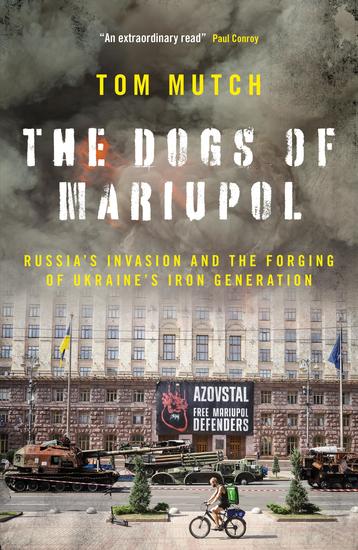
  • The Dogs of Mariupol - Russia's Invasion and the Forging of Ukraine's Iron Generation - cover

    The Dogs of Mariupol - Russia's...

    Tom Mutch

    • 0
    • 0
    • 0
    When Russia invaded Ukraine in 2022, Kateryna hung up her dresses, Oksana and Stanislav put down their lawyers' briefs and Oksen slammed shut his philosophy textbooks. Alongside thousands of their fellow citizens, they strapped on armour, picked up weapons and chose to risk their lives for the freedom and independence of their homeland. Many would never return.
    Journalist Tom Mutch woke up in Kyiv on 24 February to a world changed for ever. Making a fateful choice to stay and cover the invasion, he witnessed the forging of an 'iron generation' of young Ukrainians. With first-hand reporting from all the major battlegrounds and front lines, The Dogs of Mariupol recounts the war's notorious encounters, such as the Battle of Kyiv and the Siege of Mariupol, but also uncovers untold stories, like the 1st Tank Brigade's desperate defence of Chernihiv and the civilian guerrilla army fighting overwhelming odds in Sumy.
    This is not a triumphalist account of Ukraine's fight, however. It painstakingly documents the immense human catastrophe wrought on Ukrainian society and the divisions between those who fought and those who fled. It also delves deeper into events to answer important historical questions: could the Russian plan to capture Kyiv have succeeded? Did Ukraine make a fatal error by committing for so long to the defence of Bakhmut? And with more western support, could Ukraine have won this terrible war outright?
    Show book
  • 12 Secrets to a Millionaire Mindset - cover

    12 Secrets to a Millionaire Mindset

    Edgar Díaz

    • 0
    • 0
    • 0
    Are you ready to take charge of your financial future? This audiobook is your ultimate guide to transforming your relationship with money and building a strong financial mindset that will propel you toward success. With practical advice and an accessible approach, you’ll learn how to effectively manage your finances, optimize your income, and make smart decisions that bring you closer to your goals. 
    Inside, you’ll discover key strategies for organizing your personal finances, creating an effective budget, and saving intelligently. But this audiobook goes beyond numbers—it also explores how to cultivate an abundance mindset, overcome limiting beliefs about money, and maximize your resources to generate lasting prosperity. 
    This audiobook will equip you with the tools to:Manage your money wisely and make financial decisions that deliver results.Develop a growth-focused mindset that empowers you to pursue your dreams without fear of failure.Overcome financial obstacles like debt and lack of savings, and take concrete steps toward financial independence. 
    If you're ready to turn your financial life around and start living with more security, freedom, and abundance, this audiobook is for you. Take control of your financial future today!
    Show book
  • Writing - Articles Blog Posts EBooks Messages And PLR - cover

    Writing - Articles Blog Posts...

    Owen Jones

    • 0
    • 0
    • 0
    I hope that you will find the information helpful, useful and profitable. 
    More people are writing now than at any time in the history of civilisation. This is mainly down to education and more free time. The generation of the parents of the Baby Boomers was the first generation of mass readers – certainly in the West, and probably globally. Their parents could read, usually, but had no tradition of reading books. Instead, they read mostly newspapers. Their children had a better education, and picked up the reading habit from their parents. They were also encouraged to read books at school. The first generation where this happened. 
    Their children, the post World War II Baby Boomers, continued the progression and became avid readers. In those days, not so long ago, say, between seventy and thirty years ago, people wrote letters by hand. It was a long, but very pleasant, personal experience. Then the home computer, email, and the Internet began to spread among the masses, and pen and ink gradually became replaced with message boards, posting to forums and email. 
    Before this point, writing had been a special event for most people... thank you letters, postcards, birthday cards, and the odd personal letter home or to a friend. The home computer made it easy to dash off a quick note to someone. It took far less time to write and deliver, or have delivered by the post office. Suddenly, everyone began writing and posting to family, friends, strangers and even enemies. A barrier had been lifted – barriers of time and formality, perhaps. 
    A high percentage of those Boomers, compared with other generations, have gone on to write some kind of book, or ebook. So, the Boomers are the first generation of working-class writers, and their parents were the first working-class generation of readers.
    Show book
  • The Congress of Vienna - Redrawing Europe's Map - cover

    The Congress of Vienna -...

    Nova Ashford

    • 0
    • 0
    • 0
    The Congress of Vienna, held between 1814 and 1815, came at a pivotal moment in European history. The continent had just endured the upheaval caused by the Napoleonic Wars, which had left Europe in chaos and instability. Napoleon Bonaparte's rise to power and subsequent expansionist ambitions had dramatically altered the political landscape, reshaping borders and redrawing alliances. By 1814, with Napoleon's defeat and exile, Europe was left to deal with the aftermath of a decade of war and turmoil. The challenge for the leaders of the major powers was to rebuild a stable Europe while ensuring that the events which had led to war would not be repeated. 
    The immediate concern was to restore order and prevent any single nation from becoming too powerful. Napoleon’s domination of Europe, followed by his eventual fall, had created an imbalance of power that threatened the security of the continent. The leaders of the great powers—Great Britain, Austria, Prussia, and Russia—realized that to avoid future conflict, they needed to create a system that would maintain peace and stability through diplomacy and careful balancing of power. This would be achieved not by restoring the status quo exactly as it had been before the Napoleonic Wars, but by reshaping Europe in a way that would prevent any one nation from becoming overwhelmingly dominant. 
    The Congress of Vienna aimed to establish a new framework based on the principles of legitimacy and a balance of power. Legitimacy referred to the restoration of rightful monarchs who had been overthrown by Napoleon, while the balance of power involved redistributing territory and influence in a way that would prevent any single country from threatening the security of the others. It was a delicate process, as the major powers had competing interests and varying visions of what a stable Europe would look like. Nonetheless, the common goal was to create a system that could provide long-term peace.
    Show book
  • Anatomy of Conversation - cover

    Anatomy of Conversation

    Emma Gibbens

    • 0
    • 0
    • 0
    Communicating with others is getting more and more complex every day. Many of us are anxious about how to navigate conversations – how do I approach someone? How can I create a safe and inviting space? What happens if someone gets offended? 
    Emma Gibbens understands conversations. She delights in their depth and is thrilled by their potential. Lit with an inner fire that comes from countless hours of witnessing the power of conversation, Emma facilitates complex conversations that many of us prefer to avoid. 
    Emma provides the Anatomy of Conversation so we can better understand, more confidently prepare for, and courageously facilitate complex conversations. 
    This generous and practical book sparks us to be curious about navigating our differences and finding meaningful connection
    Show book