Join us on a literary world trip!
Add this book to bookshelf
Grey
Write a new comment Default profile 50px
Grey
Subscribe to read the full book or read the first pages for free!
All characters reduced
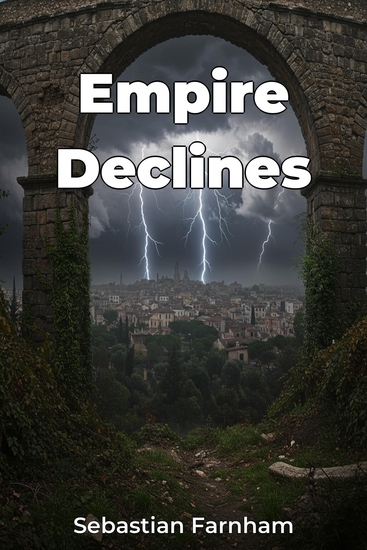
Empire Declines - cover

Empire Declines

Sebastian Farnham

Translator A AI

Publisher: Publifye

  • 0
  • 0
  • 0

Summary

Empire Declines explores the complex reasons behind the downfall of seemingly invincible empires throughout history. It posits that no single factor causes imperial collapse; rather, it's a combination of economic vulnerabilities, internal strife, and external pressures. The book argues that even robust empires can harbor hidden weaknesses that, when exploited, lead to swift decline. It is crucial to understand that the convergence and amplification of various internal and external stressors ultimately prove fatal.

 
The book progresses in three parts, first introducing key concepts such as imperial power and vulnerability. Then, it investigates internal weaknesses like economic stagnation and social unrest, using examples such as the Roman Empire. Finally, it examines external pressures, such as invasions and competition from rising powers, citing the Mongol and Ottoman Empires as examples.

 
A unique aspect of this book is its emphasis on the interplay between internal and external factors, providing a nuanced understanding of imperial decline and challenging simplistic explanations of the fall of empires. Written in an accessible style, Empire Declines draws upon historical sources, economic data, and military records to identify common patterns and unique circumstances across different empires and time periods. This comparative analysis provides insights relevant to contemporary challenges, such as managing economic inequality and responding to external threats, making it valuable for students, history enthusiasts, and policymakers alike.
Available since: 03/29/2025.
Print length: 67 pages.

Other books that might interest you

  • Translating Myself and Others - cover

    Translating Myself and Others

    Jhumpa Lahiri

    • 0
    • 0
    • 0
    Sneha Mathan narrates these luminous essays on translation and self-translation by award-winning writer and literary translator Jhumpa Lahiri
    
    With an introduction, afterword, and acknowledgements read by the author
    Translating Myself and Others is a collection of candid and disarmingly personal essays by Pulitzer Prize–winning author Jhumpa Lahiri, who reflects on her emerging identity as a translator as well as a writer in two languages.
    
    With subtlety and emotional immediacy, Lahiri draws on Ovid's myth of Echo and Narcissus to explore the distinction between writing and translating, and provides a close reading of passages from Aristotle's Poetics to talk more broadly about writing, desire, and freedom. She traces the theme of translation in Antonio Gramsci's Prison Notebooks and takes up the question of Italo Calvino's popularity as a translated author. Lahiri considers the unique challenge of translating her own work from Italian to English, the question "Why Italian?," and the singular pleasures of translating contemporary and ancient writers.
    
    Featuring essays originally written in Italian and published in English for the first time, as well as essays written in English, Translating Myself and Others brings together Lahiri's most lyrical and eloquently observed meditations on the translator's art as a sublime act of both linguistic and personal metamorphosis.
    Show book
  • Design Your Dream Life - A Guide to Living Purposefully - cover

    Design Your Dream Life - A Guide...

    Dan Desmarques

    • 0
    • 0
    • 0
    Welcome to the transformative experience of “Design Your Dream Life: A Guide to Living Purposefully," a book designed to light the way to a life of meaning and fulfillment. As we delve into the essence of aligning passion with action, we embark on a journey of self-discovery and personal growth that empowers us to create a life that resonates with our true purpose.
In the tapestry of daily life, we often find ourselves navigating the complexities of balancing work, relationships, and personal fulfillment. Just as a skilled artist chooses the right colors and strokes to create a masterpiece, aligning our passions with intentional actions allows us to create a life that reflects our deepest desires and aspirations.
Consider the daily routine of making a cup of coffee in the morning. The simple act of grinding the beans, boiling the water, and enjoying the aroma as you take your first sip represents a ritual of intentionality. When we bring the same level of mindfulness and intentionality to every aspect of our lives, we begin to see the profound impact it has on our overall sense of fulfillment.
Imagine a student embarking on a journey to pursue their dream career. By aligning their passion for a particular field of study with strategic actions such as networking, gaining relevant experience, and continuous learning, they set themselves on a path to success and personal fulfillment. This integration of passion and action is not just a theoretical concept, but a practical blueprint for turning dreams into reality.
Through the pages of this book, readers are invited to explore profound insights and actionable strategies that empower them to step into their authenticity and pursue their passions with conviction. In doing so, they unlock their true potential and create a life that aligns with their core values and beliefs.
    Show book
  • Crossing Between Worlds - Moving and Being Moved Through the Transitions of Life - cover

    Crossing Between Worlds - Moving...

    Daryl Chow

    • 0
    • 0
    • 0
    This book is for those navigating significant life transitions, those who are Crossing Between Worlds. This book is your guide.  
    These periods of change, often prompted by loss, crisis, or a desire for personal growth, can be unsettling. Yet this is an invitational season, waiting for you to become who you really are, to come fully alive.  
    Instead of forcing ideas that were not designed specifically for you, this book challenges conventional wisdom and examines 15 paradoxes to help you find your own unique path, depending on the specific season of your life. Crossing Between Worlds provides the much needed scaffolding to align your natural tendencies, nurture your unique gifts and allow yourself to move, and be moved, towards a new world so that you get to share this gift with others. 
    Drawing from his teaching and clinical experience, Daryl provides a personalisable roadmap filled with poignant anecdotes, practical wisdom, and persuasive strategies for navigating life’s seemingly contradictory forces (e.g., Should I focus on the present, or the future? Should I learn to say “Yes,” or “No”).  
    ~~~ 
    Daryl Chow, M.A., Ph.D. (Psych) is a practising psychologist and trainer. 
    His books include The Write to Recovery, The First Kiss, Creating Impact, Better Results, and The Field Guide to Better Results. He is also the co-author of several articles and edited books, including the first ever study on deliberate practice in psychotherapy. 
    For more information, visit his online home at darylchow.com and fullcircles.substack.com
    Show book
  • The Environmental Unconscious - Ecological Poetics from Spenser to Milton - cover

    The Environmental Unconscious -...

    Steven Swarbrick

    • 0
    • 0
    • 0
    Why has psychoanalysis long been kept at the margins of environmental criticism despite the theories of eco-Marxism, queer ecology, and eco-deconstruction available today? What is unique, possibly even traumatic, about eco-psychoanalysis? The Environmental Unconscious addresses these questions as it provides an innovative and theoretical account of environmental loss focused on the counterintuitive forms of enjoyment that early modern poetry and psychoanalysis jointly theorize. 


    Steven Swarbrick urges literary critics and environmental scholars to rethink notions of entanglement, animacy, and consciousness raising. Through close readings of Edmund Spenser, Walter Ralegh, Andrew Marvell, and John Milton, he reveals a world of matter that is not merely hyperconnected, as in the new materialism, but porous and off-kilter. And yet the loss these poets reveal is central to the enjoyment their works offer—and that nature offers. 


    The Environmental Unconscious offers a provocative challenge to ecocriticism that a new theory of disconnection is desperately needed. Tracing the propulsive force of the environmental unconscious from the early modern period to Freudian and post-Freudian theories of desire, Swarbrick not only puts nature on the couch in this book but also renews the psychoanalytic toolkit in light of environmental collapse.
    Show book
  • Secrets and Hidden Knowledge - Uncovering the Dark and Hidden Forces at Play (5 in 1) - cover

    Secrets and Hidden Knowledge -...

    John Harpoon

    • 0
    • 0
    • 0
    This book consists of several titles which are: 
    - Clandestine Cabals: History's Most Cryptic Organizations 
    - Global Puppet Masters: Examining the Decahedron of Ultimate World Influence 
    - Hidden Brilliance: Redefining Genius: The Overlooked Intellectual Giant 
    - Subterranean Secrets: Unveiling the Restricted Underworld Beneath the City of Light 
    - Secrets Beneath the Quicksand: Understanding the Science and Mysteries of Treacherous Terrain
    Show book
  • Hello (And Goodbye) To All That - A Memoir of a Changing New York in the 21st Century - cover

    Hello (And Goodbye) To All That...

    Jonathan Liebson

    • 0
    • 0
    • 0
    Raised in suburban Chicago, Jonathan Liebson grew up hearing fabled stories about his father's childhood in New York. The Manhattan and Queens of his father's past, and the Lower East Side of his immigrant grandfather, always shimmered in the background—until one day Jonathan finally moved there himself. This was right on the cusp of the twenty-first century: the dawn of a new millennium. The city raced headlong into an era of cellphones, the internet, and many other unpredictable changes. Over time, New York would be wracked by 9/11, a Great Recession, a great hurricane, and a great pandemic—plus much more. Hello (and Goodbye) to All That is a memoir that recounts the indelible ties Jonathan would forge in his father's city, and his up-close view of profound historical episodes. The memoir plays off Joan Didion's famous essay "Goodbye to All That," where she describes the exciting yet fleeting experience of living in New York. In contrast, Jonathan's memoir provides a narrative about the city's permanence: it tells an intergenerational story of father and son that reveals a mutual connection to a constantly changing, often-troubled, yet still-dynamic city—and to the larger American history it comprises.
    Show book