Join us on a literary world trip!
Add this book to bookshelf
Grey
Write a new comment Default profile 50px
Grey
Subscribe to read the full book or read the first pages for free!
All characters reduced
Civil Unrest - cover

Civil Unrest

Sebastian Farnham

Translator A AI

Publisher: Publifye

  • 0
  • 0
  • 0

Summary

Civil Unrest explores the history of uprisings and protests in America, arguing that these events, though disruptive, have been crucial in driving social change and addressing systemic injustices. The book examines how instances of social upheaval force a reckoning with inequality, ultimately shaping a more inclusive nation. For example, the Civil Rights Movement, marked by both nonviolent protests and violent confrontations, led to desegregation and the dismantling of Jim Crow laws. Similarly, labor movements and industrial unrest, like the Haymarket Affair, highlighted issues of labor rights and working conditions during the industrial era. The book takes a chronological approach, starting with early rebellions and moving through labor movements, the Civil Rights Era, anti-war protests, and contemporary movements like Black Lives Matter. Each event is analyzed considering the perspectives of protesters, government officials, law enforcement, and affected communities. By dissecting these historical events, Civil Unrest reveals patterns of progress and regression, offering vital lessons for addressing current social and political challenges.
Available since: 03/21/2025.
Print length: 63 pages.


Other books that might interest you

  • 1914: The History and Legacy of World War I’s First Year - cover

    1914: The History and Legacy of...

    Editors Charles River

    • 0
    • 0
    • 0
    Needless to say, the First World War came at an unfortunate time for those who would fight in it. After an initial period of relatively rapid maneuver during which the German forces pushing through Belgium and the French and British forces attempting to stymie them made an endless series of abortive flanking movements that extended the lines to the sea, a stalemate naturally tended to develop. The infamous trench lines soon snaked across the French and Belgian countryside, creating an essentially futile static slaughterhouse whose sinister memory remains to this day. 
    If trench warfare was an inevitability during the war, it is only because the events leading up to the First Battle of the Marne were quite different. The armies at the beginning of the war moved quickly through the land, but the First Battle of the Marne devolved into a bloody pitched battle that led to the construction of trenches after the Germans retreated, blocked in their pursuit of Paris. When the aftermath disintegrated into a war between trenches, some Germans thought they had the upper hand since they were occupying French territory, but with fewer soldiers than the combined Allied nations and fewer resources and supplies, it was possibly only a matter of time before they were ultimately defeated. The commander of the German armies, General Helmuth von Moltke, allegedly said to Kaiser Wilhelm II immediately after the First Battle of the Marne, "Your Majesty, we have lost the war." Winston Churchill himself would later reference that anecdote, writing, “Whether General von Moltke actually said to the Emperor, ‘Majesty, we have lost the war,’ we do not know. We know anyhow that with a prescience greater in political than in military affairs, he wrote to his wife on the night of the 9th, ‘Things have not gone well. The fighting east of Paris has not gone in our favour, and we shall have to pay for the damage we have done.’"
    Show book
  • Emotional Flow - A Practical Guide for Deep Feelers - cover

    Emotional Flow - A Practical...

    Claudia Burdette

    • 0
    • 0
    • 0
    Emotional Flow: A Practical Guide for Deep FeelersWritten by Claudia Burdette 
    If you’ve ever been told you’re “too emotional” or that you “feel too much,” this audiobook is your permission slip to stop apologizing for your depth. 
    Emotional Flow is a gentle, grounded companion for empaths, deep feelers, and highly sensitive people who often absorb the world around them. It teaches you how to honor your emotions without being ruled by them—how to move from overwhelm to wisdom, and from reactivity to radiant calm. 
    Through compassionate reflection and simple daily practices, you’ll learn to: 
    — Release emotions that aren’t yours to carry 
    — Transform sensitivity into emotional intelligence 
    — Break old emotional loops and reclaim inner peace 
    — Anchor calm and clarity in your nervous system 
    — Turn sacred sensitivity into your quiet superpower 
    Each chapter offers soft, insightful guidance to help you understand your emotional world—not as something to fix, but as something to celebrate. 
    This isn’t about numbing your feelings. It’s about learning their language. 
    It’s about remembering that your depth isn’t a burden—it’s your brilliance. 
    Includes a Bonus Companion Guide PDF with grounding tools, reflection prompts, and simple energy practices to help you stay centered in everyday life. 
    Available along side this audiobook or at: GrowWithClaudia.co.
    Show book
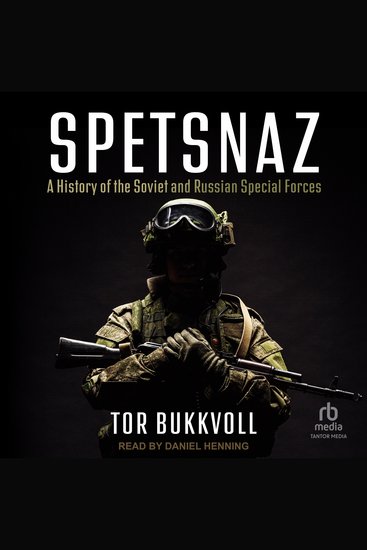
  • Spetsnaz - A History of the Soviet and Russian Special Forces - cover

    Spetsnaz - A History of the...

    Tor Bukkvoll

    • 0
    • 0
    • 0
    In January 1951, Lieutenant Evgeniy Borisov was sent to the headquarters of the Soviet 5th Army in Spassk-Dalnii, a small city in the Russian Far East. Borisov was there on a secret mission. Together with his superior, Major Rusinov, his job was to establish the 91st Special Forces Company. The 91st was to be one of forty-six similar units spread out across the Soviet Union. The new forces were called "spetsnaz"—short for spetsnialnoe naznachenie, which translates to "special purpose." 


    In Spetsnaz, Tor Bukkvoll presents the first in-depth history of the Soviet, and, later, Russian special operations forces from their establishment until today. He focuses on three broad topics: Soviet and later Russian thinking on the use of special operations forces; the actual process of constructing these forces and how this was facilitated or hampered by other agencies of the Soviet and Russian states; and the use of these forces in combat. Bukkvoll uses a variety of sources, but the most important are the recollections of former spetsnaz soldiers and officers themselves, which allow Bukkvoll to present the history of these forces as the men of spetsnaz see and have seen it. Bukkvoll also draws upon observations and judgments from other parts of the Soviet and Russian militaries, from a number of KGB sources, and from independent Russian experts and journalists.
    Show book
  • Sociology of Everyday Life - Exploring Daily Interactions and Experiences (3 in 1) - cover

    Sociology of Everyday Life -...

    Fred Grandsen

    • 0
    • 0
    • 0
    This book offers a compelling examination of the everyday social processes that shape our lives, interactions, and personal identities. 
    The Sociology of Everyday Life looks at the seemingly mundane aspects of our daily routines, uncovering the social structures, behaviors, and practices that govern how we engage with others in everyday settings. This book explores the impact of culture, class, and social norms on routine activities like work, leisure, and family life, offering a deeper understanding of the dynamics that shape how we live, communicate, and relate to one another. 
    The Sociology of Religion explores how religion influences individual and collective behavior, social interactions, and societal structures. This book examines the role of religious beliefs and practices in shaping communities, values, and social norms. It delves into topics such as religious identity, rituals, secularism, and the ways in which religion intersects with politics, economics, and culture in different societies. 
    The Sociology of Families in Flux focuses on the evolving nature of family structures and relationships in the modern world. It looks at how families adapt to social, economic, and cultural changes, exploring themes such as divorce, single parenting, same-sex families, and the impact of globalization. This book provides insights into the ways families are redefined and how their roles continue to change in contemporary society. 
    Together, these three books offer a comprehensive understanding of how social structures influence our daily lives, interactions, and familial relationships. Through the lens of sociology, they reveal how religion, family dynamics, and everyday routines shape our experiences and interactions within the broader context of society.
    Show book
  • The Slave Prince - a gay fairytale - cover

    The Slave Prince - a gay fairytale

    Jason Fronde

    • 0
    • 0
    • 0
    In a kingdom where duty reigns supreme, I, Prince James, have long hidden my true desires, yearning for a connection that feels impossible. Taken captive and made the king's slave, I never imagined I would find solace in the very man who commands my servitude. 
    As King Septimus, a ruler of strength and compassion, begins to care for me in ways I’ve never known, everything changes. When he bathes me with tenderness, I feel seen for the first time—not just as a captive or a servant, but as a man worthy of love. With each gentle touch, our bond deepens, awakening a longing within me that I can no longer ignore. 
    When his lips meet mine, I realize we have the chance to defy the expectations of our positions and embrace a love that could transform our lives. Will we dare to follow our hearts and forge a new path together, despite the chains of circumstance?
    Show book
  • Real Soldiering - The US Army in the Aftermath of War 1815-1980 - cover

    Real Soldiering - The US Army in...

    Brian McAllister Linn

    • 0
    • 0
    • 0
    What happens to the US Army after the battles are over, the citizen soldiers depart, and all that remains is the Regular Army? In this pathbreaking work, Brian Linn argues that in each decade following every major conflict since the War of 1812 the postwar army has undergone a long, painful, and remarkably consistent recovery process as it struggled to build a new model force to replace the "Old Army" that entered the conflict. 


    Real Soldiering provides the first comprehensive study of the US Army's transition from war to peace. Linn challenges three common historical interpretations: confusing Washington policy with implementation in the field; conflating postwar armies with prewar armies; and describing certain postwar eras as distinct and transformational. Rather, Linn examines the postwar force as a distinct entity worthy of study as a unique and important part of US Army history. 


    Real Soldiering represents over four decades of research into the US Army and is deeply informed by Linn's experiences teaching and working with soldiers. Insightful and entertaining, provocative and empathetic, and a work of history with immediate relevance, Real Soldiering will resonate with military historians, defense analysts, and those who have proudly worn the US Army uniform.
    Show book