Join us on a literary world trip!
Add this book to bookshelf
Grey
Write a new comment Default profile 50px
Grey
Subscribe to read the full book or read the first pages for free!
All characters reduced
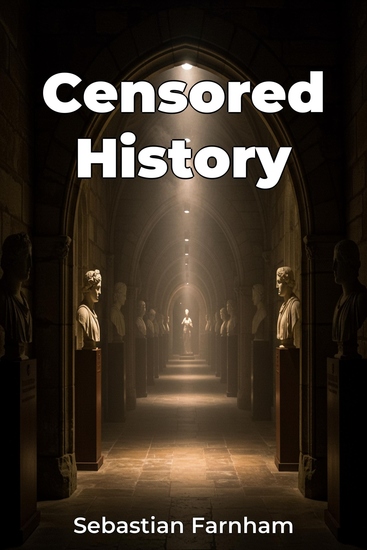
Censored History - cover

Censored History

Sebastian Farnham

Translator A AI

Publisher: Publifye

  • 0
  • 0
  • 0

Summary

Censored History reveals the unsettling ways historical events are manipulated through censorship, rewriting, and erasure, influencing everything from national identity to individual beliefs. The book uncovers how power structures shape our understanding of the past to control the present, exploring the omission of inconvenient truths and the active rewriting of events. For example, the suppression of information during wartime demonstrates how governments control historical memory. This exploration progresses through key areas, beginning with defining censorship, rewriting, and erasure before examining case studies across different regions and eras. It then investigates underlying motivations, such as political ideology and economic interests, before concluding with strategies for identifying and combating historical manipulation. By exposing these methods, Censored History equips readers to critically evaluate historical narratives and resist the ongoing threat of historical revisionism in democratic societies.
Available since: 03/21/2025.
Print length: 66 pages.

Other books that might interest you

  • The Rest Is Memory - cover

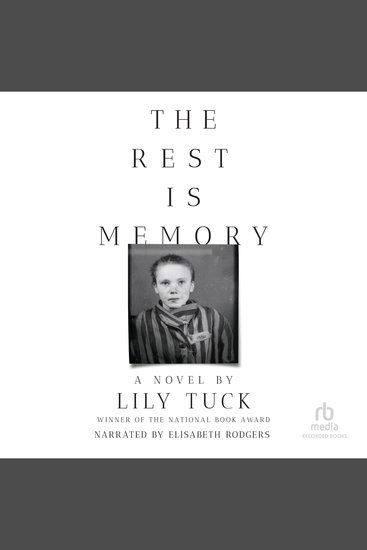
    The Rest Is Memory

    Lily Tuck

    • 0
    • 0
    • 0
    THE HEARTBREAKING STORY OF A YOUNG CATHOLIC GIRL TRANSPORTED TO AUSCHWITZ BECOMES A RASHOMON-LIKE RONDO BY ONE OF OUR GREATEST NOVELISTS. 
     
    First glimpsed riding on the back of a boy’s motorcycle, fourteen-year-old Czeslawa comes to life in this mesmerizing novel by Lily Tuck, who imagines her upbringing in a small Polish village before her world imploded in late 1942.  
     
    Stripped of her modest belongings, shorn, and tattooed number 26947 on arriving at Auschwitz, Czeslawa is then photographed. Three months later, she is dead. 
     
    How did this happen to an ordinary Polish citizen? This is the question that Tuck grapples with in this haunting novel, which frames Czeslawa’s story within the epic tragedy of six million Poles who perished during the German occupation. A decade prior to writing The Rest Is Memory, Tuck read an obituary of the photographer Wilhelm Brasse, who took more than 40,000 pictures of the Auschwitz prisoners. Included were three of Czeslawa Kwoka, a Catholic girl from rural southeastern Poland. Tuck cut out the photos and kept them, determined to learn more about Czeslawa, but she was only able to glean the barest facts: the village she came from, the transport she was on, that she was accompanied by her mother and her neighbors, her tattoo number, and the date of her death. From this scant evidence, Tuck’s novel becomes a remarkable kaleidoscopic feat of imagination, something only our greatest novelists can do. 
     
    “Beautifully written, all the while instilling a sense of horror” (Susanna Moore), Tuck’s language swirls about, yet not a word is out of place. The subtly rotating images tumble out at us, accelerating as we learn about Czeslawa’s tragic stay in Auschwitz, the lives of real people such as the barbaric Commandant Rudolf Höss; his unconscionable wife, Hedwig; the psychiatrist and child rescuer Janusz Korczak; and the mordant Polish short story writer Tadeusz Borowski. 
     
    Although we are certain of Czeslawa’s fate, we have no choice but to keep turning the pages, thoroughly mesmerized by Tuck’s near otherworldly prose. 
     
    In Lily Tuck’s hands, The Rest Is Memory becomes an unforgettable work of historical reclamation that rescues an innocent life, one previously only recalled by a stark triptych of photographs. 
     
    “The Rest Is Memory is a literary resurrection, as shattering as it is astonishing. Lily Tuck has done the impossible; from darkness and hideous cruelty, she has woven an unforgettable paean to hope, to life, to justice.”—Junot Diaz
    Show book

  • Lincoln But Trump - Narrative Metrics and Similarities Between Heroes and Villains - cover

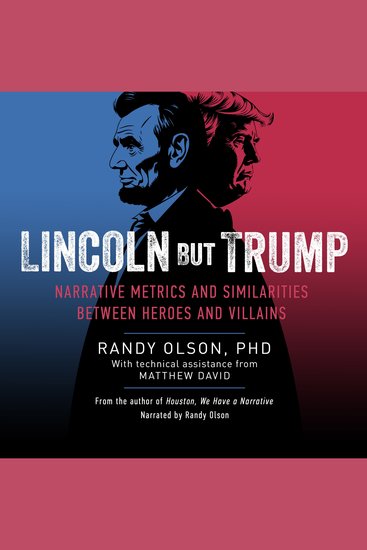
    Lincoln But Trump - Narrative...

    PhD Randy Olson

    • 0
    • 0
    • 0
    THE NARRATIVE DIAGNOSIS: I have some bad news for you — your AF (AND Frequency) is a bloated 3.8%, your N.I. (Narrative Index, BUT/AND ratio) is an anemic 4. There’s a real risk of you boring an audience to death. 
    The ABT Narrative Template, already famous for its use in “Cat Herding" and “silo busting," now has two very powerful metrics — the AF and the NI. 
    In this ground-breaking and original book, Lincoln But Trump, Randy Olson introduces a whole new quantitative component to both narrative structure and, crucial for today’s world, messaging. 
    Here, for the first time ever, are two very simple but powerful “narrative metrics” that now make possible the “narrative diagnosis” of content. The metrics do for storytelling the same thing a doctor does to assess your health — i.e. they tell you if you have a problem. 
    Is it quackery for simpletons? A fair question, but just look at the simple patterns that emerge, starting with the metrics for the legendary 1858 Lincoln-Douglas Debates. The data are as clear as "night and day" (the same comparison a reporter used to describe the two candidates). The results have been sitting there waiting to be discovered for 160 years. 
    It’s a whole new way to look at messaging and narrative strength for both the political and historical worlds. 
    - Park Howell, Host, The Business of Story Podcast 
    Following the basic ABT (And, But, Therefore) form that Olson has been researching for 15 years, he outlines the need for a quantitative approach. He introduces the two metrics, then applies them to the novel idea of, “Narrative Forensics” in which hypotheses can be tested by calculating the two metrics for various materials. 
    Using the two narrative metrics Olson shows how you can diagnose your own narrative strength, then work to improve it. 
    Download the appendices at http://abtnarrative.com or https://abtagenda.substack.com
    Show book
  • Beyond Good and Evil - cover

    Beyond Good and Evil

    Friedrich Nietzsche

    • 0
    • 0
    • 0
    "Beyond Good and Evil" by Friedrich Nietzsche is a thought-provoking and challenging work that explores fundamental questions about morality, truth, and the nature of existence. In this book, Nietzsche offers a scathing critique of traditional morality and the idea of objective truth, arguing instead for a new ethical framework that is based on the individual will to power. Drawing on a wide range of philosophical and cultural influences, Nietzsche takes readers on a journey of self-discovery that challenges many of our most deeply held assumptions about the world. With its bold and original ideas, "Beyond Good and Evil" is a classic of Western philosophy that continues to inspire and challenge readers today.
    Show book
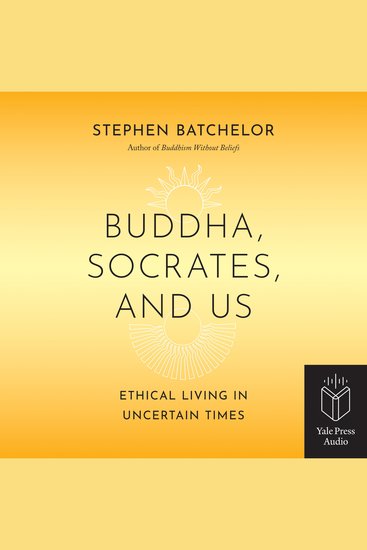
  • Buddha Socrates and Us - Ethical Living in Uncertain Times - cover

    Buddha Socrates and Us - Ethical...

    Stephen Batchelor

    • 0
    • 0
    • 0
    A renowned Buddhist teacher turns to two of the most influential figures in history for guidance on how to face the ethical challenges of our time The Buddha’s revolutionary teachings transformed Asia, and his contemporary Socrates laid the foundations of Western philosophy. Although they never met, Socrates and the Buddha each addressed in a radically new and surprisingly similar way the core questions of how to lead a good, just, and dignified life amid turbulence and violence. Common to their teachings was an ethics of uncertainty: both refused to make truth claims about the ultimate nature of reality, insisting on the primacy of critical self‑evaluation as the basis of an ethical life. In this illuminating book, best-selling author Stephen Batchelor explores the philosophical, social, and political worlds of the Buddha and Socrates, showing how their teachings continue to provide lessons in how to lead a flourishing and engaged life. Keenly aware of the fickle and conflicted nature of the human mind, Gotama and Socrates inspired their followers to act with humility and courage, risk and resolve, doubt and confidence. Drawing on their insights, and those of their followers, Batchelor uncovers a middle way between Buddhist dharma and Greek philosophy that can serve as a starting point for a “secular faith” that addresses the most pressing spiritual and planetary issues of our age.
    Show book
  • Richard Nixon - The Prominent Republican President from California - cover

    Richard Nixon - The Prominent...

    Kelly Mass

    • 0
    • 0
    • 0
    Richard Milhous Nixon was the United States' 37th president, serving from 1969 to 1974. Nixon, a Republican politician, formerly worked as the 36th Vice President from 1953 to 1961, after rising to country prominence as a California agent and senator. 
    Following the Watergate occurrence, he ended up being the only president to leave from office after 5 years in the White Home that observed the end of the Vietnam War, détente with the Soviet Union and China, the first manned moon landings, and the starting of the Epa. 
    Let’s learn more about this president who was serving in a crucial time period in American history.
    Show book
  • The Wars of the Roses - cover

    The Wars of the Roses

    History Nerds

    • 0
    • 0
    • 0
    About empty thrones, a lot can be said. Throughout history, both ancient and near modern, a lack of an heir and the sudden death of a beloved monarch always meant trouble. When the position of a king is up for grabs, a lot of eager hands come forward. Pretenders and would-be heirs, cousins and nephews, bastard sons and daughters - they all came forward staking their claim to the throne. In the history of Medieval England, such episodes were many. Usurpers who oust kings and heirs, pretenders with long-forgotten dynastic claims: many once fought for the lucrative throne of the English Kingdom. However, by far the most important of all these historic episodes lasted from 1455 to 1487 - 32 long years of struggle and bloodshed in England. And that episode was known as the Wars of the Roses. These wars ravaged England, pitting two competing cadet families of the royal House of Plantagenet - York, and Lancaster. Their supporters, the Lancastrians and Yorkists, descended into bitter warfare over the throne. For their symbols they took red and white roses, respectively - thus giving the name to the conflict.
    Show book