
Join us on a literary world trip!
Add this book to bookshelf
Grey
Write a new comment Default profile 50px
Grey
Subscribe to read the full book or read the first pages for free!
All characters reduced
Arctic Borders - cover

Arctic Borders

Sebastian Farnham

Translator A AI

Publisher: Publifye

  • 0
  • 0
  • 0

Summary

"Arctic Borders" explores the intensifying geopolitical competition in the Arctic region as melting ice opens new strategic possibilities. The book examines the historical roots and current legal battles surrounding territorial claims made by Russia, Canada, the United States, Denmark (Greenland), and Norway. Readers gain insight into how climate change is transforming the Arctic into a crucial arena for resource exploitation and military positioning, underscoring the urgent need to understand its evolving border dynamics.

 
One interesting fact highlighted is the inadequacy of current international legal frameworks, such as the United Nations Convention on the Law of the Sea (UNCLOS), to resolve overlapping claims and ambiguities in the Arctic. For example, the legal status of the Northwest Passage and the Northern Sea Route remains contested, raising the potential for conflict.

 
The book's approach is to weave together historical analysis, legal scrutiny, and geopolitical strategy to provide a comprehensive view. Beginning with Arctic exploration history, the book progresses systematically through each nation's territorial ambitions and concludes with a discussion of Indigenous communities' rights.

 
This book is particularly valuable for policymakers, scholars, and anyone interested in international relations or environmental policy. By integrating legal, political, and environmental considerations, "Arctic Borders" offers a nuanced understanding of the Arctic's challenges and opportunities. It addresses the complex interplay between national sovereignty, international cooperation, and the sustainable development of this increasingly important region.
Available since: 03/20/2025.
Print length: 69 pages.

Other books that might interest you

  • American Indian Symbolism - cover

    American Indian Symbolism

    Manly Palmer Hall

    • 0
    • 0
    • 0
    The North American India is commonly a symbolist, a spiritualist, and a savant. Like most: native people groups, his spirit was en affinity with the grandiose organizations appearing about him. Besides the fact that his Manidos controlled creation from their lifted up seats over the mists, however they additionally plunged into the universe of men and blended with their red kids. The dim mists looming into the great beyond were the smoke from the calumets of the divine beings, who could construct flames of frozen wood and utilize a comet for a fire. The Native American inhabited the woods, streams, and sky with heaps of superphysical and undetectable creatures. There are legends of whole clans of Indians who lived in lake bottoms; of races who were never found in the daytime yet who, approaching from their secret caverns, wandered the earth around evening time and waylaid unwary explorers; likewise of Bat Indians, with human bodies and batlike wings, who lived in bleak woodlands and distant bluffs and who dozed hanging head descending from extraordinary branches and offshoots of rock. The red man's way of thinking of basic animals is evidently the result of his private contact with Nature, whose mysterious miracles become the producing reason for such powerful hypotheses.
    Show book
  • Mysterious Mass Disappearances - cover

    Mysterious Mass Disappearances

    Martin K. Ettington

    • 0
    • 0
    • 0
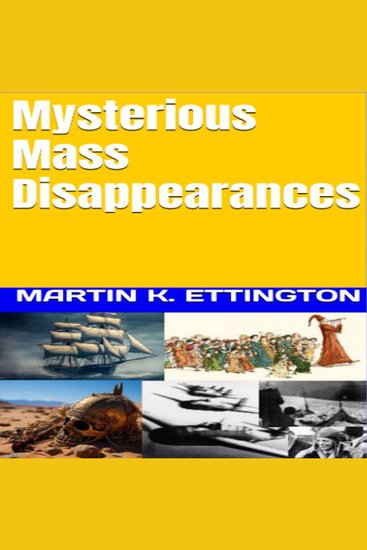
    This book is all about mass disappearances which have occurred in history. 
    These events run the gamut from entire villages whose inhabitants disappeared to a flight of military planes gone missing in the Bermuda Triangle. 
    Many ships have disappeared so I only cover a few of the most notorious ones.  
    I also do not usually cover missing families or where just several people have gone absent. 
    It is much more interesting to me if an entire army became lost and missing or strange things happened to a group which has become a big mystery. 
    There are also some recent missing persons mysteries since these events happen even in the modern age.
    Show book
  • Breaking Point: The new fostering memoir from THE MILLION-COPY BESTSELLING AUTHOR Casey Watson new for 2026 - cover

    Breaking Point: The new...

    Casey Watson

    • 0
    • 0
    • 0
    The new fostering memoir from The Sunday Times Bestselling author Casey Watson. 
    Daniel just wants a place to belong… 
    With his parents in and out of prison, Daniel has spent the last three years in a children’s home, feeling forgotten and with nowhere to truly belong. 
    When he arrives at Casey and Mike’s, his challenging and unpredictable behaviour soon reveals a much darker past than anyone had imagined. 
    Can Casey find a way to reach Daniel and help him build a brighter future before it’s too late?
    Show book
  • The Saboteur - The Aristocrat Who Became France's Most Daring Anti-Nazi Commando - cover

    The Saboteur - The Aristocrat...

    Anonymous

    • 0
    • 0
    • 0
    In the tradition of Agent Zigzag comes this breathtaking biography, as fast-paced and emotionally intuitive as the very best spy thrillers, which illuminates an unsung hero of the French Resistance during World War II—Robert de La Rochefoucald, an aristocrat turned anti-Nazi saboteur—and his daring exploits as a résistant trained by Britain’s Special Operations Executive. 
    A scion of one of the most storied families in France, Robert de La Rochefoucald was raised in magnificent chateaux and educated in Europe's finest schools. When the Nazis invaded and imprisoned his father, La Rochefoucald escaped to England and learned the dark arts of anarchy and combat—cracking safes and planting bombs and killing with his bare hands—from the officers of Special Operations Executive, the collection of British spies, beloved by Winston Churchill, who altered the war in Europe with tactics that earned it notoriety as the “Ministry of Ungentlemanly Warfare.” With his newfound skills, La Rochefoucauld returned to France and organized Resistance cells, blew up fortified compounds and munitions factories, interfered with Germans’ war-time missions, and executed Nazi officers. Caught by the Germans, La Rochefoucald withstood months of torture without cracking, and escaped his own death, not once but twice. 
    The Saboteur recounts La Rochefoucauld’s enthralling adventures, from jumping from a moving truck on his way to his execution to stealing Nazi limos to dressing up in a nun’s habit—one of his many disguises and impersonations. Whatever the mission, whatever the dire circumstance, La Rochefoucauld acquitted himself nobly, with the straight-back aplomb of a man of aristocratic breeding: James Bond before Ian Fleming conjured him. 
    More than just a fast-paced, true thriller, The Saboteur is also a deep dive into an endlessly fascinating historical moment, telling the untold story of a network of commandos that battled evil, bravely worked to change the course of history, and inspired the creation of America’s own Central Intelligence Agency.
    Show book
  • The Temples of Egypt - Sacred Spaces and Religious Practices - cover

    The Temples of Egypt - Sacred...

    Omar Khalil

    • 0
    • 0
    • 0
    Temples in ancient Egypt were far more than mere places of worship. They stood at the very heart of Egyptian civilization, functioning as both spiritual centers and instruments of political and social order. Each temple was seen as a dwelling place for a god or goddess, and the rituals performed within their walls were believed to maintain the cosmic balance known as ma’at. The presence of a temple in a city or region signaled divine favor and legitimacy, reinforcing the bond between the gods and the ruling pharaoh. 
    Pharaohs were considered divine intermediaries between the gods and the people, and their authority was deeply rooted in religious belief. Temples were a direct reflection of this divine connection. Often constructed by pharaohs to honor specific deities, temples helped assert royal power and ensure harmony across the land. Through grand architecture and lavish offerings, rulers demonstrated their piety and reaffirmed their right to govern. This link between kingship and temple worship made temples central to the ideological framework of the state. 
    Beyond their religious significance, temples also played a pivotal role in the social life of ancient Egyptians. They were the sites of numerous festivals and ceremonial events that brought entire communities together. These occasions were marked by processions, music, dancing, and the display of sacred statues, all of which reinforced communal identity and devotion. The most prominent of these was the Opet Festival in Thebes, during which statues of Amun, Mut, and Khonsu were transported from Karnak to Luxor Temple in a public procession along the Nile. Such festivals reminded people of the gods’ presence and the pharaoh’s divine role in upholding order.
    Show book
  • A Real Right to Vote - How a Constitutional Amendment Can Safeguard American Democracy - cover

    A Real Right to Vote - How a...

    Richard L. Hasen

    • 0
    • 0
    • 0
    Throughout history, too many Americans have been disenfranchised or faced needless barriers to vote. Part of the blame falls on the Constitution, which does not contain an affirmative right to vote. The Supreme Court has made matters worse by failing to protect voting rights and limiting Congress's ability to do so. The time has come for voters to take action and push for an amendment to the Constitution that would guarantee this right for all. 


    Drawing on troubling stories of state attempts to disenfranchise military voters, women, African Americans, students, former felons, Native Americans, and others, Richard Hasen argues that American democracy can and should do better in assuring that all eligible voters can cast a meaningful vote that will be fairly counted. He shows how a constitutional right to vote can deescalate voting wars between political parties that lead to endless rounds of litigation and undermine voter confidence in elections, and can safeguard democracy against dangerous attempts at election subversion. 


    The path to a constitutional amendment is undoubtedly hard, especially in these polarized times. A Real Right to Vote explains what's in it for conservatives who have resisted voting reform, and reveals how the pursuit of an amendment can yield tangible dividends for democracy long before ratification.
    Show book