Join us on a literary world trip!
Add this book to bookshelf
Grey
Write a new comment Default profile 50px
Grey
Subscribe to read the full book or read the first pages for free!
All characters reduced
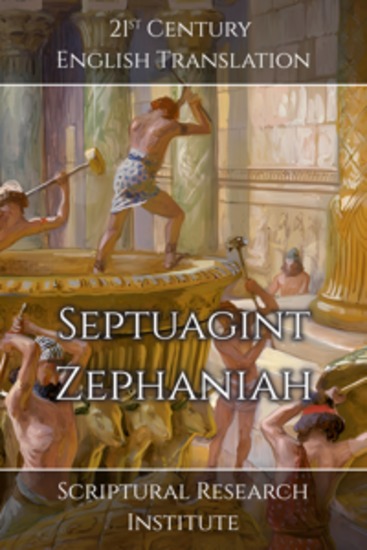
Septuagint - Zephaniah - cover

Septuagint - Zephaniah

Scriptural Research Institute

Publisher: Digital Ink Productions

  • 0
  • 0
  • 0

Summary

The Book of Zephaniah is generally considered one of the older surviving books of the Judahite books, with most scholars dating it to the era it claims to have been written in, during the reign of King Josiah of Judah. King Josiah ruled between 640 and 609 BCE, and Zephaniah’s book is set in a world consistent with that era. King Josiah also engaged in a massive religious reformation starting in 632 BCE, which Zephaniah’s book is generally consistent with. There are some inconsistencies in the way the Greek and Hebrew translations treat the old Canaanite gods, with the Hebrew translation reducing some of them to an epithet of Yahweh, the national god of Josiah’s Judah. Conversely, the Greek translation generally treats them as opposing gods to be destroyed.Based on the contents of Zephaniah’s writing, the book must have been composed before the Fall of Nineveh, in 612 BCE, shortly after the Chaldean revolt of 626 BCE. The Chaldean revolt against the Assyrians captured Babylon in its first year and coronated Nabopolassar as King of Babylon. King Josiah switched allegiances quickly from Assyria to Babylon, and four years later began his religious reforms, banning the worship of all gods other than Yahweh, several of which Zephaniah mentioned as being worshiped in Jerusalem in his writing.Zephaniah mentioned several gods in his book which were explicitly mentioned in 4th Kingdoms, during King Josiah’s religious reforms. The opening verses denounce the worship of Ba'al, which is treated as a proper name, and therefore is almost certainly a reference to Hadad, the Canaanite storm god, commonly called Ba'al. He then denounced those who worshiped the army of Shamayim, which, based on the Book of Daniel, were the stars, as some copies of Daniel use the phrase “armies of Shamayim,” while other copies use “stars of Shamayim.” Shamayim was the name of the Canaanite god of the “skies,” and the god Jonah identified as the god of his Assyrian owner when he went to prophesy in Nineveh. As all of the geographic references in the Book of Jonah locate his life in Assyrian-occupied Samaria, and later the Assyrian capital of Nineveh, it is likely he was a Samarian slave shortly after the Assyrians had occupied Samaria, as it is recorded that they reduced the entire population to slavery.
Available since: 05/15/2025.
Print length: 59 pages.

Other books that might interest you

  • How the Eucharist Can Save Civilization - cover

    How the Eucharist Can Save...

    PhD. R. Jared Staudt

    • 0
    • 0
    • 0
    The greatest civilizations have all sought immortality. 
    From inventions to massive monuments, these societies have tried to produce something that would define them and last forever. But only one is eternal: God Himself. Christ’s greatest gift, His divine flesh and blood in the Eucharist, is the eternal defining legacy of Christendom, the flower of Western Civilization. The Eucharist is not just a doctrine; it is a reality to be lived, and it must shape our entire lives and culture. Indeed, from hospitals to the great cathedrals, this gift defined Western Civilization and allowed it to reach its highest heights. 
    Yet now, our Western Civilization verges on complete collapse because we lack this supernatural framework. We have reverted to being barbarians, devoid of a noble vision of human life and the personal cultivation of virtue. But there is a remedy: a return to a Eucharist-centered life. 
    What once took us to our summit can once again be our source for a flourishing civilization. The Blessed Sacrament has more power than any medicine to heal the body and soul, more strength than any army to defeat our foes, and more grace to transform our civilization by first transforming us. Only the Holy Eucharist, which built the great culture of Christendom, can both renew and save our secular culture by infusing it with beauty, festivity, community, and charity.
    Show book
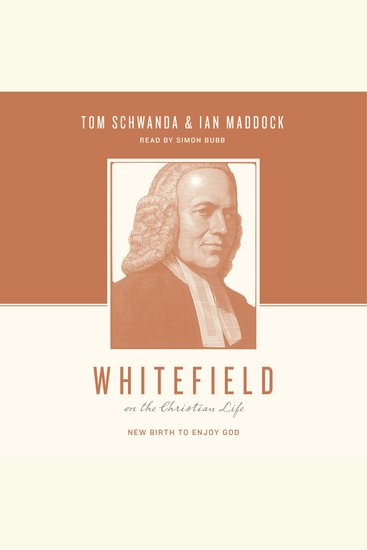
  • Whitefield on the Christian Life - New Birth to Enjoy God - cover

    Whitefield on the Christian Life...

    Tom Schwanda, Ian Maddock,...

    • 0
    • 0
    • 0
    Biography Explores the Life of George Whitefield, an Important Figure in the Early Evangelical Revival
    George Whitefield's bold "born-again" theology and passionate sermons established him as a key figure during the 18th century. Many Christians are familiar with evangelists of this time including Jonathan Edwards and John Wesley, but Whitefield, arguably the most significant member of the trio, often goes unnoticed in the church today. 
    After experiencing a profound encounter with Jesus during his time at Oxford, Whitefield dedicated his life to teaching the Scriptures to others and calling people to experience the joy of knowing and loving God. This biography aims to restore Whitefield as a prominent figure in the early evangelical revival while addressing the complexities of the time in an honest, historical, and balanced way. Authors Tom Schwanda and Ian Maddock invite readers to explore the life of George Whitefield and his commitment to guiding souls toward Jesus. 
    
    - Part of the Theologians on the Christian Life Series: Provides accessible introductions to some of church history's greatest teachers
    - Pastors, Interested Lay Readers, and Historians: Great for adult education, small groups, and college and seminary courses on evangelicalism
    - Honest: A full chapter is devoted to Whitefield's relationship to slavery and his contribution to establishing black evangelicalism
    Show book
  • Hints of Hope - Essays on Making Peace with the Proximate - cover

    Hints of Hope - Essays on Making...

    Steven Garber

    • 0
    • 0
    • 0
    We all want to make sense of life—the good, the painful, the miraculous. Who are we? Why are we here? What should we do with our lives? How do we hold on to hope, in a world that is both beautiful and broken?   
    Through eight lyrical and reflective essays, one of today's most thoughtful spiritual writers Steven Garber explores the idea of the "proximate"—a word from the Latin "proximatus," to draw near. Garber invites us to draw near to the deepest realities of life and to see with greater clarity and compassion—recognizing what is true, right, and beautiful in the world, even as we see the suffering all around us. 
    Hints of Hope probes what it means to be human; to wrestle with the contradictions we all face in our marriages, in our workplaces, in our friendships and vocations. We all experience beauty and brokenness, wonder and despair, joy and sorrow. We live with disappointment and grief and pain . . . wanting more, expecting more, but never being completely fulfilled. Paradoxically, as we make peace with the proximate, our vision is expanded to see more clearly the glimmers of beauty and grace that thread their way through our lives. Garber suggests that those hints of hope are enough in this frail world of ours, "a world stretched taut between what is and what someday will be."
    Written in memoir form, Hints of Hope weaves together decades of Garber's travels, teaching, and personal musings to offer a tapestry of wisdom on vocation, culture, faith, and hope. Readers of Wendell Berry, Parker Palmer, Marilyn McEntyre, and Frederick Buechner will find a rich, soul-nourishing feast within these pages. 
    Show book
  • What Every Christian Should Know - 10 Core Beliefs for Standing Strong in a Shifting World - cover

    What Every Christian Should Know...

    Dr. Robert Jeffress

    • 0
    • 0
    • 0
    We live in a time when believing in anything or nothing is considered equally "truthful." Many people don't identify with a specific religion, preferring to think of themselves as "spiritual" to avoid seeming intolerant of other beliefs. This has led to some squishy ideas about right and wrong, as well as false teachings infiltrating our churches. 


    More than ever, we must stand firm on the clear teaching of God's Word. In What Every Christian Should Know, Dr. Robert Jeffress equips you to understand ten core doctrines of Christianity so you can be confident that your faith is built on solid ground and stand strong against false teaching. Each chapter illuminates a core belief of the Christian faith, such as God's Word, the Trinity, angels and demons, sin, salvation, future things, and more. 


    Nothing is more hopeful and beneficial in our trying times than good theology. With clear explanations and practical applications for believers today, this book will help you ground your faith in capital T truth.
    Show book
  • FINDING MY LOST VOICE - By Acting Justly Loving Kindness and Walking Humbly with God - cover

    FINDING MY LOST VOICE - By...

    Basil Sparks

    • 0
    • 0
    • 0
    Reclaim Your Voice, Reshape the Future 
    Sparks challenges the status quo of those who feel sidelined and shutdown, those believing that it is better to remain silent than to be shamed into silence. He reminds readers that to shape a better, collective future, it is crucial that they courageously find their voice. The book is thoughtfully provocative, but also sensitive. 
    In Finding My Lost Voice Sparks steps carefully into controversial conversations that have polarised the world. He is reflective, inspiring readers to think carefully and to engage constructively with each discussion; whether that is white privilege, homosexuality, body image, or whether it is better to support Israel or Palestine. He persuades readers to reject mob mentality, and to embrace free speech whilst learning to think independently. 
    Sparks’s unique lens is that of a heterosexual, white, Christian man in his late 50’s. He speaks as a person some may prefer to cancel! But he speaks, nonetheless. He calls readers to embrace three indispensable qualities that must flavour every engagement: justice, kindness, and humility. 
    Standing at the intersection of conviction and complacency, readers must choose: Will they settle for a life of quiet desperation? Or will they ignore the voices trying to silence them? Will they find their lost voice?
    Show book
  • Passing the Torch - An Apology for Classical Christian Education - cover

    Passing the Torch - An Apology...

    Louis Markos

    • 0
    • 0
    • 0
    Imagine a world where education isn't just about information transfer but about shaping the soul, where students are nurtured to become virtuous, morally self-regulating citizens. Passing the Torch makes an energetic case for the critical role of classical Christian education in today's world. From the pre-Christian musings of Plato to the modern reflections of C. S. Lewis, Passing the Torch intertwines the wisdom of diverse epochs to argue for an educational renaissance grounded in classical Christian values. 


    Passing the Torch takes educators and parents on a literary and philosophical pilgrimage that includes: 


    ● Bibliographic Essays: Each essay serves as a gateway to key texts and influential thinkers, making it an invaluable guide for educators and homeschooling parents alike. 


    ● Close Readings: Delve into thoughtful examinations of pivotal figures such as Augustine, Rousseau, and Dorothy Sayers offering an intimate understanding of the moral and educational imperatives they championed. 


    ● Passionate Advocacy: Passing the Torch ignites a fervor for the value and necessity of classical Christian education that is both infectious and inspiring.
    Show book