Join us on a literary world trip!
Add this book to bookshelf
Grey
Write a new comment Default profile 50px
Grey
Subscribe to read the full book or read the first pages for free!
All characters reduced
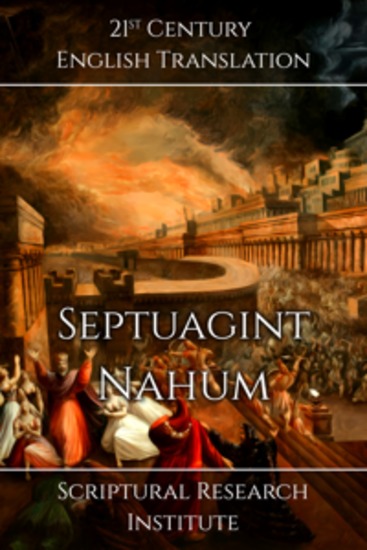
Septuagint - Nahum - cover

Septuagint - Nahum

Scriptural Research Institute

Publisher: Digital Ink Productions

  • 0
  • 0
  • 0

Summary

The Book of Nahum is generally considered one of the older surviving books of the Israelite Scriptures, with most scholars dating it to before the Torah was compiled, or at least heavily redacted in the time of King Josiah. Most scholars accept that Nahum was written by a prophet called Nahum between 663 and 656 BCE, who was most likely from the town of Alqosh in northern Iraq, although some debate the location of his home town. His world was very different from the later Kingdom of Judea that emerged in the 2nd century BCE, as the Israelites of his time were still polytheistic, worshiping the Canaanite gods, as well as statues of Yahweh, the God the Jews and Samaritans would later worship.By Nahum’s time, Samaria had been conquered by the Assyrians, as had Egypt to the south, however the smaller Kingdom of Judah, located mostly in the modern Palestinian West Bank, had maintained its nominal independence. As he is reported to be from the town of Alqosh, in modern northern Iraq, his family must have been Samaritan. After the Assyrian Empire conquered the Samaritans in 720 BCE, they dispersed the Samaritans throughout the empire in an attempt to assimilate them. The Kushites of modern Sudan, who the Greeks would later call Æthiopians, had ruled Egypt since 744 BCE, however, were driven out of most of Egypt in 663 BCE when the Assyrians sacked Thebes, called Amon in the Septuagint, and No Amon in the Masoretic Texts, ultimately derived from the Egyptian name Nủt-Ỉmn, meaning, City of Amen. According to multiple ancient sources, Thebes was plundered by the Assyrians and virtually abandoned for years until the new Libyan dynasty took control of the region in 656 BCE and began rebuilding.Nahum’s book is set during this era, after Thebes had been sacked, and presumably before rebuilding had begun. Some scholars debate this, suggesting that Nahum’s life was decades later, as the Assyrian Empire was collapsing around 612 BCE. This is mainly due to his prophecy that Nineveh would be devastated like Thebes had been, which did happen in 612 BCE, however, that does not mean the prediction was not made decades earlier. Nahum’s sentiment, that all empires eventually fall is a universal truth, and it is far more likely that he would have warned that Nineveh was going to end up like Thebes when that event was still fresh in everyone’s mind than decades later when there was more obvious evidence the Assyrian Empire was collapsing. As such, the scholarly consensus is that he wrote the Book of Nahum between 663 and 656 BCE.
Available since: 04/23/2025.
Print length: 47 pages.
Other books that might interest you

  • Heidi: A Christian Readers' Guide - cover

    Heidi: A Christian Readers' Guide

    Marissa Burt

    • 0
    • 0
    • 0
    Rediscover the timeless story of Heidi through this thoughtful and engaging guide by Marissa Burt. With chapter breakdowns, commentary, and discussion questions, this guide encourages readers to reflect on the novel’s themes of perseverance and friendship.  An enriching resource for fans of classic literature, this guide invites readers to uncover the values and lessons that continue to resonate across generations.
    Show book
  • Confronting Sexism in the Church - How We Got Here and What We Can Do About It - cover

    Confronting Sexism in the Church...

    Heather Matthews

    • 0
    • 0
    • 0
    How to Fight Sexism in the Church
    Despite the real progress that has been made in recent years, women continue to be silenced, wounded, and relegated to the sidelines in our churches. Many churches—even churches that outwardly affirm and platform women—remain unaware of the patterns and cultures at play that set up unseen barriers for women.
    This is a book for Christians who want to learn how to do better. Heather Matthews has experienced sexism in the church firsthand. In Confronting Sexism in the Church, she explores the history and culture of sexism in our contemporary evangelical world and describes the many ways—subtle and not so subtle—that it lives on in the church today. She gives simple, practical steps for how Christians can actively fight sexism in its many forms.
    The mistreatment of women has been part of the human experience from the very beginning—but in Christ, women are set free to be all they've been created to be. This book invites churches to live out that reality in all its fullness.
    Show book
  • Why The Pre-Tribulation Rapture Theory Is False - Listen to What the bible tells you - cover

    Why The Pre-Tribulation Rapture...

    Leslie Rendell

    • 0
    • 0
    • 0
    Why the pre-tribulation rapture theory is false is a brief introduction to what is wrong with the theory of a pre-tribulation rapture. As you read through this book, you will come to understand why this theory is unbiblical.  
    Those who believe in this theory are unfortunately looking for an escape from the time of the tribulation. Their studies, if they do any at all, are in the hope of finding an escape clause in God's plans for humanity. They cling to straws and errors in the interpretations of the times in which we live. They take most of their beliefs from pastors who have themselves misunderstood the scriptures. Not only that, but they do not do their due diligence and study God's holy bible for the truth that is concealed in this amazing book. 
    There are two very important scriptures that we should all take to heart when we study the bible. Read Pro 25 
    Pro 25:2 It is the glory of God to conceal a matter; to search out a matter is the glory of kings.  
    So we see here that God has concealed the truth on many matters throughout the bible and it is our task to dig into the scriptures to find the truth. The other scripture that backs up this idea in found in. 
    Isa 28:10 For precept must be upon precept, precept upon precept; line upon line, line upon line; here a little, and there a little: 
    These verses advise us to seek the truth. 
    To know the truth on this matter is to prepare the church for what is surely coming in the near future. A time of great tribulation. A time the church will have to live through. Christians should not put their hope in a rapture to take them out of the world. They must use the little amount of time left to prepare for the tribulation, and a time when Satan will persecute the church. 
     
    Show book
  • The Supreme Ideal - cover

    The Supreme Ideal

    Neville Goddard

    • 0
    • 0
    • 0
    Tonight’s subject is “The Supreme Ideal.” But really this is a misnomer, because it would have to be relative to the level on which man is placed. For what is to me today a supreme ideal would not be my ideal tomorrow after I’ve obtained it. But you can, if you have an ideal, you can realize it, and one should have an ideal. Here is a formula by which it can be realized: You sow a thought and you reap an act; you sow an act and you reap a habit; you sow a habit and you reap a character; you sow a character and you reap a destiny. So it all goes back to the thought that you sow. 
    Here, two stories come to mind. I think, in fact I know, you are familiar with both of them. Here is a North American Indian who had an idea, and he sowed it. I’ll show you later how to sow the idea.
    Show book
  • Friendship With God - The Empowerment of Honor and Grace - cover

    Friendship With God - The...

    Ted J. Hanson

    • 0
    • 0
    • 0
    Friendship with God empowers honor and grace in our lives. God wants us to know Him intimately. His gift of Jesus and Holy Spirit is proof that God is our friend. He invites us to become His friends to become givers of life to our world. 
    Grace is receiving life from God to become a giver of life to others, and honor is how we give that life to one another. Though grace is manifested in honor, it is honor that invites the power of grace for a testimony of God's glory. These things are known through a face-to-face relationship with God as our friend. Knowing God as our friend will empowers honor and grace to cause us to manifest as God's sons and daughters for the sake of our world. 
    There is an honor for who God is, worshiping who He is, being true to His name, living from His presence resting in our lives, and connecting to our God-given family inheritance. There is an honor for human life, relationships, possessions, reputations, and the boundaries of God-given authority. These levels of honor are a testimony to knowing the friendship of God in our lives and God's grace brings maturing testimonies of honor working in us. This book reveals these truths and how we find God's grace to become sons and daughters of God who exhibit these values of life.
    Show book
  • Holy Bible - 2 Kings - New Living Translation (NLT) - cover

    Holy Bible - 2 Kings - New...

    Tyndale House Publishers

    • 0
    • 0
    • 0
    HOLY BIBLE - 2 KINGS: NEW LIVING TRANSLATION (NLT) The Holy Bible, New Living Translation, is an authoritative Bible translation, rendered faithfully into today’s English from the ancient texts by 90 leading Bible scholars. The NLT’s living language breathes life into even the most difficult-to-understand Bible passages—but even more powerful are stories of how people’s lives are changing as the words speak directly to their hearts.  The New Living Translation is perfect for every age and stage of life, allowing every member of the family to read the same text.   What method did the translators use in making the NLT?  The translators of the New Living Translation set out to render the message of the original texts of Scripture into clear, contemporary English. As they did so, they translated as simply and literally as possible when that approach yielded an accurate, clear, and natural English text. Many words and phrases were rendered literally and consistently into English, preserving essential literary and rhetorical devices, ancient metaphors, and word choices that give structure to the text and provide echoes of meaning from one passage to the next.  On the other hand, the translators rendered the message more dynamically when the literal rendering was hard to understand, was misleading, or yielded archaic or foreign wording. They clarified difficult metaphors and terms to aid in the reader’s understanding. The translators first struggled with the meaning of the words and phrases in the ancient context; then they rendered the message into clear, natural English. Their goal was to be both faithful to the ancient texts and eminently readable. The result is a translation that is both exegetically accurate and idiomatically powerful. More than 90 Bible scholars, along with a group of accomplished English stylists, worked closely together toward that goal. In the end, the NLT is the result of precise scholarship conveyed in living, contemporary language.
    Show book