Join us on a literary world trip!
Add this book to bookshelf
Grey
Write a new comment Default profile 50px
Grey
Subscribe to read the full book or read the first pages for free!
All characters reduced
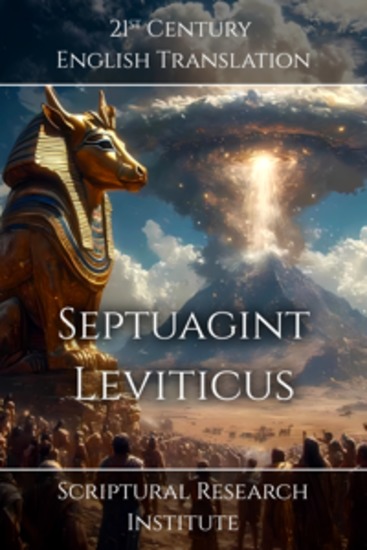
Septuagint - Leviticus - cover

Septuagint - Leviticus

Scriptural Research Institute

Publisher: Digital Ink Productions

  • 0
  • 0
  • 0

Summary

The Greek name of the book of Leviticus was το Λευιτικόν, which translates as “of Levites.” The Levites were the priestly tribe of the Israelites, who the book of Leviticus establishes as hereditary priests, with established cities to live in. The Hebrew name of the book is Vayikrá. The Hebrew name is based on the first word of the book, which translates as “and he called.” The English name is a direct copy of the Old Latin name Leviticus, which shares a common origin with the Greek. This book was not in the Samareitikon, the translation of the Samaritan Torah made at the Library of Alexandria before the Septuagint, and therefore, the book “of Levites” likely seemed like an addition to the Greek translators working at the Library of Alexandria. The Old Latin translators seemed to have viewed the book the same way and named it accordingly. The textual differences between the Greek Leviticus and Hebrew Vayikrá are far less significant than the textual differences in the other books of the Torah, supporting the book as having been written quite recently before it was translated into Greek. The laws of the book correlate with the religious reforms of the Judahite king Josiah, who reigned between 640 and 609 BCE. This was less than 400 years before the Greek translation was made. His reforms apparently began with someone finding an “original” copy of Moses’ laws in the Temple in Jerusalem, which then became the basis of his official Torah. The laws found in Leviticus parallel his reforms as described in 4ᵗʰ Kingdoms and Masoretic Kings, and therefore the book is generally viewed as originating in his time. This is supported by the fact that neither the Samaritans nor the Egypto-Israelites accepted the book in pre-Hellenic times. The Samaritans continued to use their four-book Torah until the Hasmonean dynasty destroyed all copies in the late-2ⁿᵈ century BCE. The Egypto-Israelites were mostly descended from Arameans and Samaritans who were driven out of Hama, Damascus, and Samaria as the Neo-Assyrian Empire expanded in the 8ᵗʰ and 7ᵗʰ centuries BCE. They generally did not use a copy of the Torah and did not think much of Moses, which was common among the Aramaean Israelites. While some Israelite literature was translated into Demotic Egyptian and later the Egyptian form of Aramaic, there are no Egypto-Aramaic copies of Leviticus, or even fragments of the book, suggesting it was not used in Egypt.The only Israelite priesthood that appears to have ever used the book of Leviticus was the Judahite priesthood, which explains why there are so few textual differences between the Greek and Hebrew versions. Judahite, the language in which it would have been written, was the Canaanite dialect that Classical Hebrew was based on. The only change to the book that the Hasmonean dynasty appears to have made was to transcribe it into the Aramaic square script, now known as the Hebrew script.
Available since: 09/27/2025.
Print length: 177 pages.
Other books that might interest you

  • Confessions - cover

    Confessions

    Augustine of Hippo

    • 0
    • 0
    • 0
    “For you have made us for yourself, and our heart is restless until it rests in you.”—Saint Augustine of HippoOf all the autobiographies ever written by mere mortals, Confessions by Saint Augustine of Hippo is the greatest. In this masterpiece, you will find a doctor of the Church longing for the true Doctor of the soul, Christ. Taking us from Augustine’s roots in Africa to his encounters with his spiritual father Saint Ambrose in Milan, from his battle against his concupiscence to his famed conversion, Confessions is itself a veritable pilgrimage to the threshold of the new Jerusalem. Indeed, its end is not biography but a breathtaking meditation on time and memory, on the human soul and the material world, and on the creative and redemptive power of God himself.In Dr. Anthony Esolen’s new translation, the esteemed translator and author seeks to retain and reveal the figurative by hewing as closely as possible to the literal, both in the significance of individual words and in the manner of the author’s expression. Confessions is a work of literary art, “one of the most stupendous ever wrought,” he says, immensely rich in insights, and intricate in its returning, again and again, to the questions of a soul in search of truth and of answers ready to be found, if we will only seek, and ask, and knock.Confessions is like no other book you will ever read. According to Dr. Esolen, “The Confessions is one continued and coherent prayer, a profound profession of faith, and a plea for more, ever more wisdom, ever more love. It is artistic in its whole conception, in its parts and their arrangement down to the merest sentence. It is closer to the Gothic cathedrals that would grace Europe eight hundred years later than to anything that you or I might write about ourselves and our lives.”In Confessions, the reader does more than encounter Augustine, the boy, the promising youth, the sinner, the teacher, the intellectual wanderer, the hesitant catechumen, and the Christian man set free at last. Through this book, the reader enters into his own spiritual journey, as we cry out to the living God in the depths of our hearts, “Let me know you, O Lord, who know me; let me know you even as I am known.”
    Show book
  • The Afternoon of Life Revised & Expanded Edition - Finding Purpose and Joy in Midlife - cover

    The Afternoon of Life Revised &...

    Elyse Fitzpatrick

    • 0
    • 0
    • 0
    With humor, transparency, and biblical wisdom, Elyse Fitzpatrick shows that God uses the challenges of middle age—often the most difficult time in a woman's life—to glorify himself and sanctify us.
    Show book
  • The Christmas Reindeer - cover

    The Christmas Reindeer

    Thronton W. Burgress

    • 0
    • 0
    • 0
    Tuktu and her brother, Aklak, are Eskimo children who live happily with their beloved reindeer in the Northland. When Tuktu is lost in a fog, she meets Santa Claus or the Good Spirit as she knows him. This generous little girl wants to share her reindeer with the children of the world and so works to help Santa on his annual Christmas journey.
    Show book
  • The Reluctant Billionaire - A Clean Secret Billionaire Romance - cover

    The Reluctant Billionaire - A...

    Cristina Ryan

    • 0
    • 0
    • 0
    Money can buy him (almost) everything, but will having too much make him miss his chance on true love? 
    When Shawn inherits his dad’s estate, he is thrust into the spotlight as the 'Most Desirable Man Alive'. Struggling to navigate the constant presence of bodyguards and a sudden deluge of eligible bachelorettes, he is convinced that getting back to his private life is the answer, until he meets Shelly. She doesn't care about his money or his star status, and she seems to genuinely like him, but his heart has been broken once before. Can he risk opening himself up again? 
    After Shelly meets Shawn at a charity event, she can't stop thinking about him. He’s humble, kind, and generous, everything her ex-husband wasn’t. But when his wealthy status is leaked to the press, it’s impossible to ignore all of the women who are vying for his attention, triggering her painful past. Will she be able to give love a second chance?
    Show book
  • Broken Still Chosen - Finding Hope in Jesus When You Feel Unloved Unseen or Forgotten - cover

    Broken Still Chosen - Finding...

    Rob Roozeboom, Kathleen Hauck Groom

    • 0
    • 0
    • 0
    Experience the Blessings of Brokenness 
     
    We're all broken. Mentally, physically, relationally, or emotionally--it looks different for each person. But the pain, grief, and hopelessness we feel are the same. 
     
    Diagnosed with muscular dystrophy at age five, Rob Roozeboom watched helplessly as his illness destroyed his dreams. Feeling painfully different and forgotten, he questioned his very existence, rebelling against God. But God wasn't done with him yet. Weaving his inspiring story with biblical teaching, Rob offers help for anyone feeling unloved, unseen, or unworthy, including how to 
     
    · process feelings of insecurity, inferiority, disappointment, and hopelessness 
    · replace lies and negative cultural labels with truths from God's Word 
    · wrestle with your faith when everything's out of control 
    · experience strength in your weakness 
    · receive the hope available in Jesus 
     
    In your dark hours, God still chooses you--still has purpose for you. And turning to Him is the first step toward your brighter future.
    Show book
  • Consider the Ostrich - Unlocking the Book of Job and the Blessing of Suffering - cover

    Consider the Ostrich - Unlocking...

    Scott Douglas

    • 0
    • 0
    • 0
    We all know the story of creation in the Bible. In the beginning, God created. But what if creation isn’t where things started? Not in the Bible anyway. What if the first book of the Bible wasn’t about creation…it was about pain. 
    Scholars have debated for years about what the first book of the Bible really is. Most have concluded that the Book of Job was probably the first book written. 
    Think about that: what if the message God wanted us to receive wasn’t about how we were created, but what to do when life gets bad. 
    Being a Christian means happiest. Joy. It means you get that white picket fence and have friends that bring you companionship. Hardship and spiritual warfare may be words that Christians know, but it’s not exactly something we talk about. 
    Job is a complicated and messy story because it address the elephant in the giant room that is Christianity: that believing in God doesn’t mean happiness. Or wealth. Or even goodness. 
    Job is a story that teaches us an ugly truth about what we believe: that things aren’t always better on the other side of the mountain—that good things don’t always happen to good people—and that sometimes life is just messed up. 
    Most people know the story of Job. He’s the guy who had bad things happen to him. But we often look to the story as more a Sunday school fairytale. Sure, it’s believable. But we often look at it as a moral tale about a guy who had it all taken away. 
    There’s more to it than that. Rarely do we study it to find out what God is trying to teach us. 
    The lesson here is deep, and one every believe should hear.
    Show book