Join us on a literary world trip!
Add this book to bookshelf
Grey
Write a new comment Default profile 50px
Grey
Subscribe to read the full book or read the first pages for free!
All characters reduced
Her Revenge Wears Many Faces - cover

Her Revenge Wears Many Faces

ScriptSlinger

Publisher: Publishdrive

  • 0
  • 0
  • 0

Summary

Five years ago, the Rivers family sent the real daughter to a mental institution to protect the fake one.Five years later, for the sake of profit, they abandoned Stoane once again and publicly cut ties with her.
 
But soon—
 
The miracle doctor coveted by the elite? That was her.The top scientist sought in secret by the government? Also her. The world-renowned chief jewelry designer? Still her.
 
As Stoane's many identities were revealed one by one, the Rivers family was filled with regret and begged her to return to the family registry.
 
Stoane: "Get lost."Then, with a flick of her hand, she threw every one of them in jail.
 
The cold and noble crown prince kicked aside a pursuing suitor and pulled her into his arms with overbearing force.
 
"She's my fiancée. You really must have a death wish."
 
Stoane raised an eyebrow and corrected him, "Ex-fiancée."
 
Lucas, turning on the charm: "Stoane, you've seen me naked. Now you have to take responsibility."
Available since: 08/20/2025.
Print length: 861 pages.

Other books that might interest you

  • The Bishop and Other Stories - Late Stories of Illness and Faith - cover

    The Bishop and Other Stories -...

    Anton Chekhov

    • 0
    • 0
    • 0
    Late and middle stories: a dying bishop in the last week of Lent remembering his mother, a ferryman monk on Easter Eve, a murder among religious fanatics at a lonely railway inn, and the long boyhood journey across the steppe that first made Chekhov's name. He wrote The Bishop in 1902, ill himself, and had carried the subject in his head for years. Thirty-seven plates by painters including Isaac Levitan and Mikhail Nesterov carry the cloister, the birch grove and the quiet of Russian faith alongside these last stories.
    Show book
  • The Blank Cheque - From their pens to your ears genius in every story - cover

    The Blank Cheque - From their...

    Lewis Carroll

    • 0
    • 0
    • 0
    Lewis Carroll was born Charles Lutwidge Dodgson on the 27th January 1832 at Daresbury, Cheshire, the eldest boy and the third child.  Another eight followed. 


    When Dodgson was 11, his cleric father moved his family to Croft-on-Tees in the North Riding of Yorkshire.  Although his father was active and highly conservative his son was ambivalent with those values and with the Church as a whole. 


    In his early years Dodgson was educated at home and by age 7 he was reading the likes of ‘The Pilgrim's Progress’.  He also spoke with a stammer which he called his ‘hesitation’. 


    At 12 he was dispatched to Richmond Grammar School in North Yorkshire and then on to Rugby.  He sailed through the curriculum.  He was accepted at Christ Church, Oxford but two days after arriving he was summoned home: his mother had died of ‘inflammation of the brain’ at only 47. 


    Dodgson was exceptionally gifted and, when not distracted, achievement came easily to him.  He remained at Christ Church studying and teaching in various capacities until his death. 


    In March 1856, he published the romantic poem ‘Solitude’ as by ‘Lewis Carroll’. 


    That same year he took up the new art of photography.  He soon excelled and became a well-known gentleman-photographer, and even toyed with the idea of making a living out of it.  When he ceased photography in 1880, he had his own studio and had created around 3,000 images. 


    He enjoyed moderate success with his early poems and short stories but had an array of other interests in the pre-Raphaelite circle, Psychical Research and even ordained in the Church of England in 1861. 


    In July 1862 he told a young Alice Liddell the story that would become his first and greatest success.  Alice begged him to write it down, and eventually he did and later presented her with a handwritten and illustrated ‘Alice's Adventures Under Ground’.  The publisher Macmillan agreed to publish it as ‘Alice's Adventures in Wonderland’ by Lewis Carroll. 


    It was a huge and sensational life-changing success.  Royalties quickly accumulated as did fan mail. 


    In 1871, the darker themed sequel ‘Through the Looking-Glass, and What Alice Found There’ was published.  A half decade later came ‘The Hunting of the Snark’, a fantastical nonsense poem, as nine tradesmen and a beaver set off to find the snark.  It was another enormous success. 


    He also loved to invent such delights as a writing tablet ‘the nyctograph’ that allowed note-taking in the dark as well as many word games, such as the precursor to ‘Scrabble’, and alternative systems of parliamentary voting.  Within the discipline of mathematics, he worked in geometry, linear and matrix algebra, mathematical logic, recreational mathematics and wrote nearly a dozen books on the subject. 


    Lewis Carroll died of pneumonia following influenza on 14th January 1898 in Guildford, Surrey.  He was 65.
    Show book
  • Breaking the Color Line - From their pens to your ears genius in every story - cover

    Breaking the Color Line - From...

    Annie McCary

    • 0
    • 0
    • 0
    The bookshelves of American literature are incredible collections that have gathered together centuries of very talented authors.  From this continent their fame spread and whilst among their number many are now forgotten or neglected their talents endure.  Among them is Annie McCary.
    Show book
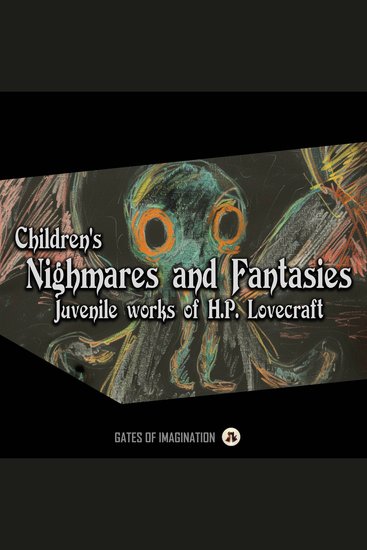
  • Children's Nighmares and Fantasies - Juvenile works of HP Lovecraft - cover

    Children's Nighmares and...

    H.P. Lovecraft

    • 0
    • 0
    • 0
    This audiobook is narrated by an AI Voice. Collection of surviving tales from Lovecraft's childhood. Young Lovecraft wrote extensively, but being dissatisfied with his early work, he destroyed most of his youthful creations. Only 4 works survived, saved by the writer's mother: 
     
    - The Little Glass Bottle - The earliest existing fictional prose work by Lovecraft. A humorous tale about the naivety of a certain ship captain who was fooled by a message in a bottle speaking of a hidden treasure. Lovecraft drew a very simple map of the Indian Ocean for the text, marking the location where the treasure was hidden. The short story was saved from destruction by Lovecraft's mother. 
     
    -The Secret Cave, or John Lees adventure - The titular John Lee, in his parents' absence, sets off with his little sister to explore a cave discovered in the basement. 
     
    -  The Mystery of the Grave-Yard, or “A Dead Man’s Revenge” - Here's the translation into English: 
    The longest of Lovecraft's youthful tales. From the author's later annotation on the manuscript, we learn that he wrote it at the end of 1898 or the beginning of 1899. It is a plot-twisting, somewhat tersely described (12 chapters of about 50 words each) typical detective story, modeled after the dime novels that Lovecraft was avidly reading at the time. The name of the story's main character, detective King John, might have been a combination of the names of two dime novel heroes: Old King Brady (from Francis Worcester Doughty's prose) and Prince John (from Joseph Badger Jr.'s prose). 
     
    - The Mysterious Ship - The latest of Lovecraft's youthful stories. It consists of ten short chapters about a ship whose appearance in any port heralded the disappearance of people. Although it is decidedly one of Lovecraft's weaker stories from his youth, the author went to extraordinary lengths to "publish" it: he typed it, bound it in small covers, wrapped it in fabric, and finally sketched a ship on both sides. Moreover, he highly valued the story – he "demanded" 25 cents for it.
    Show book
  • Love Beyond Gravity - cover

    Love Beyond Gravity

    Ella Stories

    • 0
    • 0
    • 0
    A seasoned astronaut falls in love with the voice of an unknown woman through his radio communication set on a long, solitary mission to Mars. He returns to earth, only to find the voice belonged to an advanced AI assistant who, against all odds, has also developed feelings for him. Now, the two must navigate a world that's not ready to accept their unconventional love.
    Show book
  • Forgotten Authors The - Volume 8 - S Mukerji to Eça de Queirós - cover

    Forgotten Authors The - Volume 8...

    Henry W Nevinson, Simon Newcomb,...

    • 0
    • 0
    • 0
    Throughout the long centuries of human history is the want, and the need, to share information, to exchange ideas and for that knowledge and experience, for curiosity and learning, to be the basis of a civil society. 
    In literature the ambition is much narrower.  In order to be known, to be popular, you had to be published.  And for that people had to know you existed and your ideas worth reading.  Obviously for most of humanity’s time people couldn’t read and texts couldn’t be published in any great number. 
    In the 15th Century Gutenberg’s printing press began the revolution to address the second and by the 19th century had gathered pace with startling speed and mass distribution.  Education for the many was brought in to help people understand more of their world and, with new skills, how to have a better place within it.  Now, if the powers that owned the presses and means of distribution agreed an audience would now be able to avail themselves of your ideas, your printed words.  
    Sadly, in the thirst for the new, the recent and the past fell from sight, relegated to dark corners and dusty shelves.   
    But the printed word is rarely without someone, somewhere busying themselves through piles of papers and books rediscovering what a good story is, whatever its age. 
    Sadly, in the thirst for the new, the recent and the past fell from sight, relegated to dark corners and dusty shelves.    
    But the printed word is rarely without someone, somewhere busying themselves through piles of papers and books rediscovering what a good story is, whatever its age. 
    In this volume we offer up a small selection of those talents whose time has now come again.
    Show book