Join us on a literary world trip!
Add this book to bookshelf
Grey
Write a new comment Default profile 50px
Grey
Subscribe to read the full book or read the first pages for free!
All characters reduced
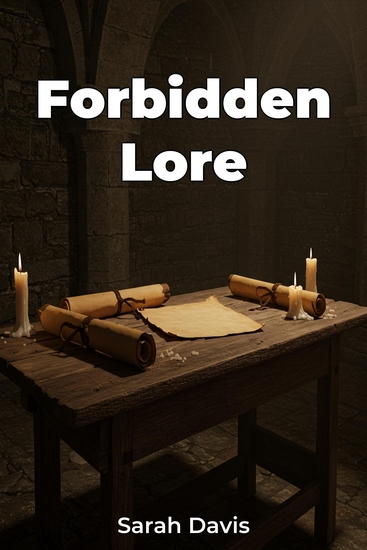
Forbidden Lore - cover

Forbidden Lore

Sarah Davis

Translator A AI

Publisher: Publifye

  • 0
  • 0
  • 0

Summary

Forbidden Lore explores the hidden side of history, delving into suppressed knowledge and alternative perspectives often excluded from mainstream narratives. It examines how suppressed knowledge can challenge established power structures, offering different views on humanity's origins and potential. For example, the book investigates the systematic suppression of Gnostic texts and alternative Christian doctrines during the Roman Empire's rise, highlighting how religious institutions can shape societal beliefs. The book also covers the persecution of esoteric and occult traditions in medieval and early modern times, which led to the loss of valuable magical and scientific knowledge. In the modern era, it addresses the marginalization of research challenging scientific paradigms, especially concerning ancient civilizations and unexplained phenomena.

 
By drawing on ancient texts, historical documents, and academic research, the book offers a rigorous historical analysis while maintaining an accessible tone. The book unfolds in three parts, beginning with an introduction to the concept of forbidden lore. It then examines specific historical instances of knowledge suppression, such as the witch hunts of Europe. Finally, it synthesizes these analyses to propose a framework for understanding the dynamics of knowledge control and its implications for intellectual freedom and scientific progress.
Available since: 02/26/2025.
Print length: 70 pages.

Other books that might interest you

  • True Love - cover

    True Love

    Peter Walker

    • 0
    • 0
    • 0
    Of the billions of humans now alive and kicking, let two of them fall in love, marry, and yet it can’t stick. They chose each other, and even still…Just two can’t make ‘love’ work – not two lovers, two races, two nations, two siblings, two people. We crave to know true love. That’s the deep well of thirst in every eye, every soul. It’s not in our control, however. Our own spirits are not the source, the spring - that’s why our ‘love’ breaks down.When we see this, when we feel this, our hearts cry out to God to know true love. We need his touch, not just a story. We need the healing Spirit of God’s love, not a religion. In this short book I share with you the simple, powerful story of Jesus and his offer of God’s love and Spirit to you.
    Show book
  • Branch Davidians the Peoples Temple and Heaven’s Gate The: The History of 20th Century America’s Most Notorious Cults - cover

    Branch Davidians the Peoples...

    Editors Charles River

    • 0
    • 0
    • 0
    The United States has never had a shortage of cults based on religious teachings and charismatic leaders, but perhaps none are as infamous as Jim Jones and the Peoples Temple, which remain notorious for the mass murder-suicide event in Jonestown, Guyana on November 18, 1978, during which nearly 900 people drank cyanide-laced Flavor Aid, including nearly 300 children. To this day, “drinking the Kool-Aid” is a popular phrase in America to refer to people who blindly follow a person or idea without thought, and the event at Jonestown was the deadliest deliberate act involving Americans in history until the 9/11 attacks. In addition to those deaths, Peoples Temple members also murdered a handful of others on the same day, including journalists, a member trying to leave Jonestown, and Congressman Leo Ryan.  
    	David Koresh, the leader of the Branch Davidians, had deep convictions based on the Book of Daniel and the Book of Revelation, and his sect believed the world was in the power of Satan and that the nations were merging to form a new Babylon. David hoped to establish the kingdom in Jerusalem, where, according to him, he would suffer martyrdom. The headquarters of the sect was a complex called Mount Carmel Center located in Waco, Texas. Koresh claimed to be the mysterious Lamb of Revelation who opens the sealed scroll, as well as the figure who rides the White Horse when the first seal is opened. 
    On paper, the extraordinarily unorthodox ideology spouted by Heaven's Gate ranks near the top of the list of most outlandish end-of-the-world prophecies, and it was built on a blend of Christian, Gnostic, supernatural, New Age, and extraterrestrial lore. Although the cult did not speak in Christian terms, it was clearly apocalyptic, and its belief system was a strange mix between science fiction and the basic message of Revelation.
    Show book
  • Mommy’s Always Here - cover

    Mommy’s Always Here

    Tina Moore

    • 0
    • 1
    • 0
    An MDLG and ABDL themed love story for the age play fetishist.Please note: This book contains content only appropriate for individuals interested in the MDLG subgroup of BDSM. It includes kink related themes, psychological power-play both sexual and non-sexual, sub training in diaper wetting, punishment by bondage, spankings, butt plug, and genital teasing.The story is a work of fiction, and although based on multiple personal experiences, Tina Moore does not assume to speak for the entire community. She also believes that the kink is as broad and diverse as the consenting adults who engage in it, and thus there is not a ‘correct’ way to be a consenting adult involved in age play and/or regression.Tina Moore would like to thank all her loyal, supportive, and loving fans. She wishes you every happiness and success and hopes that you stay safe, calm, and healthy.Leila knew that life could be better, but she had no idea it could be this good! With her 20year high school reunion looming, Leila discovers the power of personal reflection and evolving into the person she wishes to become. As her younger Mommy trains her, Leila enjoys the freedom to be herself, to learn what real love feels like and how to finally be at peace with who she is as a person, a little and a woman.If you are looking for a loving and romantic MDLG story…Then scroll up and click “add to cart”
    Show book
  • Pancho Villa - The Bandit That Fought in the Mexican Revolution - cover

    Pancho Villa - The Bandit That...

    Kelly Mass

    • 0
    • 0
    • 0
    Francisco Villa, better known as Pancho Villa, was a key figure in the Mexican Revolution, known for his transformation from a bandit to one of the revolution’s most influential commanders. Villa’s rise to prominence in the early 20th century marked him as a central player in the violent upheavals that reshaped Mexico’s political landscape. In 1911, Villa became a significant actor in the revolutionary violence that led to the overthrow of President Porfirio Díaz, ushering in Francisco I. Madero’s government. Villa, initially a leader of outlaw groups, aligned himself with Madero’s revolutionary cause, contributing to the instability that culminated in the fall of Díaz’s long-standing dictatorship. 
    The power dynamics in the revolution shifted again when General Victoriano Huerta attempted a right-wing coup in February 1913. As Madero’s government crumbled under Huerta’s forces, Madero led anti-Huerta soldiers in the Constitutionalist Army from 1913 to 1914. The civilian governor of Coahuila, Venustiano Carranza, became the leader of this anti-Huerta coalition. After Huerta’s eventual defeat and exile in July 1914, Villa and Carranza began to diverge politically. Villa, alongside other revolutionary leaders, assembled a gathering of generals in a bid to form a new government, but the resulting coalition was weak and inefficient. Though Villa and Emiliano Zapata, another revolutionary leader, were formally allied during this period, their partnership was largely theoretical. Both men supported land reform, but Villa’s reforms remained unrealized during his tenure of influence.
    Show book
  • The Two Cultures and the Scientific Revolution - cover

    The Two Cultures and the...

    C. P. Snow

    • 0
    • 0
    • 0
    This is the publication of the influential 1959 Rede Lecture by British scientist and novelist C. P. Snow. Its thesis was that "the intellectual life of the whole of western society" was split into the titular two cultures - namely the sciences and the humanities - and that this was a major hindrance to solving the world's problems. Published in book form, Snow's lecture was widely read and discussed on both sides of the Atlantic, leading him to write a 1963 follow-up, "The Two Cultures: And a Second Look: An Expanded Version of The Two Cultures and the Scientific Revolution."
    Show book
  • The Unstoppable Shero - A Woman's Guide to Thriving in a Resistant World - cover

    The Unstoppable Shero - A...

    Barbara Walker-Green

    • 0
    • 1
    • 0
    In a world that too often seeks to limit women's potential, it's time to shatter the expectations that confine you. You’ve felt the subtle barriers, the persistent doubts, the pressure to conform in spaces not designed for your success. But there’s a fire within you waiting to break free. Now is the time to embrace that power and rise above every challenge.
    Show book