

Join us on a literary world trip!
Add this book to bookshelf
Grey
Write a new comment Default profile 50px
Grey
Subscribe to read the full book or read the first pages for free!
All characters reduced
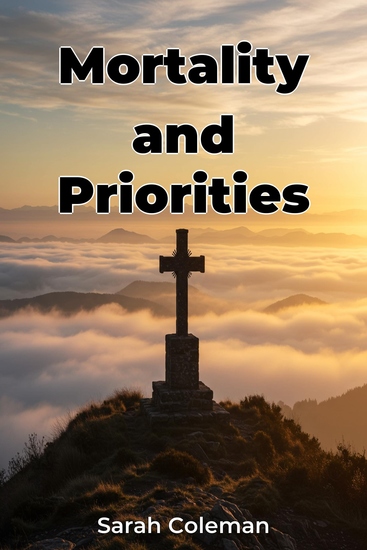
Mortality and Priorities - cover

Mortality and Priorities

Sarah Coleman

Translator A AI

Publisher: Publifye

  • 0
  • 0
  • 0

Summary

Mortality and Priorities explores how acknowledging our inevitable death shapes our values and daily decisions, ultimately guiding us toward meaningful living. It delves into thanatology, examining how our understanding of death influences our life priorities through philosophical and religious lenses. The book highlights that recognizing mortality isn't morbid but a catalyst for reprioritizing what truly matters, challenging readers to confront their own mortality with purpose rather than fear. 

 
The book begins by establishing a foundation of how death is perceived across different cultures and historical periods. It transitions into philosophical perspectives, from Stoicism to existentialism, and religious viewpoints, particularly Christian theology, to demonstrate how various thinkers and spiritual leaders have addressed mortality. 

 
Structured in three parts, the book first introduces mortality awareness and its psychological effects, then examines shifts in priorities that occur when individuals genuinely acknowledge their mortality, and finally synthesizes these insights, offering practical guidance on cultivating a life aligned with one's deepest values. 

 
By incorporating insights from philosophy, religion, psychology, and sociology, Mortality and Priorities presents a multifaceted perspective on living a purposeful life. It reframes death as a tool for prioritization, offering practical strategies for personal growth and spiritual values by integrating an awareness of death into our daily existence.
Available since: 03/03/2025.
Print length: 83 pages.
Other books that might interest you

  • The Art of the Pharaohs - Sculptures Paintings and Jewelry - cover

    The Art of the Pharaohs -...

    Omar Khalil

    • 0
    • 0
    • 0
    Ancient Egyptian art is one of the most iconic and influential art forms in history. Spanning over three millennia, it provides a deep insight into the culture, religion, and beliefs of ancient Egyptian society. The art of Egypt is characterized by its symbolic use of colors, the strict adherence to formal rules of representation, and its focus on the afterlife. It was primarily created for religious, funerary, and commemorative purposes, serving as a medium to honor the gods and pharaohs, as well as to ensure a successful passage into the afterlife for the deceased. 
    The origins of Egyptian art can be traced back to the early dynastic periods, where it evolved in response to both religious needs and political structures. As the power of the pharaohs grew, so did the complexity and grandeur of Egyptian art. The early works were heavily influenced by the religious beliefs that governed life and death. Art was not seen as a form of personal expression but rather as a tool to serve divine and societal purposes. The rigid style and symbolic representations seen in Egyptian art reflect the culture's focus on order, permanence, and the divine, rather than individualism or naturalism. 
    Key materials used in Egyptian art included stone, wood, and metals, often adorned with vibrant pigments. The Egyptians were skilled in creating sculptures, jewelry, and paintings that survived for thousands of years due to their mastery of preservation techniques. The most recognizable aspects of Egyptian art include the distinctive posture and proportions in their sculptures, as well as the use of vibrant, symbolic colors in their paintings. These works were often intended for tombs, temples, and other sacred spaces, ensuring the continued favor of the gods and providing a connection to the divine realm.
    Show book
  • Urban Geography - Patterns and Processes in Cities - cover

    Urban Geography - Patterns and...

    Lyric Vale

    • 0
    • 0
    • 0
    Urban geography is a specialized subfield within human geography that focuses on the spatial aspects of cities and urban areas. It seeks to understand the patterns, processes, and interactions that shape the development of cities, as well as the complex dynamics between urban spaces and the broader environment. This discipline is essential for comprehending how cities evolve, function, and adapt to the challenges of urbanization in a rapidly changing world. 
    The role of cities in geography is multifaceted. Cities are not only the centers of economic, political, and cultural activity but also crucial nodes in the global network. They function as hubs for trade, finance, education, and innovation, while also representing unique environments that reflect the broader social, economic, and environmental conditions of their regions. Urban areas often act as catalysts for growth and change, influencing not just their immediate surroundings but the larger global landscape as well. 
    At the core of urban geography lies the exploration of key concepts that shape the organization and transformation of cities. These concepts include urbanization, which refers to the increasing concentration of populations in cities, and urban systems, which describe the networks and interconnections between various urban centers. Additionally, urban geography explores issues like land use, transportation, housing, and social dynamics, all of which play a significant role in the functioning of urban environments.
    Show book
  • Myths and Mysteries: The Knights Templar - cover

    Myths and Mysteries: The Knights...

    Raphael Terra

    • 0
    • 0
    • 0
    This audiobook has been recorded using Text to speech (TTS). 
     
    The Knights Templar, an enigmatic and revered medieval order, hold a significant place in history and captivate the imagination of many. Their story is one of mystery, power, and religious devotion.  
     
    In this book, we delve into the historical background of the Knights Templar, exploring their origins, rise to prominence, activities during the Crusades, financial and political influence, downfall and persecution, as well as their lasting legacy and modern cultural references. Join us on a journey to uncover the captivating tale of the Knights Templar and their enduring impact on the world.
    Show book
  • Is It Racist? Is It Sexist? - Why Red and Blue White People Disagree and How to Decide in the Gray Areas - cover

    Is It Racist? Is It Sexist? -...

    Betsy Leondar-Wright, Jessi Streib

    • 0
    • 0
    • 0
    Is It Racist? Is It Sexist? Two questions that seem simple on their face, but which invite a host of tangled responses. Jessi Streib and Betsy Leondar-Wright offer a new way of understanding how inequalities persist by focusing on the individual judgment calls that lead us to decide what's racist, what's sexist, and what's not. 


    Racism and sexism often seem like optical illusions, but the lines that most consistently divide our decisions might surprise you. Indeed, white people's views of what's racist and sexist are increasingly up for grabs. As the largest racial group in the country and the group that occupies the most and the highest positions of power, what they decide is racist and sexist helps determine the contours of inequality. 


    By asking white people—Southerners and Northerners, Republicans and Democrats, working-class and professional-middle-class, men and women—to decide whether specific interactions and institutions are racist, sexist, or not, Streib and Leondar-Wright take us on a journey through the decision-making processes of white people in America. The authors are able to distinguish the responses as being characteristic of different patterns of reasoning. They produce a framework for understanding these patterns that invites us all to engage with each other in a new way, even on topics that might divide us.
    Show book
  • Kaizen - the Advantage - cover

    Kaizen - the Advantage

    Hoshihiko Mukai

    • 0
    • 0
    • 0
    Do you find it difficult to change because your fear of it blocks you and costs you an insane amount of energy?  Then you should learn more about Kaizen, because Kaizen is a Japanese philosophy of life, which is very effective. Translated, kaizen means "change for the better", step by step, and that means small steps. Instead of force and pressure, efficiency comes first and should make the way to the goal as easy as possible. Take the first step and don't miss one of the most exciting journeys in your life, learn how this philosophy came into being and why and how it can contribute to your personal development.
    Show book
  • Psychological Coercion - Using Psychological Persuasion to Force Compliance - cover

    Psychological Coercion - Using...

    Cito Harder

    • 0
    • 0
    • 0
    Psychological coercion is a powerful and often insidious form of manipulation designed to force an individual to act against their will or better judgment. It involves the use of mental and emotional tactics to instill fear, guilt, or pressure, making the person feel compelled to comply with demands or expectations. While it does not rely on physical force, the impact of psychological coercion can be just as damaging, if not more so, as it leaves lasting emotional scars that can affect an individual’s sense of self-worth, autonomy, and mental health. 
    At its core, psychological coercion undermines a person’s ability to make decisions freely. It exploits their vulnerabilities—whether emotional, psychological, or social—in order to gain control or influence their behavior. This form of coercion can take many different shapes, including threats, isolation, intimidation, manipulation, or subtle forms of pressure. While the methods may vary, the common thread is the intentional use of mental and emotional tactics to manipulate or control another person’s actions. 
    Psychological coercion is distinct from other forms of persuasion because it involves the use of power and control to manipulate an individual into compliance. In many cases, the person being coerced may not even recognize the pressure being applied to them. This is due to the subtlety with which coercion often operates—it can take place in everyday interactions, with the perpetrator using psychological manipulation in a way that may seem harmless or even caring at first. Over time, however, the individual being manipulated becomes increasingly susceptible to the influence of the coercer, often leading to a loss of personal agency and a sense of powerlessness.
    Show book
